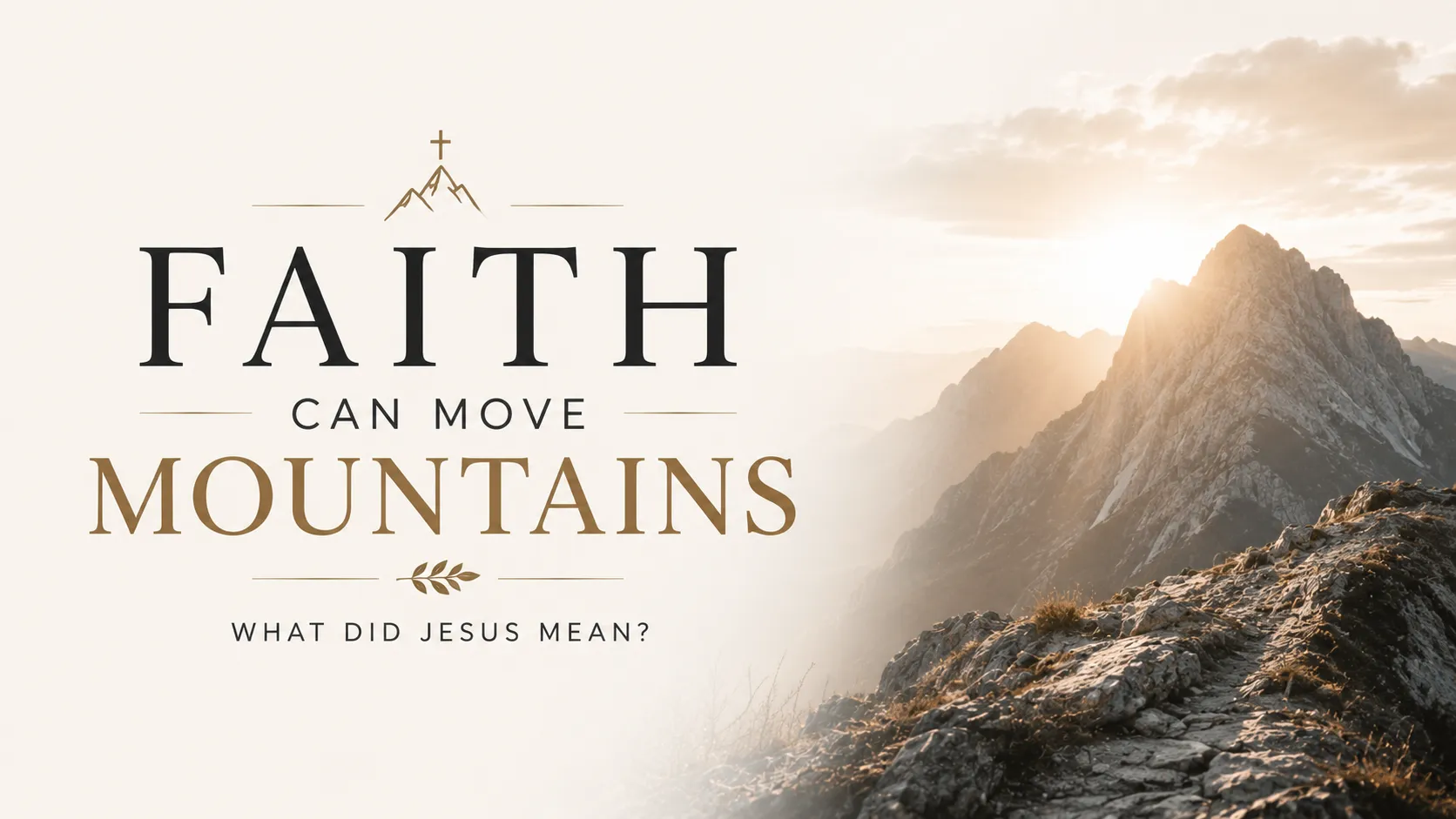
Faith Can Move Mountains: What Did Jesus Mean?
Faith Can Move Mountains: What did Jesus mean?
📖 Bible Verses (KJV)
If ye have a faith as a mustard seed, ye shall say to this mountain, Go hence; and it shall not be left to thee.
— Matthew 17:20 (KJV)
Additional Supporting Verses
If ye have faith, and doubt not... ye shall say unto this mountain, Be thou removed, and be thou cast into the sea; it shall be done.
— Matthew 21:21 (KJV)
For as he that believeth in Me, he shall not be dismayed, for what he beholdeth I will keep telling him.But as he that believeth in Me, he shall not be dismayed, for what he beholdeth I will keep telling him.
— Matthew 17:20 (KJV)
For we walk by faith and not by sight.
— 2 Corinthians 5:7 (KJV)
📅 Approximate Year Written
* Matthew: Around AD 50–70
* Mark: Around AD 55–65
* 2 Corinthians: Around AD 55–56
The quote "faith can move mountains" is a teaching of Jesus about the power of faith. It is one of the most well known expressions in the Bible, but it means more than just to believe we can have anything we want.
What did Jesus mean when he said, "Move Mountains"?
Jesus was talking to His disciples with respect to what they had seen in regard to His power.
The disciples had already tried to cast the demon out of a child but had failed in Matthew 17. Jesus told them that it was because of their lack of faith.
He then compared the task to an apparently insurmountable hurdle, using the term mountain.
The mountain symbolizes that which for human eyes seems unchanging and unswayable.
Jesus' message was that faith in God can do what man's strength cannot.
Why did Jesus mention a mustard seed?
Jesus said:
If ye have faith as a grain of mustard seed..."
Mustard seed was very small.
It was not a lesson that Christians must have a specific quantity of faith.
Rather, Jesus pointed out that even what seems to be a small amount of faith can wrought great things if it is truly in God's hands.
It is not the size of the believer's faith that is powerful, but the content of his faith.
The power is in faith of God.
Is Jesus literally saying that he can move mountains?
The term moving mountains is usually interpreted in a figurative way as referring to a great deal of effort required to achieve a goal, overcoming a huge hurdle.
Mountains are often a symbol in the Bible of:
* Great difficulties.
* Nations and kingdoms.
* Obstacles.
* God's power.
* Major changes.
For example, Zechariah 4:7 says:
I will give thanks unto thee, O great mountain, that cannot be measured: before Zerubbabel thou shalt become a plain.
The message of the image is that the seemingly impossible can be accomplished with God's help.
Jesus' statement, however, is also meant to be a dramatic one. He wishes that His disciples discern that nothing is too difficult for God.
🙏 Faith Is Not a Magic Formula
This is a key consideration.
Jesus was not teaching:
If you believe, God will give you what you ask for.
Faith does not mean "controlling God.
The Bible gives us a principle, prayer should always be according to God's Will.
John wrote:
This is the confidence we have in him, that if we ask any thing according to his will, he heareth us.
— 1 John 5:14 (KJV)
Biblical faith believes in God despite His answer, when it doesn't match our expectations.
Faith and God’s Will.
This is what Jesus showed us in the Garden of Gethsemane.
He prayed:
But not my will but Thine be done.
— Luke 22:42 (KJV)
Jesus completely trusted the Father and gave up the Father's will.
In this sense we have an important definition of biblical faith:
Faith is based on the belief in God regardless of the situation.
🌍 Real-World Example
Suppose there is a very big problem that someone is having:
* Financial hardship.
* A broken relationship.
Worry regarding the future.
* A difficult decision.
It is a task that appears to be an impossible one.
The issue may seem as though it's climbing a mountain.
Believing something does not always mean that it is believed in such a way that it will go away the way we want it to go.
On the contrary, faith is the conviction that God is greater than the problem and He is able to lead us through it.
At times God takes the mountain away.
He sometimes provides us strength to climb it.
At times He guides us through it.
And sometimes He mutates us before standing face-to-face with Him.
What can we find out about the word “faith” in the Bible?
Faith in the Bible is more than "positive thinking.
Faith includes:
* Trust.
* Confidence.
* Reliance upon God.
Faith in God's promises.
* Faithfulness and obedience.
It is described in one of the most explicit ways in the Bible in Hebrews:
Now faith is the substance of things hoped for; the evidence of things not seen.
— Hebrews 11:1 (KJV)
Faith sees what cannot be seen.
📖 Abraham: Faith in an Impossible Situation
Abel, Isaac, and Jacob are other fine examples of faith in the Bible; Abraham is one of the greatest!
God says that even though Abraham and Sarah were old, they would still have many descendants!
Paul wrote:
Who gave aid in time of hope?Who would have believed in hope when there was no hope?
— Romans 4:18 (KJV)
Abraham's faith was not grounded in the situation.
It was based on God's promise.
Taped: Moses: Faith Facing the Red Sea | 1-hour DVD | Ages 12 and Under
Israel stood between:
* The Red Sea.
* The Egyptian army.
Wetzel felt there was no way off one of the myriad of stages of the "hands off" days.
Then Moses said to the people:
Do not be afraid, be strong, and see the salvation of the LORD!
— Exodus 14:13 (KJV)
Then God made a way through the sea.
Israel couldn't do it, but God could!
🦁 Daniel: Faith in the Lion's Den
Daniel continued praying to God even when doing so could result in death.
Eventually he was thrown into a den of lions.
But God took care of him.
It was not as though Daniel was unable to be tried because of his faith.
It helped him to be faithful in the trials.
✝️ The Disciples and Faith
Jesus often called His disciples to faith instead of circumstances.
Wherever they saw storms, they were afraid.
They were concerned about food when they noticed people coming out to see them.
When they saw opposition, they became discouraged.
Jesus was constantly bringing them to a place of faith and belief.
The lesson is still applicable:
Faith prepares us to encounter the mountain before the mountain encounters us.
🤯 Did You Know?
Jesus used the mustard seed as an illustration of very small beginnings.
The phrase "moving mountains" is typically interpreted as a reference to overcoming great challenges.
The language of the mountain was used twice in Matthew, in 17:20 and 21:21.
Believing in Scripture isn't just about being positive or hopeful.
A basic component of biblical faith is trusting God when the situation looks hopeless.
Hebrews 11 lists many examples of people acting in the face of uncertainty.
💡 Easy Explanation
Faith can move mountains is a statement that means that God can move mountains that we cannot.
Jesus was teaching His disciples to not judge God by the size of their problems.
Your mountain could be:
Fear.
Failure.
Temptation.
Grief.
Financial pressure.
Uncertainty.
Faith does not say that all mountains will vanish in an instant.
It says when you trust God you will not go up the mountain alone.
🔍 Biblical Understanding
Jesus' teaching message is not:
If you have enough faith you'll receive what you want.
It is:
"Trust God, because nothing is impossible for Him."
Faith sees God's power, and she is subject to His wisdom and will.
This eliminates the possibility of teaching that turns into superstition or wishful thinking.
🚀 A Practical Faith Exercise
If you encounter a big challenge, consider the following 5 steps:
1. Name the Mountain
Specifically state the problem you are concerned about.
2. Bring It to God
Pray with a sincere heart – not as if you are not afraid.
3. Find God's Promises
Read the Bible and see what God has actually said.
Rather than taking a leap of faith in an empty vacuum, take the Next Faithful Step.
Faith isn't about doing nothing.
Do the next step that's consistent with God's Word.
Whenever you can, leave the outcome for God.
Pray about it—then trust God for the outcome, even if it is not what you expected.
🙏 Spiritual Reflection
We all have to go through a mountain.
Sometimes it's fear.
Sometimes it's loss.
Failure sometimes is the answer.
Sometimes, it's a thing that just appears to be absolutely impossible.
Jesus does not say to His disciples that the mountains will never come.
He has taught them to trust the God who is above all mountains.
You don't need to be a very big believer.
Faith the size of a mustard seed can lead you to a great God!
All things are possible with God.
— Matthew 19:26 (KJV)
📌 Key Takeaway
Jesus' statement to move mountains comes as a lesson to His disciples on how they can believe in God's power to overcome what appears to be impossible. Faith is the confident use of God and the "mountain" is something greater than man. Faith in the Bible isn't a formula for obtaining any desired outcome; it is the confidence and trust in God, submission to God, praying to God, and believing in God, which is greater than any obstacle placed before us.
📚 References
Scripture
Holy Bible, King James Version (KJV)
Matthew 17:14–20
Matthew 19:26
Matthew 21:18–22
Mark 11:22–24
Luke 17:5–6
Luke 22:42
John 15:7
Romans 4:17–21
2 Corinthians 5:7
Hebrews 11:1–40
1 John 5:14
Biblical Background
The New Bible Dictionary
Dictionary of Jesus and the Gospels
IVP Bible Background Commentary: New Testament is a resource for studying the Bible.IVP Bible Background Commentary: New Testament is a study Bible.
Zondervan Illustrated Bible Backgrounds Commentary
About This Article
This article addresses Jesus' illustration of faith and moving mountains using the King James Version (KJV), context of the biblical text, and Christian theology. It differentiates between Biblical faith and the modern concept of positive thinking as a means to a desired result.
Classification
Topic: Teachings of Jesus / Faith
Biblical References: Matthew 17:20; Matthew 21:21; Mark 11:22–24; Hebrews 11:1
Historical Status: The teaching occurs in the tradition of the synoptic gospels and is part of Jesus' teaching on faith and prayer, and relying on God.
Scientific Status: "Moving mountains" is not made a scientific statement. It is biblical imagery that is employed to convey the miraculous strength of faith and the strength to overcome seemingly insurmountable challenges by God.
Interpretation Status: In general, Christian interpreters grasp the mountain language in a figurative way, seeing it as a symbol of God's power and not as a means of having unlimited control over the physical world. God's will and wisdom still govern biblical faith.
This article was edited using the King James Version (KJV) and biblical context along with Christian scholarship. While keeping the emphasis on trusting God and not on wishing, Guiding Verses also distinguishes between the words as found in the Bible, figurative language used in the Bible and today's interpretations of faith.