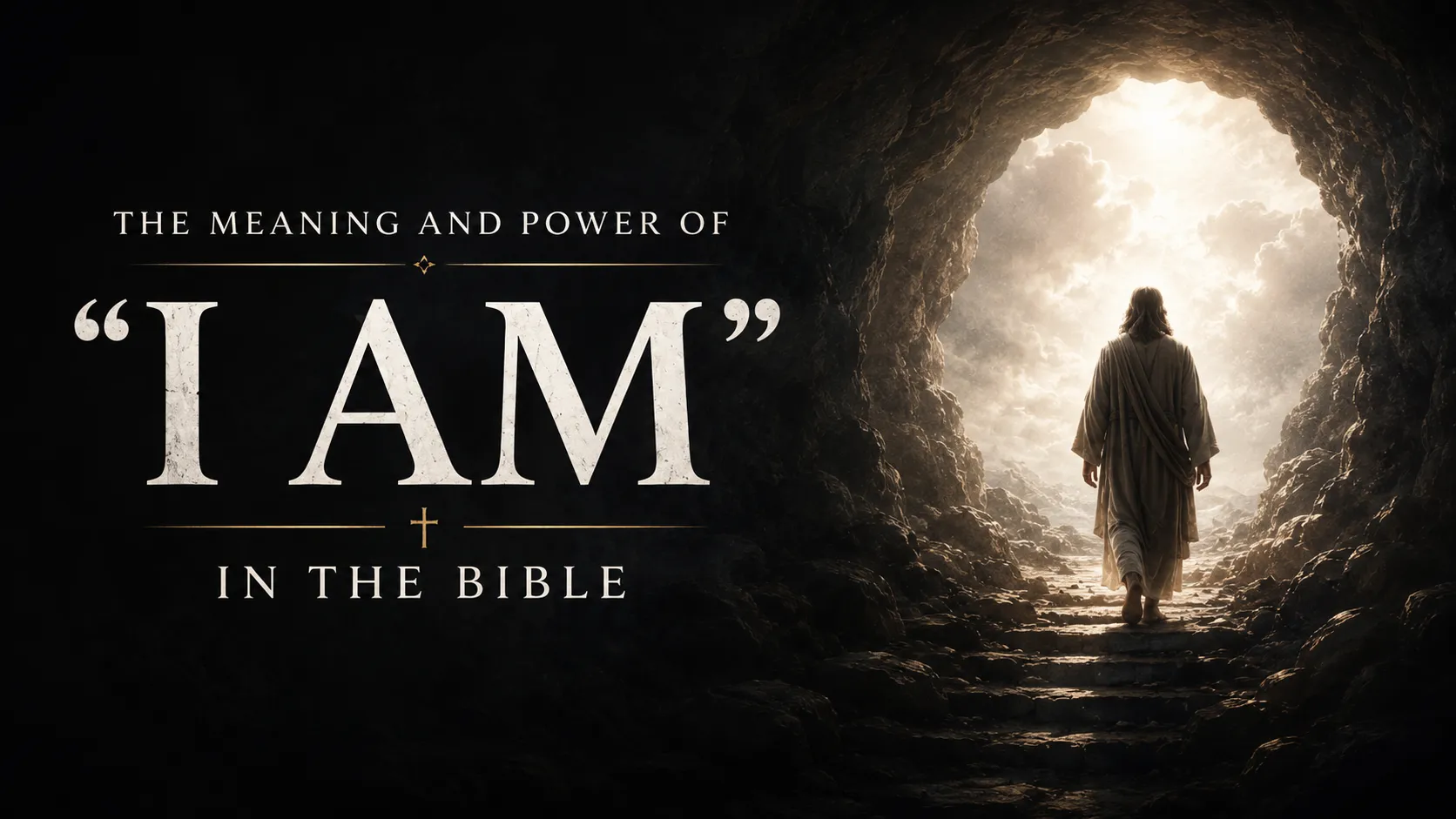
The Meaning and Power of "I AM" in the Bible
Why Were the Words "I AM" So Powerful?
When Jesus said,
"Before Abraham was, I AM." (John 8:58)
He wasn't merely saying, "I existed before Abraham."
He deliberately used the divine name God had revealed centuries earlier.
The Beginning: Moses and the Burning Bush
When Moses asked God:
"When the Israelites ask me who sent me, what shall I say?"
God answered:
"I AM THAT I AM." (Exodus 3:14, KJV)
The Hebrew phrase is:
Ehyeh Asher Ehyeh
It can be understood as:
I AM WHO I AM
I WILL BE WHAT I WILL BE
THE SELF-EXISTING ONE
THE ETERNAL ONE
God did not define Himself by anything outside Himself.
He simply IS.
What Does "I AM" Mean?
Unlike humans, God doesn't depend on anyone.
We say:
I am tired.
I am hungry.
I am young.
Our identity changes.
God simply says:
I AM.
He has no beginning.
No ending.
No creator.
No source outside Himself.
He simply exists eternally.
Why Did the Jews Become Angry?
In John 8, Jesus declared:
"Before Abraham was, I AM."
Notice something extraordinary.
He did not say:
"Before Abraham was, I was."
Instead He said:
"I AM."
To His Jewish audience, this was unmistakable.
They immediately understood that Jesus was identifying Himself with the divine name revealed to Moses.
Their response?
They picked up stones to stone Him for what they considered blasphemy.
They understood the claim far better than many modern readers do.
"I AM" in the Garden of Gethsemane
One of the most dramatic moments occurs in John 18.
Soldiers came to arrest Jesus.
Jesus asked,
"Whom seek ye?"
They answered,
"Jesus of Nazareth."
Jesus replied,
"I am he."
Many English translations add "he" in italics to clarify the sentence, but the Greek text simply has "I AM" (ἐγώ εἰμι, ego eimi).
Then something astonishing happened.
They went backward, and fell to the ground. (John 18:6)
Why Did They Fall?
The text does not explicitly explain the reason, so we should be careful not to claim more than Scripture says.
Many Christians understand this moment as a powerful revelation of Jesus' divine authority. His declaration, combined with His presence, overwhelmed those who came to arrest Him.
Others emphasize that the fall demonstrates His complete control over the situation—He was not captured because He lacked power, but because He willingly gave Himself up.
Either way, the scene powerfully shows that Jesus was not a helpless victim.
He surrendered voluntarily.
The Seven Great "I AM" Statements
Jesus repeatedly used "I AM" together with vivid images to reveal different aspects of His mission.
1. I Am the Bread of Life
Without bread,
people die physically.
Without Christ,
people die spiritually.
2. I Am the Light of the World
Light reveals truth.
Light drives away darkness.
Jesus reveals God.
3. I Am the Door
In ancient sheepfolds,
the shepherd himself became the gate.
Jesus is the entrance to salvation.
4. I Am the Good Shepherd
Unlike hired workers,
the Good Shepherd lays down His life for the sheep.
5. I Am the Resurrection and the Life
Jesus does not merely give resurrection.
He is resurrection.
6. I Am the Way, the Truth, and the Life
Not
a way.
Not
one truth.
Jesus declares Himself to be the way, the truth, and the life.
7. I Am the True Vine
Branches have life only while connected to the vine.
Believers flourish by remaining in Christ.
"I AM" Is More Than a Name
When God says,
I AM
He is declaring:
I am eternal.
I am self-existent.
I am unchanging.
I am sufficient.
I am sovereign.
I am faithful.
I am present.
Unlike us,
God never says,
"I was."
or
"I will become."
He simply IS.
The Power of "I AM"
Throughout Scripture, God's presence transforms situations.
When Jesus said,
"Peace, be still,"
the storm ceased.
When He said,
"Lazarus, come forth,"
Lazarus came out of the tomb.
When He declared,
"It is finished,"
His redemptive work reached its climax.
These events highlight that Jesus' words carry divine authority. The phrase "I AM" is significant because it points to His identity, while the miracles demonstrate the authority associated with that identity.
Theological Significance
The Gospel of John repeatedly presents Jesus using "I AM" language to reveal who He is.
These statements are not simply descriptions of His role.
They are declarations that connect Him with the God who spoke from the burning bush.
This is one reason John's Gospel places such emphasis on them.
Life Application
The name "I AM" reminds believers that God is everything we ultimately need.
When we are weak,
He is strength.
When we are lost,
He is the way.
When we are in darkness,
He is the light.
When we hunger spiritually,
He is the bread of life.
When we fear death,
He is the resurrection and the life.
Our circumstances change.
Our emotions change.
Our abilities change.
But the God who revealed Himself as "I AM" remains the same yesterday, today, and forever.
Key Bible References
Exodus 3:14 — God reveals His name to Moses.
John 8:58 — "Before Abraham was, I AM."
John 18:4–6 — Soldiers fall back when Jesus says, "I AM."
John 6:35 — I am the Bread of Life.
John 8:12 — I am the Light of the World.
John 10:7 — I am the Door.
John 10:11 — I am the Good Shepherd.
John 11:25 — I am the Resurrection and the Life.
John 14:6 — I am the Way, the Truth, and the Life.
John 15:1 — I am the True Vine.