
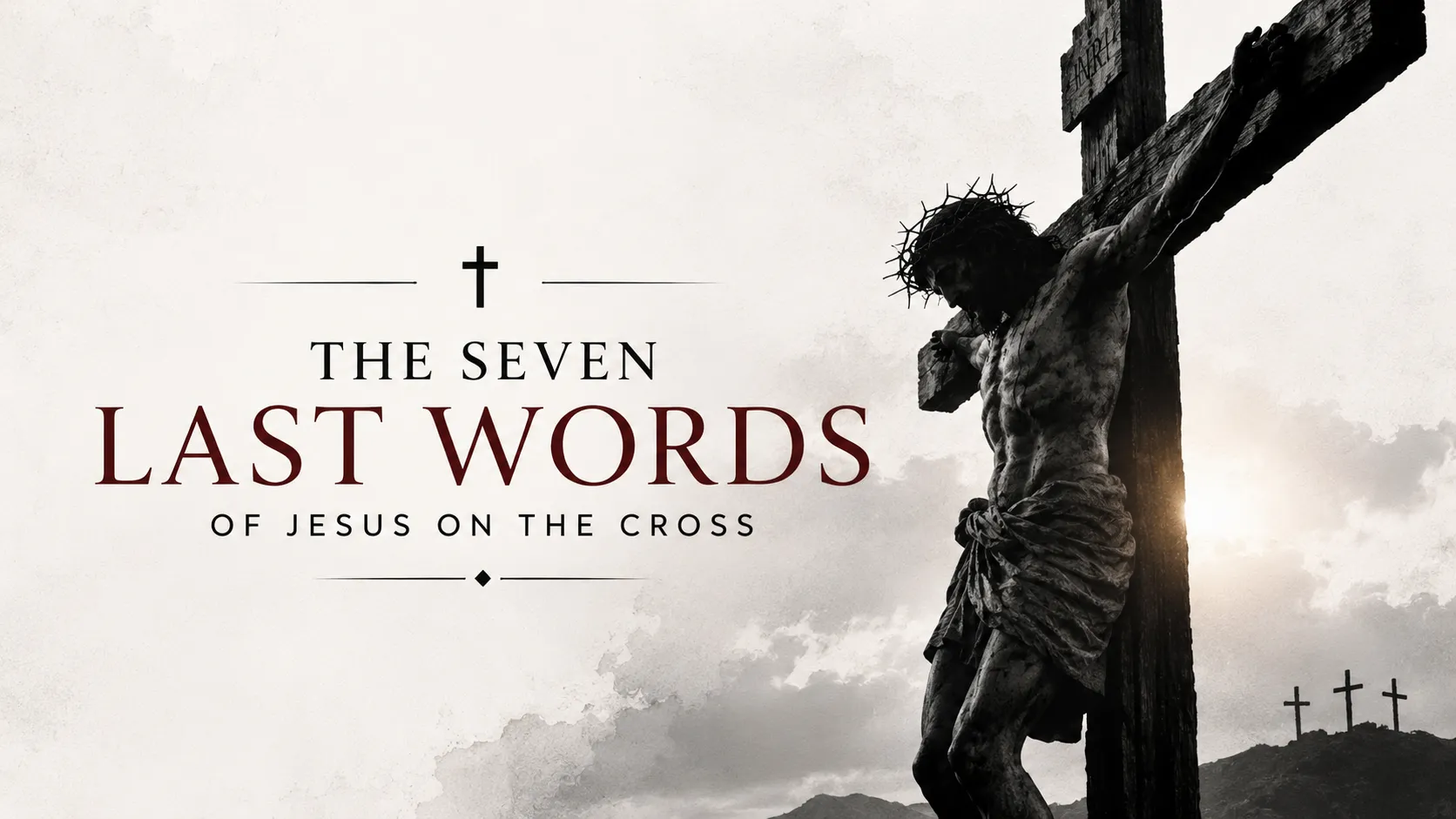
The Seven Last Words of Jesus on the Cross are Christ's final sayings prior to his death.
📖 Bible Verses (KJV)
The last words of Jesus were uttered during His crucifixion, and they are mentioned in all four of the Gospels. They show us His forgiveness, His compassion, His suffering, His fullness in the scriptures, His victory and His total reliance on the Father.
📅 Approximate Year Written
* Matthew: Around AD 50–70
* Mark: Around AD 55–65
* Luke: Around AD 60–62
* John: Around AD 85–95
All four Gospels have a variety of sayings, but taken together they give a full account of Jesus' final hours on the cross.
🏛️ Historical Background
Around AD 30-33, Jesus was crucified outside of Jerusalem at the place called Golgotha ("the place of a skull") under the charge of the governor of Judea, Pontius Pilate.
One of the most torturous ways of execution employed by the Roman Empire was by crucifixion. It was common for victims to be left on the cross for several hours until they died.
Although Jesus suffered what no one ever could, He still spoke words of mercy, fulfillment and hope.
✝️ The Seven Last Words
1. Forgive them Father, for they know not what they do.
Then Jesus said: "Father, forgive them; for they know not what they do.
— Luke 23:34 (KJV)
Jesus prayed for those who brought Him suffering when He was nailed to the cross.
This is an incredible prayer of His love, His mercy and His willingness to forgive even His enemies.
2. “Today you will be in my presence in paradise.”
Then Jesus said to him, "Truly I tell you, today you will be with me in paradise.
— Luke 23:43 (KJV)
One of the criminals hanging on the cross next to Jesus admitted that he was guilty and asked Jesus to remember him.
Jesus gave hope this time and eternal life, demonstrating that salvation is through faith in Him.
3. Woman, look, your son! Woman, look, your mother!
So when Jesus saw his mother, and the disciple who she loved... he says to his mother, Woman, behold thy son!
— John 19:26–27 (KJV)
Jesus' care for his mother, Mary, while he was dying was to leave her in the care of the beloved disciple, who is generally believed to be St. John.
His concern shows His compassion and faithfulness when it comes to family duties.
4. O my God, O my God, why hast thou abandoned me?
At the 9th hour Jesus cried with a loud voice, saying... My God, my God, why hast thou forsaken me?
— Matthew 27:46 (KJV)
The first verse of the psalm 22, which is a prophecy concerning the sufferings of the Messiah.
Jesus' words convey the fullness of His suffering, but lead listeners to a psalm filled with hope and God's final victory.
5. "I thirst."
Then Jesus, knowing that all things were now finished,..." saith he, ‘I thirst.’
— John 19:28 (KJV)
Jesus suffered bodily afflictions.
John makes the statement because it is a fulfilment of Scripture (Psalm 69:21) to remind the reader that Jesus was fully human, but also fully divine.
6. "It is finished."
So, when Jesus did receive the vinegar, he said, It is finished.
— John 19:30 (KJV)
These words express Jesus' declaration that the work the Father sent Him to do was finished.
His sacrifice, promised in the Old Testament, had now been fulfilled.
It was not defeat, it was a victory.
7. “Father, I give my spirit to You.”
JESUS cried out with a loud voice, then he said, "Father, into thy hands I commend my spirit.
— Luke 23:46 (KJV)
Jesus' last words are taken from Psalm 31:5, a psalm of total trust in the Father.
After speaking these words, He willingly gave up His life.
🔬 Historical Reliability
The seven sayings are taken from the four canonical Gospels.
It is generally accepted by historians that:
Jesus died on the cross at the hands of Pontius Pilate.
He was crucified at a place outside of Jerusalem.
His disciples recorded His last words in the gospel.
The crucifixion is one of the most attested events in ancient history, although historians disagree about the theological aspects.
Why do the sayings occur in four gospels?
None of the Gospel writers mention all seven sayings.
The emphasis of each Gospel writer is on different aspects of Jesus' ministry:
Matthew points to the fulfillment of prophecy.
Mark's gospel is focused on Jesus' suffering.
Luke emphasizes Jesus' compassion, forgiveness, salvation.
Jesus' divine mission and victory are the focus of John's emphasis.
The four accounts collectively give a more complete account of Christ's last days.
💡 Easy Explanation
Jesus' last words express His heart.
At the same time, while he was dying, He forgave sinners, consoled a repentant criminal, attended to His mother's needs, fulfilled prophecy, completed his mission, and handed Himself over to God.
Each of the sayings conveys an important lesson about Him and His work.
🤯 Did You Know?
We use all 7 of the sayings, not just one Gospel.
Psalm 22, and Psalm 31, were quoted by Jesus at the cross.
The Greek word for "it is finished" is tetelestai, which means "completed" or "fully accomplished.
The repentant thief was offered Jesus' assurance of paradise on the day of the crucifixion.
These are the seven sayings that are usually remembered at church on Good Friday.
🔍 Historical and Biblical Consensus
The seven sayings are believed to have been brought together from the gospel accounts, and have been valued by the church since the early church.
Some scholars propose different sequences of events, but generally the sequence above is accepted into Christian teaching.
All of Jesus' sayings show that He fulfilled Old Testament prophesy, was compassionate, and was obedient to the Father.
🙏 Spiritual Reflection
The cross symbolizes the justice of God as well as His love.
Jesus forgave His enemies, he gave salvation to a repentant sinner, he looked after His mother, he fulfilled Scripture, he did the work of redemption, and he gave Himself over fully to the Father.
He leaves behind his last words, which are still going to all the generations of the world to call them to faith, repentance, forgiveness and hope.
As the Apostle Paul would go on to write:
But God is demonstrating his love toward us in that, though we were sinners, Christ died for us.
— Romans 5:8 (KJV)
📌 Key Takeaway
The Seven Last Words of Jesus go beyond being His final words, they are the heart of the Gospel. They show His forgiveness, compassion, fulfilling of prophecy, overcoming of sin and complete trust in the Father. These words were spoken from the cross, and they still inspire believers, and remind them of the hope given in Christ's sacrificial death and resurrection.
📚 References
Scripture
Holy Bible, King James Version (KJV)
Matthew 27:33–50
Mark 15:22–37
Luke 23:26–49
John 19:16–30
Psalm 22
Psalm 31
Psalm 69
Romans 5:8
Historical Sources
The New Bible Dictionary
Baker Encyclopedia of the Bible
The IVP Bible Background Commentary: New Testament
Zondervan Illustrated Bible Backgrounds Commentary
The death of the Messiah.
About This Article
This article explores the Seven Last Words of Jesus through the lens of the King James Version (KJV), the four Gospel accounts and historical scholarship. It describes their biblical meaning without mixing up history with theology.
Classification
Topic: Life of Jesus / Passion Week
Biblical References: Matthew 27; Mark 15; Luke 23; John 19; Psalm 22; Psalm 31; Psalm 69
Historical Status: SUPP. The crucifixion of Jesus, under Pontius Pilate, is one of the most well-documented events in ancient history. The words of these seven sayings are recorded in all four of the canonical Gospels.
Archaeological status: Roman crucifixion is well attested by the evidence from archaeology and history. There is no archaeological evidence for the sayings themselves, rather the New Testament manuscripts.
Interpretation Status: All Christians recognize that these sayings are very important. The sayings are significant theologically and have been acknowledged from Christian history to the present; although scholars may debate chronology or literary focus, among the Gospels, the theology of the sayings is always clear.
Editorial Note: This article uses the King James Version (KJV) of the Bible, the four books of the gospel, and trusted biblical scholarship. Guiding Verses separates out the tradition of the historical record, the text of the Bible, and the theological interpretation, and offers the Christian interpretation of Jesus' last words from the cross.