
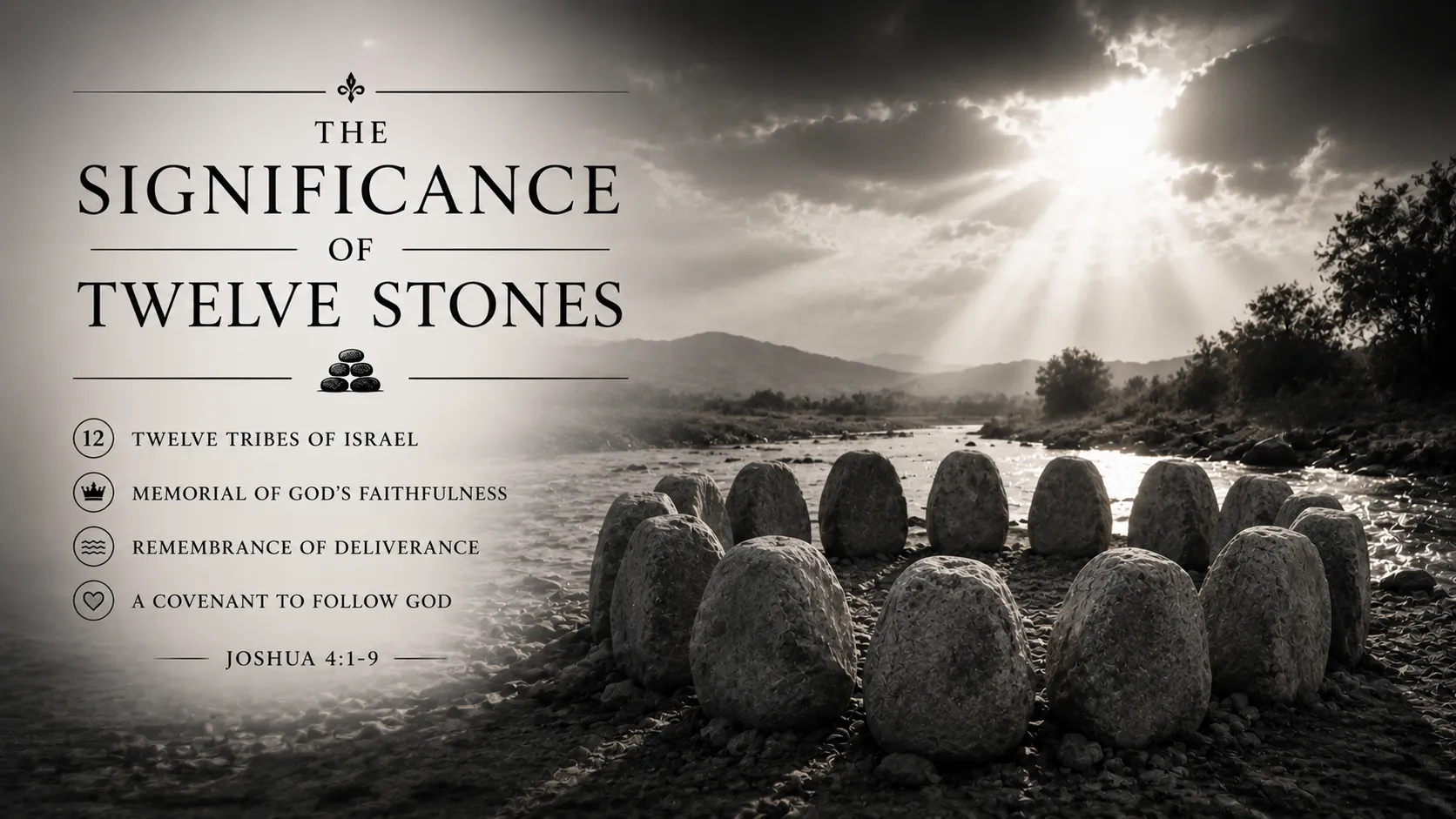
The Significance of Twelve Stones
The meaning of the 12 stones in the Bible.What is the importance of the 12 stones in the Bible?
📖 Bible Verses (KJV)
Joshua erected twelve stones in the middle of Jordan, and to this day they remain.
— Joshua 4:9 (KJV)
Additional Supporting Verses
And take you hence out of the midst of Jordan... twelve stones... that this may be a sign among you.
— Joshua 4:3, 6 (KJV)
Elijah then took 12 stones, each for one of the tribes of the sons of Jacob.
— 1 Kings 18:31 (KJV)
“It had a wall great and high, and twelve gates… and on them were the names of the twelve tribes of the children of Israel.”
— Revelation 21:12 (KJV)
Approximate Year Written
* Joshua: Around 1400–1375 BC
* 1 Kings: Around 560–540 BC
* Revelation: Around AD 95–96
The number twelve is used throughout the Bible to represent God's people. The twelve stones that were placed on special occasions were tangible reminders of God's faithfulness and His relationship with Israel.
Historical Background
In the ancient Near East, people tended to build stone monuments to mark significant occasions.
These memorials were used to remind future generations of:
* Significant historical events.
* Covenants.
* Victories.
Divine intervention:
Memorial Stones were set up to remind the Israelites of the Lord and His great power, in contrast to pagan monuments set up to honor false gods.
Why did God choose to use twelve stones?
The number twelve was named for the 12 tribes of Israel, the 12 sons of Jacob (Israel).
When the twelfth stones were used together, they reminded the nation that:
God had selected Israel as His people of the covenant.
All the twelve tribes were included in God's promises.
The people were to stay united with God's covenant.
The stones stood for unity—not division.
These stones are located at the Jordan River.
One of the best known is in Joshua 4.
God miraculously halted the Jordan River for Israel to enter the Promised Land, and Joshua commanded 12 men, one from each tribe, to bring back a stone from the bottom of the river.
Here at the place called Gilgal, they were set up as permanent memorials.
God told them what they were to do:
Now when they shall say to you, ‘What do you mean by these stones?
— Joshua 4:6 (KJV)
The parents were expected to share their experience of God leading Israel safely over the Jordan with the generations to come.
The stones were not to be worshipped, but they were a reminder of God's faithfulness.
Elijah's Twelve Stones
In the book of 1 Kings 18, another important example is shown.
The prophet Elijah restored the altar of the Lord at Mount Carmel with twelve stones.
This was important because the kingdom of Israel had split.
When Elijah selected twelve stones, he was stressing the point that:
God was still the God of all Israel.
His covenant was with all the twelve tribes.
People were being summoned back to the true worship.
Right after that, God responded to Elijah's prayer with fire from heaven, thus displaying His power over the false god Baal.
The High Priest's Breastplate.
Twelve was also used symbolically in Israel's worship.
The breastplate the High Priest wore had the following:
* Twelve precious stones.
One stone was for each of the tribes of Israel.
(Exodus 28:17–21)
Every time the High Priest went to the presence of God, he represented the whole community before the Lord.
The twelve stones of the New Jerusalem.
The number twelve is continued in the New Testament.
In Revelation:
Twelve gates are on the New Jerusalem, each of which is named for one of the twelve tribes of Israel.
It is surrounded by 12 foundation stones with the names of the 12 apostles (Revelation 21:12-14).
These images together represent the oneness and wholeness of God's redeemed people in the New Covenant.
What did the stones mean?
The twelve stones stood for some significant truths.
1. God's Faithfulness
They reminded Israel that God fulfills His promises.
2. God's Power
God's miracle at the Jordan was the first step in Israel's journey to the Promised Land.
3. Covenant Identity
All 12 tribes were symbolized in the stones.
4. Teaching Future Generations
Parents were asked to share with children the meaning of the stones.
The very memorial became a means of transmitting the faith.
Real-World Example
In many countries, they have monuments which are kept to commemorate significant events in history.
The twelve stones at Gilgal were also a reminder to Israel of the faithfulness of God.
These stones are not monuments of human achievement, but stones that directed people to what God did.
Easy Explanation
The twelve stones were a reminder to Israel of the safe delivery they had received from God into the Promised Land.
They were a reminder of the power, faithfulness and covenant of God to future generations.
The number twelve is always used to refer to God's people in the Bible.
Did You Know?
There are two sets of twelve stones, one at Gilgal and one at the Jordan by Joshua (Joshua 4:8–9).
Even with the division of the kingdom, Elijah re-built the altar with twelve stones.
The High Priest's breastplate had 12 precious stones for Israel's tribes.
Jesus then selected the twelve Apostles as a symbol of the new people of God.
The number twelve appears on various occasions in the Book of Revelation, highlighting the completeness and covenant fulfillment of the New Jerusalem.
Historical and Biblical Consensus
In fact, biblical scholars are in agreement that the twelve stones in Joshua served as memorials to the covenant, rather than objects of worship.
Twelve is used repeatedly in Scripture and always references God's covenant people.
The number 12 is significant, representing unity, completeness, and the continued workings out of God's redemptive plan from the 12 tribes of Israel to the 12 apostles of God to the New Jerusalem.
Spiritual Reflection
That is the message of the 12 stones: Remembering God's faithfulness helps strengthen faith for the future.
As Israel emphasized the power of God in their history to the next generation, Christians are commanded to teach their children and communities about the story of God's salvation.
The past history of God's faithfulness justifies trust that He will be faithful in the future.
Key Takeaway
The 12 stones in the Bible were symbols of God's faithfulness and a reminder of His covenant with the 12 tribes of Israel. They were a reminder to God's people of His promises, His power, and their oneness in Him. The symbolism continues in the New Testament to refer to the fullness of the people of God in Christ.
📚 References
Scripture
Holy Bible, King James Version (KJV)
Exodus 28:17–21
Joshua 4
1 Kings 18:30–39
Matthew 19:28
Revelation 21:12–21
Historical Sources
The New Bible Dictionary
Baker Encyclopedia of the Bible
Joshua
Dictionary of Biblical Imagery
Zondervan Illustrated Bible Backgrounds Commentary
About This Article
This article is going to discuss the meaning of the 12 stones in Scripture, as well as with historical context and biblical theology. It includes an account of how these memorials reminded them of God's covenant, His faithfulness, and His people, and how they differed from objects of worship.
Classification
Bible Story: Biblical Symbols & Themes: Old Testament
Biblical References: Exodus 28:17–21; Joshua 4; 1 Kings 18:30–39; Matthew 19:28; Revelation 21:12–21
Historical Status: 2008, 2009, 2010: Strongly Supported. The use of memorial stones in the ancient Near East was frequent, and the Bible narratives always spoke of the twelve stones as covenant memorials that were set by God's command.
Archaeological Evidence: Archaeologists have discovered many ancient stone memorials (masseboth) and standing stones throughout the Levant, supporting the archaeological idea that stone memorials were a regular part of life. But there is no archaeological proof of Joshua's twelve stones at Gilgal nor of Elijah's altar.
Interpretation Status: The twelve stones represent the twelve tribes of Israel, God's covenant faithfulness, and the unity of His people more or less broadly accepted by Christian scholars. The New Testament applies this symbolism to the twelve apostles, and to the image of the New Jerusalem.
This article will be based on the King James Version (KJV), historical evidence, archaeological research, and recognized biblical scholarship. Guiding Verses is faithful to the scriptural text, distinguishing between recognised historical practices and biblical teaching, and between biblical and theological symbolism.