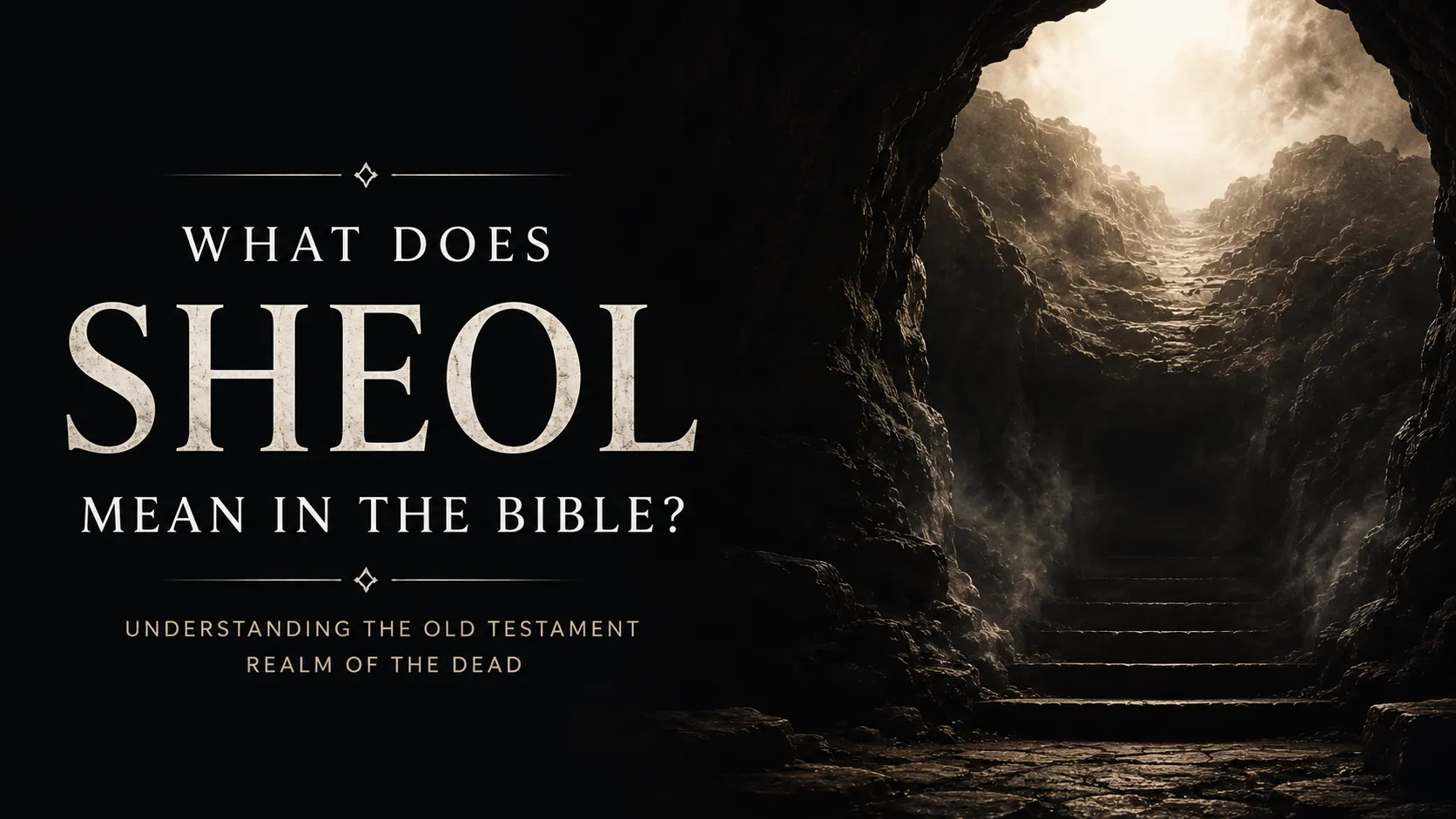
What Does Sheol Mean in the Bible? Understanding the Old Testament Realm of the Dead
📖 Bible Verses (KJV)
You do not leave my soul in Hades, nor allow thine Holy One to see decay.
— Psalm 16:10 (KJV)
Additional Supporting Verses
The wicked shall be turned into hell, and all the nations that forget God.
— Psalm 9:17 (KJV)
Then, "Who is the man that liveth and shall not see death? who is the child of man that shall not be old?
— Psalm 89:48 (KJV)
In my bed I will make my bed, but thou, art Thou in the midst of it.
— Psalm 139:8 (KJV)
📅 Approximate Year Written
* Psalms: Around 1000–900 BC
* Job: Around 2000–1800 BC (events recorded; date of writing debated)
In the Old Testament, Sheol (שְׁאוֹל) is a term translated "hell" over 65 times and one of the most misunderstood words in the Bible.
🏛️ Historical Background
Perhaps the word "hell" is one of the most misunderstood terms in the Bible.
The English word hell may be a translation of the Hebrew word Sheol in the Old Testament, according to the King James Version (KJV).
But Sheol is by no means the same place of judgment that is later revealed in the New Testament.
The term Sheol was a general term used by ancient Israelites to describe the afterlife, or the place where people went after they died.
It was considered to be a mysterious place below the ground and was linked with silence, darkness and the grave.
Very little information is known about Sheol from the Old Testament. In the course of God's revelation as it is communicated through the New Testament, the description of resurrection and eternal life, judgment and final destiny of humanity is enriched.
🌍 What is meant by the word "sheol"?
The Hebrew word Sheol means:
*The land of the dead.
* The grave.
* The unseen world.
*The abode of the dead.
In the light of the context, English translations of Sheol might be rendered as:
* Hell (KJV)
* Grave
* Pit
*The world of the dead (in many recent translations)
The reason why some Bible verses contain the word "hell" in the KJV is that it is used to describe death or the grave, which is not necessarily eternal punishment.
📖 How Is Sheol Described in the Old Testament?
According to the Bible Sheol is:
A Place of the Dead
"There the wicked cease from troubling; and there the weary be at rest."
— Job 3:17 (KJV)
The word "Sheol" was interpreted to mean "destruction" for everyone who dies.
A Place of Silence
In death there is no remembrance of thee: in the grave who shall give thee thanks?
— Psalm 6:5 (KJV)
There is a focus on the absence of activity and silence of death, rather than the specifics of what happens in the afterlife.
There is no escaping death.
Who is that man that lives and never sees death?
— Psalm 89:48 (KJV)
All men must all die.
God is Sovereign Even Over Sheol
David declared:
I may make my bed in Sheol, Thou art in Sheol with me!
— Psalm 139:8 (KJV)
This verse reminds us that "no place is too dark for God's eyes or too deep for His feet.
✝️ Sheol and the New Testament
There is more teaching in the New Testament as the story of the Bible continues.
The most similar Greek word to Sheol is Hades.
But Jesus also used another word:
The final judgment place of "Gehenna".
These terms should not be confused.
Sheol - Hebrew - Realm of the dead (Old Testament)
Hades - Greek - Realm of the dead (New Testament equivalent of Sheol)
Gehenna - Greek - Final place of judgment after God's final judgment
This distinction accounts for some of the different translations of these words in the English Bibles.
Biblical Scholars Say?
It should be noted that the majority of Hebrew scholars do not agree that every occurrence of Sheol refers to the place where the wicked go to receive their punishment in eternity.
In general, however, it is used to denote the afterlife in the Old Testament.
As the revelation of God's Word unfolds:
Sheol is introduced in the Old Testament.
Resurrection is explained in the NT.
Jesus speaks of eternal life and judgement.
Revelation is about the final judgment and the Lake of Fire.
This progression is not contradictory teaching but a progression of the revelation of the Bible.
🚀 Real-World Example
Suppose you read a book of history that references the word "kingdom.
Depending on the context, it could refer to:
* A country.
* A ruler's authority.
* A specific dynasty.
Similarly, the word “hell” in the older Bible translations could be a translation of a different Hebrew or Greek word.
It is important that the reader knows the meaning of the original language so he/she can better read the individual passages.
💡 Easy Explanation
Consider Sheol to be the generic term in the Old Testament for the realm of the dead.
It's like people say today:
“He has gone away to his sleep.”
She has died.
The term does not necessarily refer to what will follow at the end of the world.
Other books of the Bible provide more information about resurrection, heaven, judgment, and eternal life through Jesus Christ.
🤯 Did You Know?
In the Old Testament, the word Sheol is used over 65 times.
In the KJV, Sheol is translated as the word "hell" or "grave" or "pit," depending on the context.
In general, the New Testament translates Sheol as Hades.
Jesus taught a great deal about the subject of resurrection, eternal life, and judgment and developed the concept of these truths from the Old Testament.
Even death and Hades will be judged -- Revelation 20:14.
🔍 Historical and Theological Consensus
The general view of biblical scholars is that Sheol is the Old Testament's ordinary word for the underworld.
There is general consensus among Christians that Sheol can't simply be described as the Lake of Fire from Revelation, but there are areas of difference.
When reading older versions of the English text, such as the King James, knowing the original Hebrew meaning will give less chance of confusion.
🙏 Spiritual Reflection
The Bible says that death is a reality for all of us.
But Scripture also speaks a greater hope.
Sheol is mentioned in the Old Testament as the place of the dead, and in the New Testament Jesus Christ's resurrection as the proof of His victory over death.
As Paul writes:
O death, where's thy sting? O, Death, where is thy sting?
— 1 Corinthians 15:55 (KJV)
Believers do not fear death. The promise of Resurrection and eternal life provides hope after this life, through Christ.
📌 Key Takeaway
In the Old Testament the Hebrew word for the realm of the dead is sheol. It normally means “grave” or “the place of the dead” and not “the place of eternal punishment.” The New Testament develops this theology with the ideas of resurrection, judgment and eternal life in Jesus Christ. The book of Sheol is better understood in the context of its original biblical usage, thus facilitating an understanding of the teaching of the Bible on life, death and hope.
📚 References
Scripture
KING JAMES BIBLE (KJV)
Genesis 37:35
Job 3:11–19
Psalm 6:5
Psalm 9:17
Psalm 16:10
Psalm 89:48
Psalm 139:8
Isaiah 14:9–15
Luke 16:19–31
Acts 2:27
Revelation 20:13–14
Biblical Language Resources
Brown-Driver-Briggs Hebrew Lexicon
HALOT This is a Hebrew and Aramaic lexicon of the Old Testament.
Strong's Concordance – H7585 (Sheol)
Historical Sources
New Bible Dictionary
Baker Encyclopedia of the Bible
A guide to the background of the biblical text for every verse.A reference guide to background information for each verse in the biblical text.
The Bible Writer's Dictionary.The Old Testament Bible Writers Dictionary.
Classification
Topic: Bible Study
The Bible has nine references to David's dreams.There are nine references to David's dreams in the Bible.
Historical Status: The Hebrew word Sheol is very old and has been used in ancient Hebrew texts extensively, in the Old Testament.
Interpretation Status: Sheol is the Old Testament's common word for the world of the dead, with the majority of biblical scholars agreeing on this. There is agreement generally that the intermediate state is not identical with the final judgment state described in Revelation, although there are differences on certain points.
Note: This article is quoted using the King James Version (KJV), Hebraica work and well accepted biblical scholarship. Guiding Verses aims to clarify the original meaning of biblical words and to differentiate between linguistic evidence, historical context and theological interpretation.