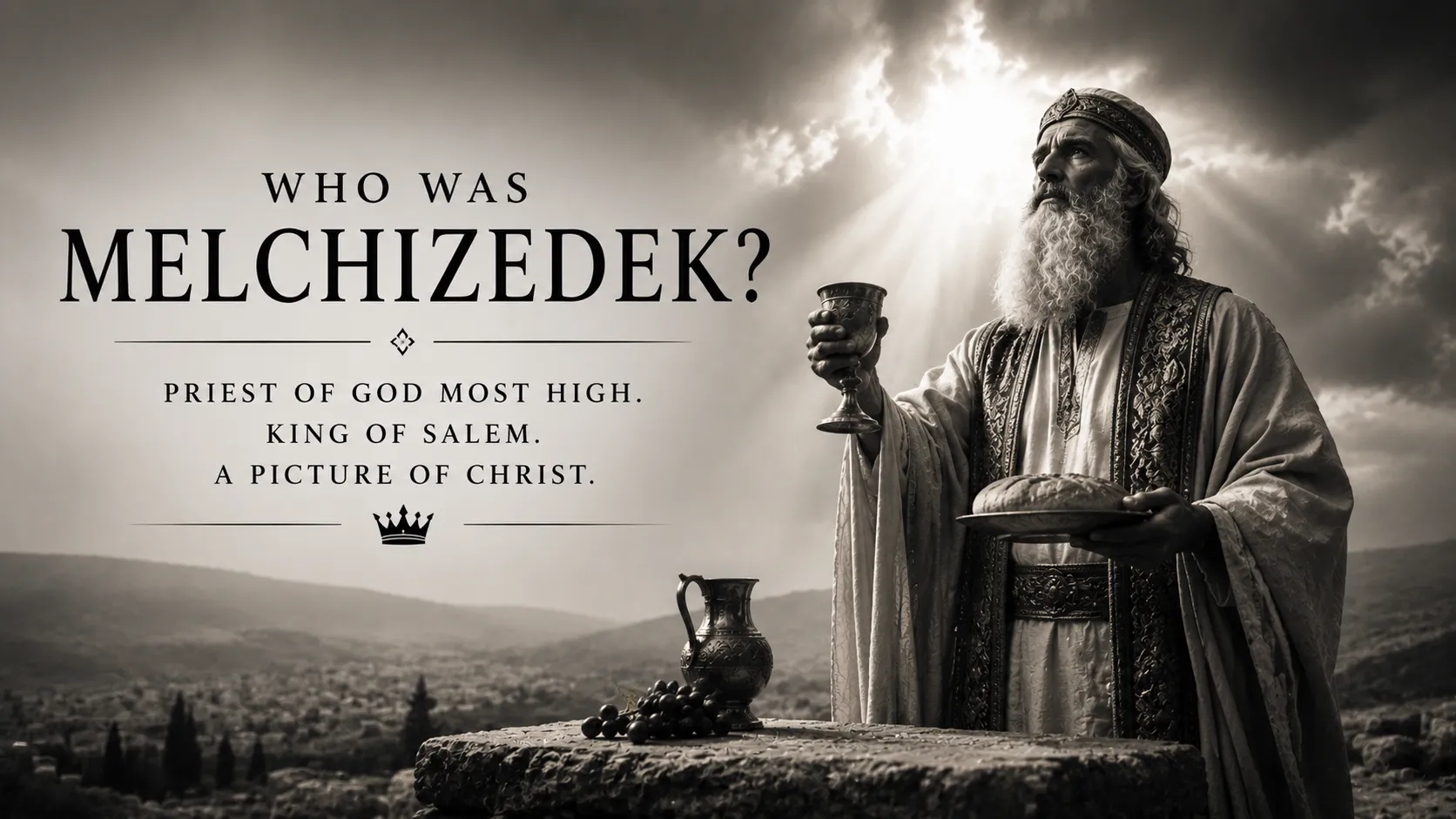
Who Was Melchizedek? The Ancient Father of the Old Testament, the mysterious King and Priest.
📖 Bible Verses (KJV)
"And Melchizedek king of Salem brought forth bread and wine: and he was the priest of the most high God.
— Genesis 14:18 (KJV)
Additional Supporting Verses
Thou art a priest for ever after the order of Melchizedek, the LORD hath sworn, and will not repent.
— Psalm 110:4 (KJV)
Even Jesus, "who is made an high priest for ever after the order of Melchisedec" is entered into the first place when it is said, "Whither the forerunner is for us entered, even Jesus.
— Hebrews 6:20 (KJV)
There "For this Melchisedec, king of Salem, priest of the most high God, by whom I believe shall be more abundantly supplied the grace of righteousness, for without ceasing our ancestors were made perfect.
— Hebrews 7:1–2 (KJV)
📅 Approximate Year Written
Genesis: Around 1445–1400 BC
Psalm 110: Around 1000 BC
Hebrews: Around AD 60–70
Melchizedek is mentioned only briefly in the Old Testament, but in the New Testament he is proclaimed to be one of the most important characters leading up to Jesus Christ.
🏛️ Historical Background
Melchizedek's name is mentioned right after Abram (Abraham) saved his nephew Lot who was being surrounded by a group of kings.
After Abram's victory:
Melchizedek greeted him.
Blessed him in the name of God Most High.
Brought bread and wine.
Received a tenth (tithe) from Abram.
He is mentioned in just three places in the Old Testament (Genesis 14:18–20), but is referred to as "a priest for ever after the order of Melchizedek" in the New Testament (Psalm 110).
The book of Hebrews in the New Testament provides an answer to the question of why this strange priest-king was a prophetic image of Jesus.
🌍 Who Was Melchizedek?
The Bible mentions the name Melchizedek twice—first as:
1. King of Salem
Most biblical scholars agree that Salem is the same as Jerusalem, but can never be certain.
If so, Melchizedek ruled the city centuries prior to David setting up Jerusalem as Israel's capital.
Melchizedek is the name which meant:
"King of righteousness."
Hebrews says that Salem means:
"Peace."
In all of these titles Melchizedek appears as:
King of righteousness.
King of peace.
All of these are attributes of the Messiah.
2.To be a holy man in the service of the Most High God
Melchizedek is the first person in the Bible mentioned as a priest.
To his credit it should be said that he was serving as the priest long before:
Moses.
Aaron.
The Levitical priesthood.
The Tabernacle.
The Temple.
This demonstrates that God had a priest serving Him even before Israel became a nation.
Why Is Melchizedek Important?
1. He Blessed Abraham
Normally the blessing was given by the greater person, as it was in biblical culture.
Hebrews argues:
"The less is blessed of the better."
— Hebrews 7:7 (KJV)
Melchizedek's blessing reveals his special role in God's plan.
2. Abraham Paid Tithes to Him
With the spoils of war, Abram would give Melchizedek a tenth.
It is the first example of a tithe mentioned in Scripture.
This event is used in Hebrews to tell us that Melchizedek's priesthood was more excellent than the later Levitical priesthood because Levi was still in Abraham's lineage.
3.He Foreshadowed Jesus Christ
There is no mention in the New Testament that Jesus was a member of Aaron's priestly clan.
Instead:
Jesus is "a priest for ever after the order of Melchizedek.
In contrast to the Levitical priests:
Jesus was of the tribe of Judah.
He has an eternal priesthood.
Once for all, He has sacrificed Himself for us.
He continually prays for His people.
The ministry of Melchizedek is prophetic and is a foreshadowing of the ministry of Christ as Eternal Priest.
Was Melchizedek Jesus?
Throughout the history of the church people have asked themselves this question.
There are three key perspectives.
View 1: A Historical King and Priest (Most Widely Held)
It is believed by most biblical scholars that Melchizedek was:
A true historical king.
An authentic representative of the most High God.
A heavenly ordained anticipation of Christ.
This interpretation accords best with both Genesis and Hebrews.
View 2: An appearance of Christ before his birth.
In some Christian interpretations Melchizedek is a Christophany, or manifestation of Christ before His birth.
They refer to Hebrews 7:3 which says:
"With no father, no mother, no descent... . . . . . . . ."
But many scholars believe that this language is a reference not to the actual birthplace of Melchizedek, but to the fact that his genealogy, birth, and death are not recorded in Genesis.
View 3: A Literary Type of Christ
Others stress that Melchizedek is principally a theological model.
Hebrews refers to him as being like Christ in his role and in his priesthood but not as Christ Himself.
Why Does Hebrews Say "Without Father or Mother"?
Hebrews 7:3 states:
Neither was there a descent nor a beginning of days, nor an end of life to him;There was neither a father nor a mother, nor was there descent to him, neither beginning of days nor end of life;
This can give rise to queries.
According to most biblical scholars, that:
Genesis does not give a genealogy for Melchizedek.
There is no birth mentioned.
There are no reported deaths.
There is no heir specified.
The silence is a literary portrait of a permanent priesthood in a book where genealogies are important.
That silence is used by the author of Hebrews to depict the eternal priesthood of Jesus.
The passage does not imply that Melchizedek was indeed literally forever.
Bread and Wine
Genesis is saying that Melchizedek brought:
Bread.
Wine.
These were the very normal meals of Abraham and his men following a battle.
Many Christians also view them as symbolic anticipations of the bread and cup of Holy Communion that was later used by Jesus at the Last Supper.
It is not written anywhere in the New Testament that the symbolism in the opening chapters of Genesis was its original intent, but rather a theological reflection.
Real-World Example
Think of a glimpse of a great king some centuries before the king's coming.
The preview is not the king, but it assists people to recognise the king when he comes.
Melchizedek serves the same sort of role in Scripture.
A prefiguring of his priesthood, kingship, righteousness, and peace introduces readers to the higher priesthood of Jesus Christ.
Easy Explanation
Melchizedek was in Abraham's day both a king and a priest for God.
He does not seem to be mentioned much in Genesis, but the NT clarifies that he is a reference to Jesus.
His priesthood was unique and was to be the pattern for Christ's ministry of intercession, as the perfect High Priest.
Did You Know?
The name Melchizedek is found only in Genesis 14, Psalm 110, and Hebrews 5 - 7.
In the Bible, he is the first person to be called a priest.
He is called "King of Righteousness.
He is the King of Peace, with Salem meaning "Peace".
Jesus is never referred to as a priest after the order of Aaron but after the order of Melchizedek.
Some consensus exists in history and in the Bible.There is some agreement in the past and in the Bible.
It is generally accepted that Melchizedek is a historical figure represented as a king and a priest.
He was a divine providence foreshadowing the eternal priesthood of Christ, according to the book of Hebrews.
Some Christians see Melchizedek as a pre-incarnate manifestation of Christ, but most Christians believe that he was a real historical figure whose documented attributes are designed to be an allusion to Jesus.
Spiritual Reflection
Melchizedek encourages believers to remember that God's plan of salvation was not first revealed in the New Testament.
Centuries before Jesus' birth, God put in place an incredible image of the coming Messiah in scripture.
Jesus, the King of Righteousness, the Prince of Peace, the High Priest forever, who always intercedes for His people.
Believers can come into the very presence of God through Him and have full assurance in what He has accomplished.
Key Takeaway
The King of Salem and the priest of the Most High God who blessed Abraham and took his tithe was Melchizedek. He is only mentioned briefly in the book of Genesis, but his importance is recognized in the books of Psalm 110 and Hebrews. Most Christian scholars believe that he was an actual historical king and priest whose life was a foreshadowing of Jesus Christ, the eternal King of Righteousness and Peace, and the perfect High Priest forever after the order of Melchizedek.
References
Scripture
Holy Bible, King James Version (KJV)
Genesis 14:18–20
Psalm 110:4
Hebrews 5–7
Historical Sources
The New Bible Dictionary
Baker Encyclopedia of the Bible
The Epistle to the Hebrews
Hebrews
Dictionary of Biblical Imagery
About This Article
In this article, the identity and significance of Melchizedek is explored in the context of the King James Version (KJV), the historical background of the text, and the interpretation of the New Testament in Hebrews. It makes a clear distinction between those parts which Scripture actually teaches, and those parts which have been majorly interpreted throughout Christian history.
Classification
Biblical Text: Genesis 22:18
Biblical References: Genesis 14:18–20; Psalm 110:4; Hebrews 5–7
Historical Status: There is a strong history of support. In the Book of Genesis, Melchizedek is described as a historical personage, a King of Salem, who encountered Abraham. He is further highlighted in Psalm 110 and the Epistle to the Hebrews.
Archaeological Evidence: There is no direct archaeological evidence identifying Melchizedek as an individual. The account is set in the city of ancient Jerusalem (Salem) and the historical context of the patriarchal period.
The interpretation status of Melchizedek: Christian scholars generally recognize that Melchizedek anticipates the eternal priesthood of Jesus Christ. The question of whether Melchizedek was a historical figure, a pre-incarnate appearance of Christ, or first and foremost a literary type is a question of theological interpretation but the most common interpretation is historical-typological.
Editorial Note: This article first draws upon the King James Version (KJV); it secondly relies upon the accepted biblical scholarship, and thirdly upon the interpretation given in the book of Hebrews. When Scripture does not give a clear answer, Guiding Verses separates from the biblical text any elements of historical facts or theological interpretations.