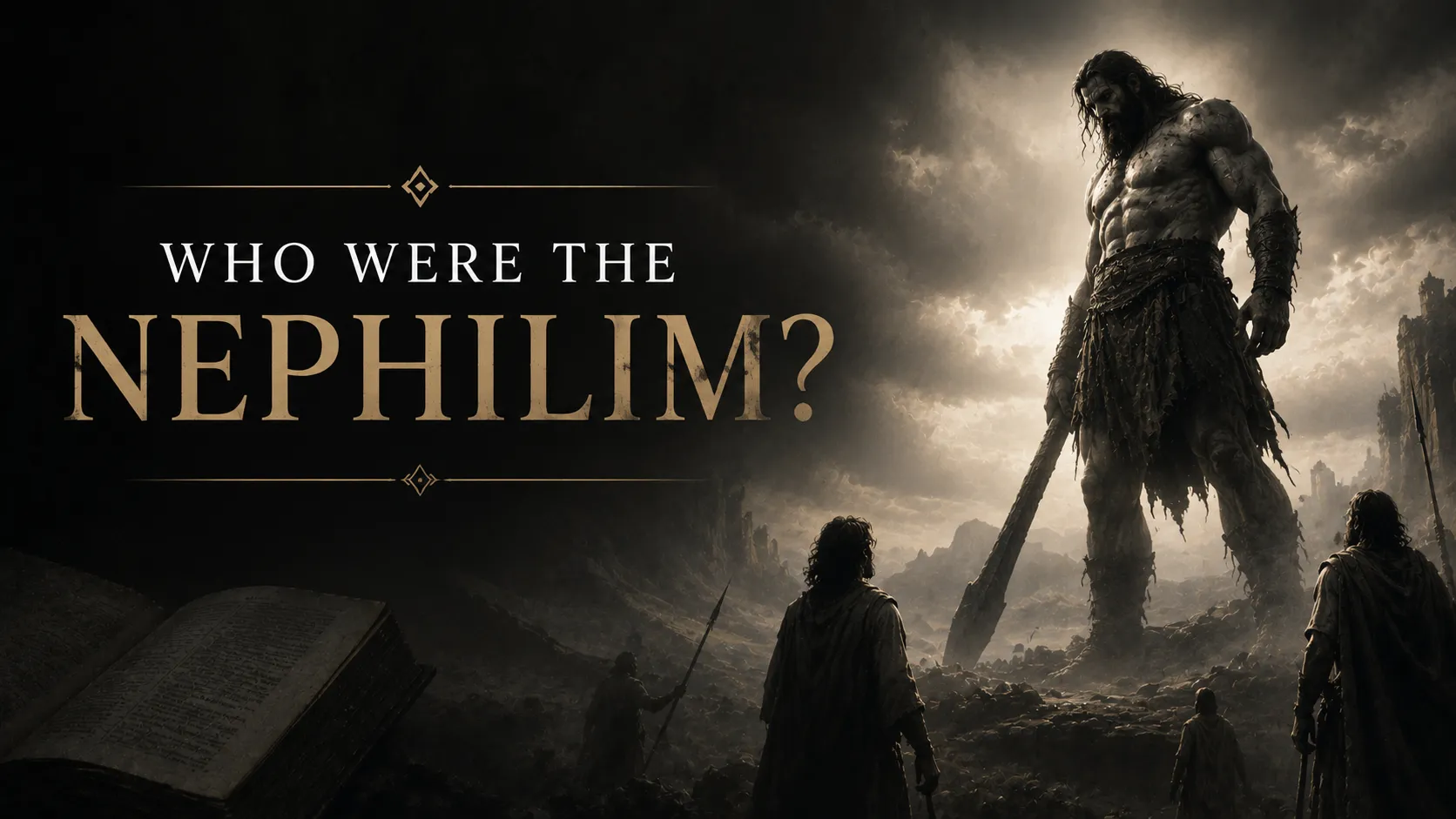
Who were the Nephilim? It is important to be able to understand one of the greatest mysteries in the Bible.It's important to understand one of the Bible's greatest mysteries.
📖 Bible Verses (KJV)
In those days there were giants in the earth; and also after those, when the sons of God came in unto the daughters of men, and they bare children to them, the same were mightier than men.
— Genesis 6:4 (KJV)
Additional Supporting Verses
There we saw the giants, the sons of Anak, which are come of the giants; and we were seen of them as grasshoppers.
— Numbers 13:33 (KJV)
Then God saw that the wickedness of man was great in the earth,…
— Genesis 6:5 (KJV)
📅 Approximate Year Written
Around 1445–1400 BC
Though barely mentioned in the Bible, the Nephilim have been the subject of centuries of discussion and debate. While there are numerous books, movies and internet theories about them, Scripture only gives a limited amount of information.
🏛️ Historical Background
Genesis 6 is about a time of growing sinfulness before the universal Flood.
The Bible mentions a mysterious group known as the Nephilim in this period—
In the Old Testament, the Hebrew word Nephilim (נְפִילִים) is found only twice:
* Genesis 6:4
* Numbers 13:33
The Bible provides little information and so many questions remain without answers.
What Genesis 6 is concerned with is not the Nephilim themselves, but the increasing corruption of humanity, culminating in God's judgement through the Flood.
🌍 What Does "Nephilim" Mean?
The exact meaning of Nephilim is uncertain.
Some scholars trace the word to a Hebrew root which means:
* "to fall"
* "fallen ones"
Others state it is an allusion to:
* Powerful warriors.
* Mighty men.
* Giants.
* Violent rulers.
In the Bible's book of Genesis 6:4, the word is rendered "giants" in the King James Version.
But many contemporary scholars prefer to not translate the Hebrew word as there is disagreement on its exact meaning.
The three major interpretations are
Throughout the history of Christianity, there are three significant schools of thought.Throughout Christian history, there are three important perspectives.
1. The Fallen Angels View.
The interpretation that takes the "sons of God" in the book of Genesis 6 as angels.
In this perspective:
Fallen angels had human wives.
Their progeny were the Nephilim.
The unparalleled evil of their nature helped bring about the corruption before the Flood.
Many explainers mention:
* Job 1:6
* Job 2:1
* Jude 6
* 2 Peter 2:4
This was held by a number of ancient Jewish writers, and is found in the Book of Enoch.
But in most Christian traditions the Book of Enoch is not part of the scriptures and the Bible does not say that angels had children.
2. The Sethite View
Numerous Christian scholars hold the belief that:
Godly children of Seth were the sons of God.
The **"daughters of men" (descendants of Cain) were sons of God or ungodly people.
The passage refers to the split of faithful and unfaithful lines of mankind by intermarriage.
This is a popular interpretation in Christian theology, as it allows one to say that angels are not physical parents.
3. The Royal Rulers View
Another reading of the text takes the term sons of God as referring to the powerful kings or rulers.
Divine titles were used to describe the kings of the ancient Near East.
From this perspective:
Tyrannical rulers had numerous wives.
Their strong young were renowned as warriors.
The passage denounces the pride, violence and misuse of power by humankind.
This reading is now accepted by a number of contemporary Old Testament scholars.
The investigation of the past using archaeological methods.
The Nephilim have yet to be discovered archaeologically.
The mythology of giants is found in many ancient cultures, such as Mesopotamian, Greek, and Canaanite.
However:
There is no archaeological proof of an existence of a race of giant human beings as most of them are heard on the internet.
There are many photographs of massive skeletons that have been revealed as fake online, and others that are artistically created.
Mainstream archaeology has not accepted claims of extraordinary discoveries, such as the ones suggested with the giant find.
The biblical references to the Anakim, Rephaim and other people that were taller than usual refer to actual peoples of the ancient Near East but the bible does not explicitly mention them as being Nephilim.
Did the Nephilim exist after the Flood?
Genesis 6 says:
There were giants in the earth in those days; and also after that…" (Gen. 6:4)
This saying has given rise to various interpretations.
Numbers 13:33 mentions the Israelite spies seeing the “Nephilim” in Canaan.
Many scholars, however, point out that the spies' report contains hyperbole (when comparing themselves to grasshoppers) and Scripture later indicates that their report was filled with fear and exaggeration (Numbers 14:36–37).
Others feel that the reference to ‘Nephilim' in Numbers was descriptive of unusually large warriors and not to the pre-Flood family.
The meaning of the term is not fully specified in the Bible, and can be debated.
🚀 Real-World Example
Suppose you read a historical narrative that tells about a popular community twice, but doesn't tell you what it is.
Readers give varying interpretations centuries later, as a result of language, culture, and related passages.
It's this with the Nephilim.
Since there are only short mentions, Christians have come to different conclusions, but are consensus on the general message of Genesis 6 - man's rebellion against God.
💡 Easy Explanation
The Bible refers to the Nephilim just twice and does not give an exhaustive description.
Instead of feeding our interest in the wonders of creatures, Genesis highlights the extent to which evil had spread among humans, and God's judgment of the world through a flood.
Who these Nephilim were is not known, but the clear lesson in the passage is that sin has a corrupting effect on humanity, as well as God's justice and mercy.
🤯 Did You Know?
The term Nephilim is used only twice in the Old Testament.
There is no explicit reference to them being half human, half angel in the Bible.
The Book of Enoch is an ancient Jewish work that elaborates on this tale, but few Christian traditions accept this as Scripture.
Numerous giant skeletons have turned out to be hoaxes on the internet.
Christians have been united in the main message of the Bible, that of God's judgment and salvation, but they have differed on the interpretation of Genesis 6 for centuries.
🔍 Historical Consensus
It is undeniable that Biblical scholars will agree that the Nephilim is one of the most difficult topics to handle in the Bible.
No consensus has been reached about who they are.
Biblical arguments and historical supporters exist with each of the three major interpretations (The Fallen Angels View, the Sethite View and the Royal Rulers View).
It is generally accepted that the emphasis of chapter 6 of Genesis is on the spread of wickedness among men prior to the Flood and not on the Nephilim themselves.
🙏 Spiritual Reflection
Scriptures call us to look at a more important truth, even when the Nephilim is a mystery that arouses curiosity.
Genesis 6 is really about the moral depravity of man and the reaction of God to it.
But one man in a time of much sin found favor in the sight of God:
But Noah was a man of grace in the sight of the LORD.
— Genesis 6:8 (KJV)
The story is a reminder that God's grace is there in the darkest of times.
Instead of speculating God's Word, which will never let us down, believers are urged to faithfully respond to it.
📌 Key Takeaway
One of the greatest mysteries of the Bible is the Nephilim. They are only briefly referred to in Scripture and their exact identity is still unknown. There are several interpretations Christians have put forward, such as that of fallen angels, that of descendants of Seth, and that of powerful human rulers. Although the Nephilim have not been found by archaeology, it is evident from the main theme of Genesis 6 that the more wicked the people became, the more severe God's judgement was, and the greater His mercy was shown to Noah and his family.
📚 References
Scripture
A copy of the Holy Bible, King James Version (KJV)
Genesis 6:1–8
Numbers 13:25–33
Job 1:6
Job 2:1
Jude 6
2 Peter 2:4
Biblical Language Resources
Brown-Driver-Briggs Hebrew Lexicon
The Hebrew and Aramaic Lexicon of the Old Testament (HALOT) is a dictionary of Hebrew and Aramaic for the Old Testament.
Strong's Concordance – H5303 (Nephilim)
Historical Sources
New Bible Dictionary
A collection of 12,000+ word definitions and explanations of Biblical terms.
Zondervan Illustrated Bible Backgrounds Commentary
Gen. 49:27–28, “John H. Walton – The NIV Application Commentary: Genesis “
Gordon J. Wenham – Genesis 1–15
About This Article
The article is intended to clarify the biblical references to Nephilim, through the use of the King James Version (KJV), Hebrew language studies and through the use of recognized biblical scholarship. It offers the key Christian interpretations and clarifies between what is said in Scripture and what is only a theory.
Classification
Bible Study / Old Testament.
Biblical References: Genesis 6:1–8; Numbers 13:25–33; Job 1–2; Jude 6; 2 Peter 2:4
Historical Status: The Nephilim are referred to in the Bible, but there are no historical records apart from the Bible that can be considered certain to identify them.
Archaeological Status: Unconfirmed. There is no archaeological proof nor any popular evidence of skeletons of giants, known as Nephilim. These are not backed up by the mainstream archaeological community.
Interpretation Status: The question of the identity of the Nephilim has been unclear. Actually, all three main interpretations—the Fallen Angels View, the Sethite View and the Royal Rulers View—are found in Christian scholarship. The Scriptures do not directly answer the question.
Editorial Note: This article uses the King James Version (KJV) of the Bible, Hebrew word studies and accepted biblical scholarship. Guiding Verses are verses that are clearly taught in Scripture, in history, and where the interpretation is still an issue of debate in contemporary theological circles.