
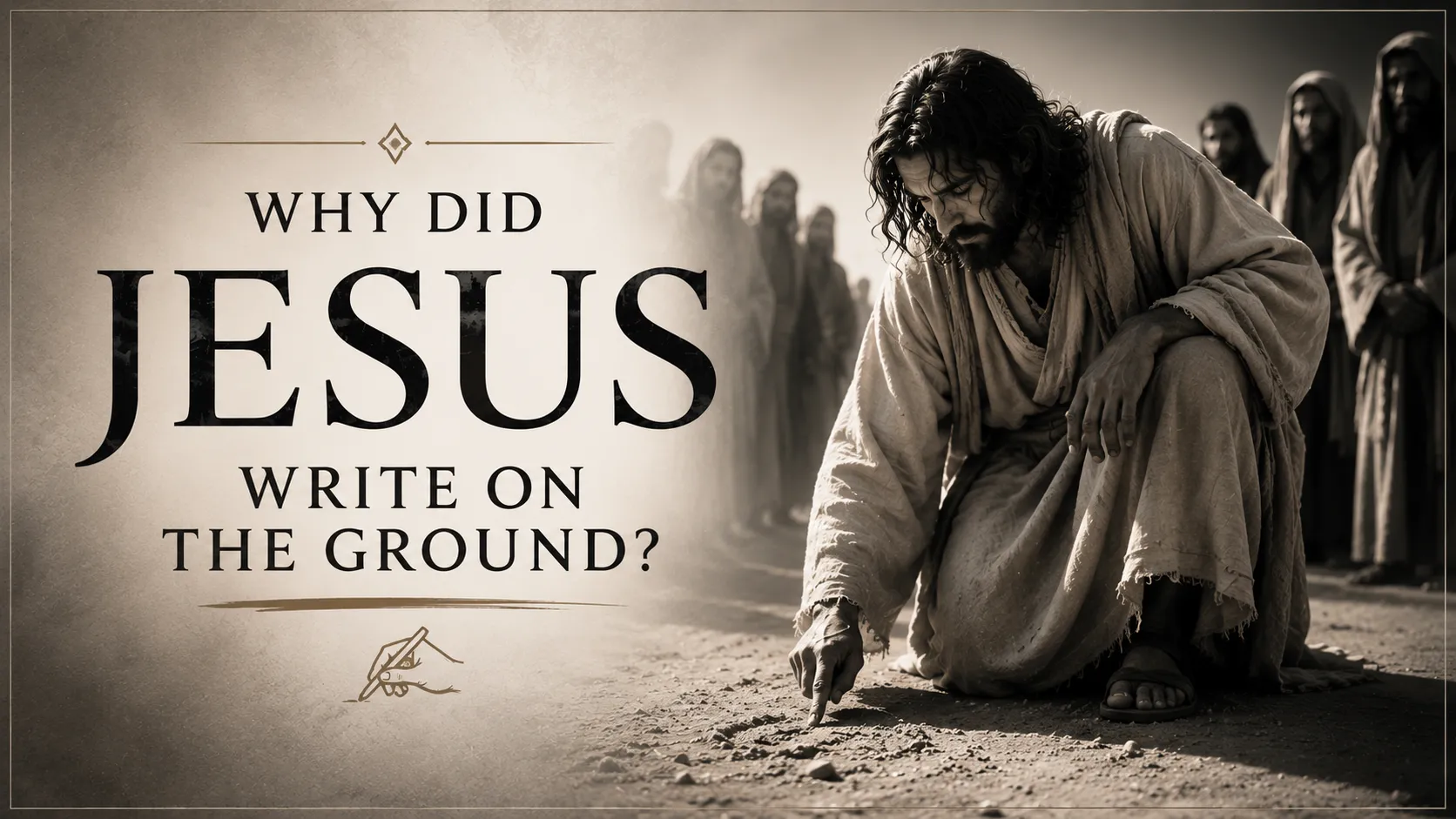
Why did Jesus write on the ground? The questions are not meant to be hard.The questions are meant to be easy, in fact, one of the great mysteries of the Bible.
📖 Bible Verses (KJV)
Then Jesus bent down and with his finger wrote on the ground, as though he didn't hear them.
— John 8:6 (KJV)
Additional Supporting Verses
He that has no sin among you, let him first throw the first stone.
— John 8:7 (KJV)
Again he was on his knees and wrote on the earth.
— John 8:8 (KJV)
But I do not condemn thee: go, and sin no more.
— John 8:11 (KJV)
---
📅 Approximate Year Written
Around AD 85–95
In John 8:7 we read of the woman caught in adultery and Jesus writing in the dirt. This incident is one of the most commented passages in the NT, as there is no record in the scriptures as to what Jesus wrote.
The Pericope Adulterae (John 7:53–8:11) is not present in some of the oldest Greek manuscripts of the Gospel of John. In the vast majority of modern Bible translations, this passage is accompanied by a mention of the manuscript history of that passage. However, this literary conversation aside, the story has been cherished by Christians for centuries.
🏛️ Historical Background
The religious leaders came to Jesus with a woman they said was caught in the act of adultery.
The Law of Moses was a serious offense on adultery (Leviticus 20:10; Deuteronomy 22:22). The leaders said to Jesus:
Moses in the law commanded us, that such should be stoned: but what sayest thou?
— John 8:5 (KJV)
John tells us this was a trap.
If Jesus disobeyed the Law, they could turn the tables on Him by saying that He was breaking the Law of Moses. They could suggest that He did not have mercy and might even take up grievance with Roman authorities, who tended to be the ones who exercised that power.
Rather than respond, Jesus bent down and scratched in the sand.
What was Jesus writing on the stones?
But the Bible doesn't say so.
Except that Jesus writes on the ground twice, writes John.
Where Scripture is silent, any particular statement concerning the words written by Jesus is speculation and not fact.
📖 Common Interpretations
There are a number of suggestions made by Christians over the centuries, and Bible scholars.
1. Author of the Sins of the Accusers
Another of the oldest traditions is that Jesus recorded the secret sins of the religious leaders.
This thought could be the reason why they left "being convicted by their own conscience" (John 8:9).
Evidence: This is an old-fashioned way to interpret it.
Is this in the Bible? No.
2. He Wrote the Ten Commandments
Others feel that Jesus recorded the Law and gave the commandments back to the lawbreakers, as a reminder that they also had broken God's law.
Evidence: Potentially (but not explicitly) found in Scripture.
3. He Fulfilled Jeremiah 17:13
Several scholars make this association to:
They that depart from me shall be written in the earth; -- (KJV)
— Jeremiah 17:13 (KJV)
Jesus wrote on the ground as he challenged unbelief, and some believe that this is a symbolic fulfillment or reference to Jeremiah's words.
Evidence: This is the literary and theological relationship that some scholars suggest there is, but isn't explicitly stated in the Gospel of John.
---
4. He put off His Answer
Others think that Jesus deliberately waited.
Instead of answering right off the bat, He wrote on the ground so that he would give the group an opportunity to consider the reasons for their sin.
This is a faithful representation of His narrative without the need to speculate on the content of His writing.
What can we say confidently? 🔬
The text provides us with a clear indication:
Jesus drew in the sand twice.
John never records what He wrote.
Jesus showed the hypocrisy of those who accused Him.
One by one, they the accusers left.
Jesus offered mercy to the woman and called her to repent:
"Go, and sin no more."
These are those parts of the story that Scripture directly supports.
Why Didn't John Tell Us?
John likes to dwell on the significance of Jesus' actions and not every detail.
This story isn't about the writing, it's about Jesus' wisdom, justice, and mercy.
This is the question that has been asked for generations by readers of Scripture, and it is also what Scripture does not let readers forget—the big lesson: All of us are in need of God's grace.
💡 Easy Explanation
If a person wrote an important message on a whiteboard that book, but the author doesn't tell you what it said, that's what this book is like.
Rather, the author wants you to observe what happened as a result of the writing.
That's the same here.
The Bible points to the impact:
The accusers went away.
The woman was spared of the harshness of judgment.
Jesus commanded her to abandon her sinful way of life.
🤯 Did You Know?
Only written record is found of Jesus writing in the Gospels on this single occasion.
Twice Jesus wrote, says John.
The Bible does not tell us what He wrote.
One of Jesus' most famous sayings is "He that is without sin among you.
The balance of truth and grace is well illustrated in this account – Jesus did not excuse sin, nor did he condemn the repentant woman.
The consensus within the historical and scholarly community.The general agreement of historians and scholars.
There are some points which biblical scholars concur are identified:
The Gospel doesn't tell us what Jesus wrote.
If you explain the content, then it is a speculation.
The theme of the narrative is not the words on the ground, but rather to demonstrate Jesus' wisdom, authority, justice, and mercy.
As for the text, many scholars also comment on the textual history of John 7:53-8:11, yet acknowledge its rich tradition in Christian history.
🙏 Spiritual Reflection
The story is a reminder that God's justice is complete and His mercy is rich.
Jesus did not look down on the woman's sin, nor did he give in to self-righteousness.
He instead faced with hypocrisy, forgave the woman and invited her to the new life!
His last words are for all believers:
Go and sin not anymore.
Christ calls us to accept the mercy, but also to live in obedience.
📌 Key Takeaway
It is never revealed in the Bible what Jesus wrote on the ground! Many good suggestions have been offered about what it might have been about, such as writing the name of the accusers or referring to Jeremiah 17:13, but none can be made a positive affirmation. The word of God is very clear on Jesus' wisdom, His exposure of hypocrisy, His mercy to the repentant and His call to live a changed life.
📚 References
Scripture
The Holy Bible King James Version (KJV)
Leviticus 20:10
Deuteronomy 22:22
Jeremiah 17:13
John 7:53–8:11
Biblical Language & Commentary
New Bible Commentary
This is an illustrated Bible background commentary that explains the biblical context of the biblical text.
IVP New Testament Commentary Series
Who was the most likely man to write the Gospel of John?Who would have been the most likely person to write the book of John?
The Gospel of John by Craig S. Keener.
Historical Sources
New Bible Dictionary
Baker Encyclopedia of the Bible
A few critical editions of the Greek New Testament are available, including textual studies of John 7:53–8:11.
About This Article
The account of Jesus writing on the ground, as translated from the King James Version (KJV), historical context, and biblical scholarship are explained in this article. It clarifies the differences between what is literally written in Scripture and what has been understood by Christians in the course of tradition.
Classification
Story Topic: The Life of Jesus / Bible Study
Biblical References: John 7:53–8:11; Jeremiah 17:13; Leviticus 20:10; Deuteronomy 22:22
Historical Status: The account survives in the Christian manuscript tradition, though this has led to some debate as to its textual history since it is not present in some of the earliest Greek manuscripts.
Jesus' writing is interpreted: Any guess of what He wrote is going on a lot of assumptions without being explicitly written in Scripture. The main idea of the passage is that of Jesus' Justice, Mercy, and Repentance (regardless of the unanswered question).
This article has been written using the King James Version (KJV), historical context, textual scholarship and recognized biblical commentaries. Guiding Verses is clear about the different ways Scripture is taught and how historical evidence—along with theological interpretations that are still topics of informed Christian conversation—are taught.