
Introduction
It would be one of the most surprising events in the Gospels if Jesus' public ministry didn't yet start.
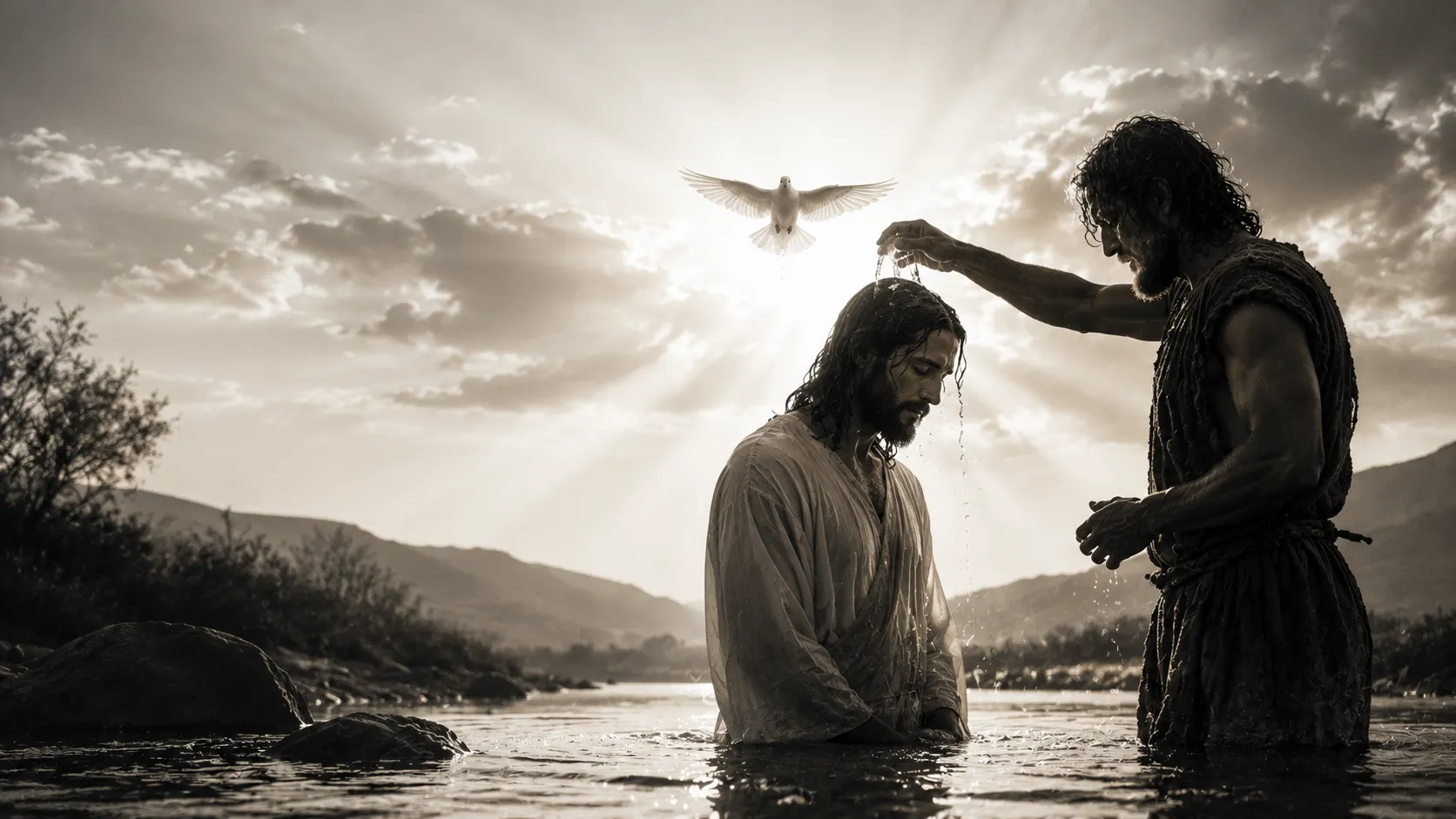
Jesus comes to John the Baptist and asks to be baptized.
This initially might appear puzzling.
John's baptism was a baptism of repentance for sinners.
But Jesus had no sin.
Why was it necessary for Jesus to be baptized if He did not sin?
The solution is one of the most beautiful truths in the bible.
Jesus didn't have to be baptized because He needed forgiveness.
He was baptized to be identified with humanity, to be obedient to God, to show who He is, and to kick off His public ministry.
The Biblical Account
The event is recorded in Matthew 3:13–17, Mark 1:9–11, and Luke 3:21–22.
When Jesus came to the Jordan River, John immediately hesitated.
He said:
I need to be baptized of you, and do you come to me? (Matthew 3:14, KJV)
John knew who Jesus was.
He knew that Jesus had no sin to confess.
But Jesus answered:
For it is expedient unto us to suffer it so now: for thus it becometh us to fulfill all righteousness. (Matthew 3:15)
John then baptized Him.
John's Baptism?
The title of one of the people called to repentance was John the Baptist.
Baptism was a sign of his repentance from sin and his readiness for the future Messiah.
People repented and were baptized in the river Jordan.
But Jesus had no need to repent.
His baptism was for a different reason.
Why did Jesus get baptised?
1. To complete all righteousness,
Jesus Himself quoted as the main reason:
To accomplish everything that is right.
This is to indicate that Jesus did everything exactly as the Father wanted him to do it.
From the outset of His ministry, He was ready to go God's way.
His life would be a life of unconditional submission – from the waters of the Jordan to the Cross at Calvary.
2. In order to be connected to the sinners.
Jesus was sinless yet chose to set His life among those He came to redeem.
He came to "bear" the guilt of the repentant sinners in the same waters, not because He shared the guilt, but because He was born into the world to bear it.
Jesus always associated with the broken, the outcast and the needy.
He was baptized to suggest the greater identification that would occur at the cross.
3. To start His Public Ministry
Jesus' 30 years were spent in relative obscurity.
His baptism was the start of His public ministry.
The Holy Spirit came upon Him immediately, and He was taken to the wilderness before He went into the work of teaching, healing and declaring the Kingdom of God.
The baptism was a public declaration of His mission.
4. To Reveal the Trinity
One of the most obvious places in Scripture where we see the Father, the Son, and the Holy Spirit working together is at the baptism of Jesus.
As Jesus came up from the water:
The Son was standing in the Jordan River.
The Holy Spirit came down, like a dove.
The Father's voice came from heaven.
The Father declared:
This is the voice of God saying, “This is my beloved Son, in whom I am well pleased.” (Matthew 3:17)
This lovely scene is a testimony to the unity and the three personalities of the Trinity working together.
5. To declare Jesus as the Messiah
John the Baptist had been sent to get people ready for the coming of the Messiah.
Jesus' baptism was when God declared publicly that Jesus is the promised Savior.
When the Holy Spirit came down, John said that the One who received the Holy Spirit was the Messiah.
Beyond this, there would be no reason in doubt Jesus' identity.
Why did the Holy Spirit come down in the form of a dove?
The baptism of the Holy Spirit was not lacking in Jesus because He didn't have the Holy Spirit previously.
Rather, it was as a tangible token of His anointing to serve in the public.
In many ways, the dove can be interpreted as a symbol of:
* Peace
* Purity
* God's presence
* Gentleness
Jesus' descent into the earth was an indication of God's approval and the start of Jesus' earthly ministry.
Why did the Father speak from heaven?
The Father's voice served a number of purposes.
It declared Jesus' love for His Son.
It was the voice of God's blessing before Jesus ever did anything that was seen as a miracle.
It also proclaimed to the onlookers that Jesus was the Messiah that God had chosen.
This helps us to remember that Jesus' identity is not based on His success, but on His connection to the Father.
Was Jesus Baptized to set an example?
Yes.
While His baptism was once, and it could not be more unique, it was also an example of humble obedience.
Later, Jesus instructed His disciples to baptize those who believed in the name of the Father, Son and Holy Spirit.
The Christian baptism is not a repetition of Jesus' baptism but a call to death, burial and resurrection.
Read and discuss the connection between baptism and the cross.Read and discuss the relationship between Baptism and the Cross.
Jesus' baptism began His journey to Calvary.
He openly associated Himself with sinners in the Jordan River.
He Himself was the sacrifice for sin, Who was born to be sin for us—
His baptism was a foretaste of His sacrificial ministry.
Another step in the redemptive plan of God.
Jesus' baptism provides us with five deep lessons
1. Obedience Comes Before Ministry
Before Jesus went out to preach, heal, or do miracles, He was a man who obeyed the Father.
Fruitfulness will always come after faithfulness.
2. God Honors Humility
The sinless Son of God had come among the sinful people.
Humility is the hallmark of greatness and not status.
3. Our Identity Comes from God
The Father spoke of His love and approval before Jesus started His public ministry.
It is His works that identify Him before His identity.
Believers are reminded that their value is in their relationship with God rather than their achievements.
4. God Fulfills His Promise
Jesus' baptism was an embodiment of the promise of the old testament concerning the coming Messiah.
God's promises work out in His perfect time.
5. The Trinity Works Together in Salvation
The Father sends.
The Son obeys.
The Holy Spirit is the power that empowers.
The baptism of Jesus is a beautiful illustration of the oneness of God's work of redemption.
Common Misunderstandings
We are told that Jesus was baptized because He was a sinner.
No.
The apostle Paul and the rest of the NT writers make it a habit of stating that Jesus had no sin.
His baptism was not for repentance, but to fulfill God's righteous plan.
Jesus is God's Son because he was baptized.
No.
It is incorrect to say that Jesus was the Son of God when He was baptized.
The Father's declaration was to make His identity known, but not make it.
A person is saved at the time of baptism in the name of the Father and the Son and the Holy Spirit.
In the New Testament baptism is a command and a declaration of the person's relationship to Christ.
The way to salvation is through God's grace by faith in Jesus Christ.
Baptism is an outward sign of this faith.
Frequently Asked Questions
How old was Jesus when He was baptized?
Luke tells us that Jesus started His public ministry at the age of 30 ( Luke 3:23).
Who baptized Jesus?
Jesus was baptized in the Jordan River by John the Baptist.
Why wouldn't John not go?
John knew that Jesus was holy, and he was afraid that he was unfit for baptizing Him.
What was the next thing Jesus did after He was baptized?
The Holy Spirit came down like a dove; the Father spoke from heaven, and Jesus was guided by the Spirit into the desert to be tempted.
Reflection
The word "baptism" is not used here to refer to the washing away of sin.
It was a matter of total subservient surrender, of lowly acceptance of the human condition, and of the public inaugurating God's plan of redemption.
Jesus stood in the waters of the Jordan and proved that the Savior had come, not to be served, but to serve, and to give His life for many.
His baptism is a reminder that God's greatest victories start with humble obedience.
Closing Prayer
Heavenly Father,
Thank You for sending Your Son, Jesus Christ, who perfectly obeyed Your will in every way. Teach me to be humble, teach me to obey, teach me to be faithful, Just like Jesus, Lord! Help me to trust Your plan, to walk according to Your will even if I don't fully understand and to live in confidence that my identity is in You.
In Jesus' name, Amen.