
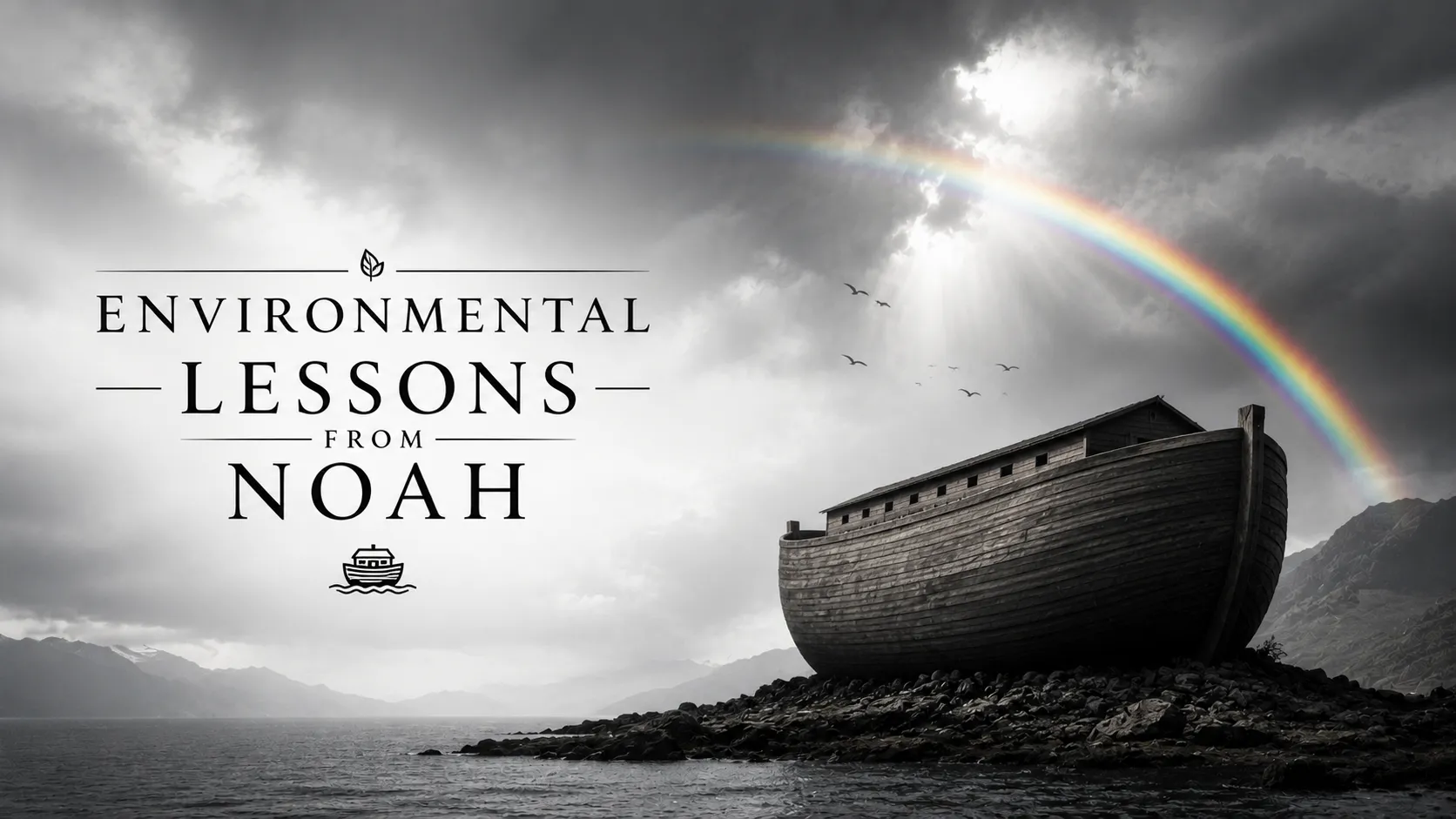
What can we learn from the Flood and the Ark?
📖 Bible Verses (KJV)
And God blessed Noah and his sons and said to them…“Be fruitful, and multiply, and replenish the earth.
— Genesis 9:1 (KJV)
Additional Supporting Verses
Then God looked at the fruit and every good thing that he had made, and he was pleased.
— Genesis 1:31 (KJV)
The earth is His, and the fullness thereof. . . .
— Psalm 24:1 (KJV)
A man of righteousness considereth the life of his beast…"
— Proverbs 12:10 (KJV)
📅 Approximate Year Written
* Genesis: Around 1445–1400 BC
* Psalms: Around 1000 BC
* Proverbs: Around 970–930 BC
The story of Noah is most famous for the Flood, but has much to say about the relationship of people to God's creation.
🏛️ Historical Background
Genesis says, "the wickedness of man is now spreading across the earth.
God sent a great flood to destroy the world and save:
Noah and his family!
Representatives of land-dwelling animals:
The future of humanity.
God renewed His covenant with mankind and gave the earth over to Noah and his offspring after the Flood.
The emphasis of the account is on God's judgment and His desire to save life.
What Principles of the Environment can be learned?
Genesis wasn't written as a book of environmental advice, but a few principles are evident in the story of Noah.
1. The Earth is God's gift to us.
The Bible tells us that creation is God's creation and therefore belongs to God.
The earth is the LORD'S, the fullness thereof.
— Psalm 24:1 (KJV)
The human being is thus a steward and not an absolute owner.
This helps to promote environmentally sound stewardship.
2. Human Life and Animal Life Matter.
God told Noah to put animals inside the ark to save their "kinds.
Throughout Genesis God is concerned with:
* Human beings.
* Domestic animals.
* Wild creatures.
* Birds.
After the Flood, the covenant that was made included:
"Every living creature."
— Genesis 9:10 (KJV)
This is an expression of God's concern for all living creation.
3. Stewardship is a God given responsibility.
From the outset, creation was handed to humanity to care for.
Genesis 2:15 says that Adam was placed in the Garden of Eden:
To put it on and to hold it!
The tale of Noah follows this theme, demonstrating humanity's duty to save life in a time of judgment.
Biblical stewardship is the wise use of creation and an acknowledgement that it is God's.
4. God's Creation is Ordered.
Noah saved the representatives of animal kinds as God told him.
The Flood story is God's concern to preserve life and order in a world that was in chaos.
Post- flood God set up regular seasons:
Until the earth doth cease, seedtime and harvest shall not cease.
— Genesis 8:22 (KJV)
This promise testifies to God's continuing providential care for creation.
5. Caring for Creation Reflects Gratitude
The Bible never says anything about worshiping nature.
Rather, creation points to its Creator.
Respecting the environment is one way to show thanks for God's gifts, not the worship of creation (Romans 1:25).
What do the Bible's teachings have to do with modern environmentalism?
The Bible does not have anything to say about:
* Climate change.
* Carbon emissions.
* Plastic pollution.
* Renewable energy.
These are modern problems, which came into existence after the time of the Bible.
But scripture does teach principles that many believers practice today such as:
* Responsible stewardship.
* Avoiding waste.
* Caring for animals.
* The use of resources in a way that is wise.
Thanks to God for Creation.
These are biblical principles that various Christians could agree on, but draw other conclusions about environmental policies.
Noah's Ark and Biodiversity
The story of the ark is all about saving lives.
In Genesis, God tells the story of Noah's ark and orders him to put the animals in the ark in order to save them for posterity after the Flood.
Modern biological classifications, conservation science, are not explained in the Bible, but clearly God is concerned about the perpetuation of living things.
This is a positive sign to the many Christians who take this as a call to responsible stewardship of the natural world and thinking about biodiversity.
Real-World Example
Suppose someone were to give you a beautiful garden that belongs to him.
You can eat its fruits, but you must take care of it, protect it and leave it well.
The Bible's view of humanity and its relationship to creation is similar.
The earth is our God-given responsibility, we are stewards of the Earth.
Easy Explanation
In Noah's story we can learn that God cares for human beings as well as the environment.
The ark saved life, God's covenant that all the living things would be saved and the humans to care the creation.
These principles promote intelligent use of nature, but not the worship of nature.
Did You Know?
God's covenant after the Flood was with **Noah, his descendants and "all the living creatures" (Genesis 9:9-10).
Noah's ark represents the preservation of life as described in the book of Genesis, which was done by bringing in representatives of animal kinds.
The rainbow was adopted as the symbol of God's covenant with humankind and creation.
Proverbs is a book that teaches the righteous to take care of animals (Proverbs 12:10).
The Bible opens in a garden (Genesis) and closes with the re-creation of the garden (Revelation 21-22).
---
Historical and Biblical Consensus
Theological considerations are the chief purpose of the Flood story, as biblical scholars have been united in their interpretation of the story as God's judgment for sin, His mercy for Noah, and His covenant faithfulness.
Most scholars also acknowledge the principles of stewardship, the value of Life and man's responsibility to creation that remain in the story.
Although the Bible does not give us a comprehensive environmental programme, it repeatedly portrays the natural world as God's creation which is good and placed in human care.
Spiritual Reflection
The story of Noah is a reminder of the world being a gift from God.
The Christian is to play a grateful role in enjoying creation, exercising it wisely, treating the living creatures, and keeping in mind that creation ultimately points beyond itself to its Creator.
Faithful stewardship is a form of worship because it is an honour to God, the creator of heaven and earth.
As Paul wrote:
In Him all things were created... and in Him all things exist.
— Colossians 1:16–17 (KJV)
Key Takeaway
The Flood is not the only lesson that Noah teaches. It reminds us that the earth is God's, that we are called as stewards of creation, and that God loves human life and the created order! Although the Bible is not a science textbook, it does teach the responsibility of caring for God's creation, the duty to be thankful for God's gifts, and the responsibility of being faithful stewards of God's gifts.
References
Scripture
Holy Bible, King James Version (KJV)
Genesis 1–2
Genesis 6–9
Psalm 24
Proverbs 12:10
Romans 1:25
Colossians 1:16–17
Revelation 21–22
Historical Sources
The New Bible Dictionary
A comprehensive reference to the Bible.
Genesis 1–15
The NIV Application Commentary: Genesis, 2nd Edition
Dictionary of Biblical Imagery
About This Article
Using the King James Version (KJV), biblical theology and historical scholarship, this article examines the principles of the environment contained in the story of Noah. It clearly sets apart biblical stewardship from today's policy debates on the environment and emphasizes the long-term duty to be stewards of God's creation.
Classification
Topic: Creation Care / Old Testament
Biblical References: Genesis 1–2; Genesis 6–9; Psalm 24; Proverbs 12:10; Romans 1:25; Colossians 1:16–17
Historical: Noah's story is told in Genesis as an account of Israel's sacred history. It has been a theological concept that has influenced Jewish and Christian education for centuries in the themes of judgment, mercy, covenant, and stewardship.
Scientific Status: This article does not make scientific statements about environmental issues, but appeals to ethical principles found in the Bible. Questions of contemporary environmental science and policy are not part of the purpose of the story of Genesis.
Noah's Story interpretation status: The interpretation of the story of Noah is commonly accepted by the Christian scholars, who teach it as lessons in stewardship, respect for life, and God's care for creation. There may well be variations among believers as to the application of these principles to current environmental issues.
This article is based on the King James Version (KJV), which is considered to be a text of biblical scholarship, and the themes of biblical books, namely Genesis. Guiding Verses will differentiate between biblical stewardship teachings and current environmental issues that are not contained in the biblical text.