Has Noah's Ark Been Found?
Has Noah's ark been found? Analysis of Evidence, Claims and Continuing inquiry.
📖 Bible Verses (KJV)
On the seventeenth day of the seventh month the ark rested on the mountains of Ararat.
— Genesis 8:4 (KJV)
Additional Supporting Verses
Then God remembered Noah and all the animals that were with him in the ark...
— Genesis 8:1 (KJV)
Noah, by faith, "being warned of God of things not seen as yet... prepared an ark to the saving of his house.
— Hebrews 11:7 (KJV)
📅 Approximate Year Written
* Genesis: Around 1445–1400 BC
* Hebrews: Around AD 60–70
The Bible states that Noah's Flood was many centuries prior to the time of Moses and his book of Genesis.
🏛️ Historical Background
Noah's ark is a story that is widely known throughout the Bible.
Genesis 6-9 tells of God's command to Noah to construct a large ark before He sent a flood upon the world as punishment for man's sinfulness. Before the waters covered the earth, Noah and his family, and representatives of all kinds of land animals boarded the ark.
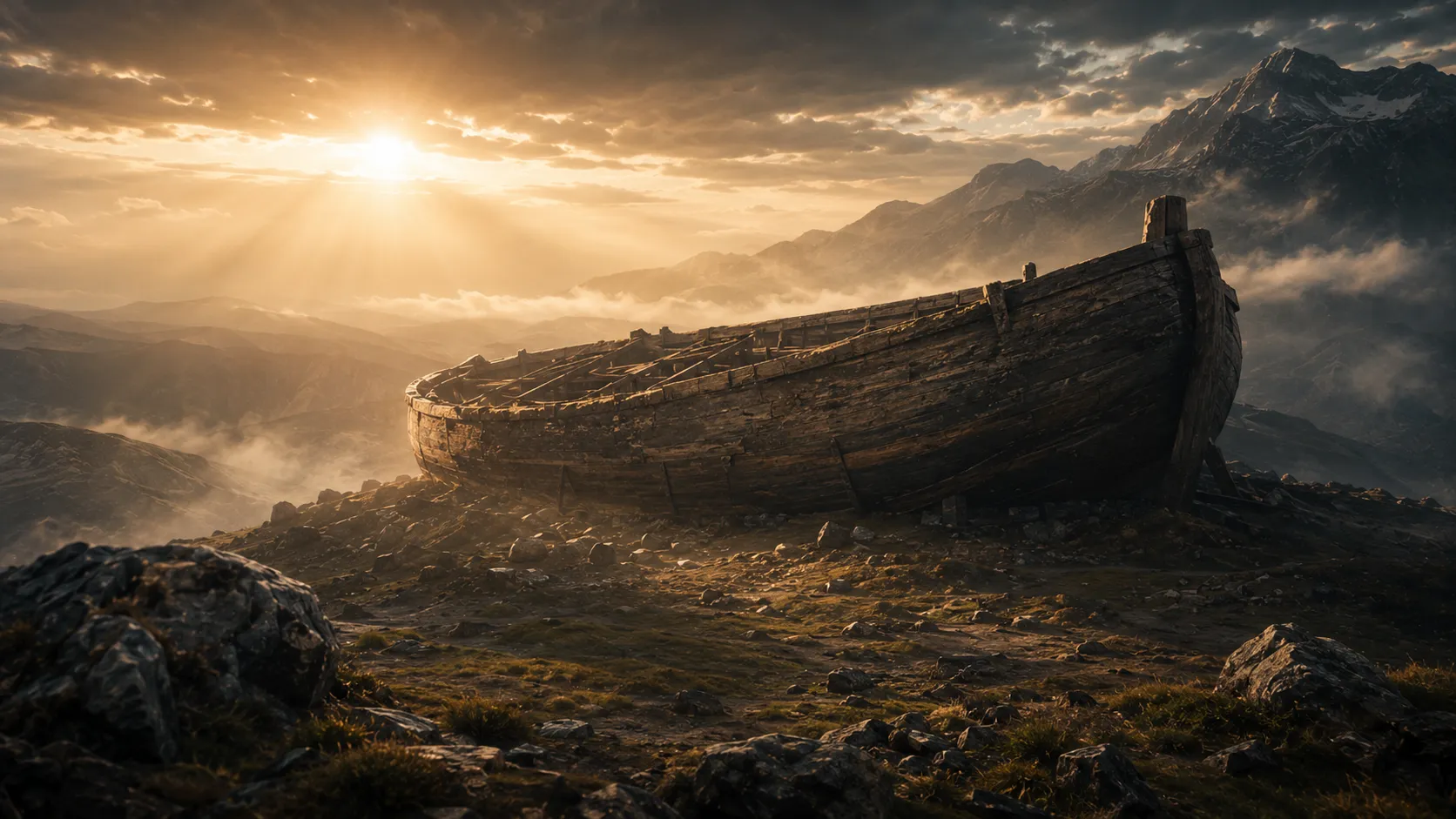
Following the receding waters, the ark rested "upon the mountains of Ararat.
In search of the ark, explorers, historians and archaeologists have searched for the physical evidence of the ark for thousands of years. There have been many expeditions, especially in eastern Turkey, but it's one of the greatest mysteries in archaeology.
What is the meaning of "Mountains of Ararat"?
It is commonly believed that the Bible indicates the ark touched down on Mount Ararat, a famous volcano in eastern Turkey.
However, the correct translation of Genesis 8:4 is "the mountains of Ararat.
The word Ararat in the ancient world did not mean "mount Ararat", but a larger mountainous area, in the heart of which was Urartu, the ancient kingdom.
This means that the Bible does not give an exact location of the highest point where the ark landed.
This has led to a number of suggestions over the years for the site of Ararat.
🔬 What Archaeology Has Discovered
Although numerous expeditions have been made, no archaeological finding has ever been universally accepted as Noah's Ark.
A number of sites have garnered interest.
Mount Ararat
The most famous search area is Mount Ararat (5,137 meters / 16,854 feet).
Climbers and explorers have recorded over the years:
* Wooden structures.
* Unusual rock formations.
* Satellite anomalies.
* Ice-covered objects.
No one has yet been able to verify any of these reports as the remains of Noah's ark.
Durupınar Formation
The Durupınar Formation is a boat-shaped geological structure found about 30 kilometres south of Mount Ararat, which was discovered in the 1950s.
Its size is thought to be similar to that of Noah's ark by some scientists.
Others say that the geological research shows that it is a natural rock formation and not a manmade vessel.
However, most geologists do not believe that it is a piece of the ark's archaeological remains.
Other Proposed Locations
Over the years, other locations have been postulated for:
* Eastern Turkey
* Iran
* Armenia
None have generated any evidence that is accepted by the general archaeological community.
The search is powered by modern technology.The search is powered with modern technology.
The area is still being explored with up-to-date tools such as:
* Satellite imagery.
* Ground-penetrating radar.
* Drone surveys.
* Geological mapping.
* Ice-penetrating radar.
* Remote sensing technology.
These techniques are useful for detecting anomalous features under snow, ice and rocks.
Despite all these advances, no one has ever found the location of the ark.
---
💡 Easy Explanation
What would it take you to locate a wooden vessel after being battered by thousands of years of weather, earthquakes, ice and volcanic activity!
It would be very hard to preserve and identify the ark after all these centuries even if it had been built at the location described in Genesis.
This is why the search remains on.
---
🤯 Did You Know?
Turkish highest mountain is Mount Ararat.
The Bible does not refer to the actual mountain called Ararat, but rather to the mountains that the ark landed on.
For the last two centuries, hundreds of explorations have been made to find Noah's Ark.
As wood deteriorates from age, it is inevitable that it will decay naturally, unless the conditions surrounding it are very special.
A number of strange shapes have been spotted from space; none have been proven to be the ark.
---
A consensus of history and archaeology.
Flood legends are attested in a number of old traditional cultures of the Near East.
As for the ark of Noah, there has been no universal consensus of an archaeological discovery.
The majority of archaeologists have reached the conclusion that there is no physical evidence, at this time, that has been verified to identify the ark.
Claims over the Durupınar Formation, Mount Ararat and other sites are still unresolved and subject to debate.
This is why it's important to differentiate between a documented discovery and a plausible hypothesis or unverified claim.
---
🙏 Spiritual Reflection
The main idea of the story of Noah's ark is not that God saved him in the ark, but that he showed justice, mercy and faithfulness.
The ark became a symbol of God's provision and salvation to Noah and his family.
Even if the ark is never found, the Bible's narrative is a reminder to the faithful that God is faithful and will find a way to save us from our plight if we trust Him.
Noah's Ark is also a reminder to the Christian church of God's promises of salvation through Jesus Christ.
📌 Key Takeaway
The Bible does not specify which mountains on Ararat Noah's ark landed, but it does say it did. Numerous searches have been carried out for the ark, but no one finding has been accepted by all archaeologists. The quest continues, and the Bible story is one of the most powerful tales of judgement, preservation and hope in history.
📚 References
Scripture
The King James Bible (KJV)
* Genesis 6–9
* Hebrews 11:7
* 1 Peter 3:20–21
Archaeological Sources
1. Biblical Archaeology Society
2. Israel Antiquities Authority
3. Encyclopaedia Britannica – Noah
4.The Mount Ararat is now featured in the Encyclopaedia Britannica in the following way:
5. Oxford Encyclopedia of Archaeology in the Near East
Historical Sources
New Bible Dictionary
Zondervan Illustrated Bible Backgrounds Commentary
The Archaeological Study Bible
A literature search of the ancient Near East flood stories are examined.The ancient Near Eastern flood literature is examined.
About This Article
In this article, we take a look at the claims of Noah's Ark, using biblical evidence (KJV), archaeological evidence, geological evidence, and historical evidence. It tells you when the information is proven, when the investigation is still underway and when information is only a theory and has not been proven.
Classification
Please include the title in your question.
Biblical References: Genesis 6–9; Hebrews 11:7
Historical significance: Noah's Ark is a story that has been passed down through history, religion and culture for thousands of years. There's a history of flood legends in several different civilizations of the Near East.
Archaeological Status: Unconfirmed. There is no universally accepted site as the remains of Noah's ark. The proposed sites in question, such as Mount Ararat, and the Durupınar Formation are still under research and debate.
Interpretation Status: It is not known where the ark is. There are mountains of Ararat, and the Bible mentions them, but doesn't say what one is, so it may be an on-going project, though there are no conclusions to be drawn until all the evidence is gathered.
This article is based on the King James Version (KJV), archaeological research, geological studies, and historical scholarship. To facilitate readers' responsible exploration of biblical history, Guiding Verses differentiates between facts, credible hypotheses, and unverifiable claims.