
What Do Archaeologists Say About Jesus?
📖 Bible Verses (KJV)
"And Jesus increased in wisdom and stature, and in favour with God and man."
— Luke 2:52 (KJV)
Additional Supporting Verses
"And he came and dwelt in a city called Nazareth..."
— Matthew 2:23 (KJV)
"And Jesus went about all Galilee, teaching in their synagogues, and preaching the gospel of the kingdom..."
— Matthew 4:23 (KJV)
"And it came to pass in those days, that Jesus came from Nazareth of Galilee, and was baptized of John in Jordan."
— Mark 1:9 (KJV)
"And there came a voice from heaven, saying, Thou art my beloved Son, in whom I am well pleased."
— Mark 1:11 (KJV)
📅 Approximate Historical Period
Jesus' birth: commonly placed around 6–4 BC
Jesus' ministry: approximately AD 27–30
Crucifixion: commonly dated around AD 30–33
Gospels: written during the first century AD
Jesus lived in first-century Galilee and Judea, regions that have been extensively excavated by archaeologists.
Archaeology cannot prove every event described in the Gospels, but it can investigate the people, places, buildings, customs, political authorities, burial practices, and material culture surrounding Jesus' life.
And this evidence provides an important historical setting for the Gospel accounts.
What Can Archaeology Actually Tell Us About Jesus?
There is an important distinction to make.
Archaeologists have not discovered an inscription saying "Jesus of Nazareth lived here", nor have they discovered an object that directly proves one of Jesus' miracles.
Instead, archaeology provides evidence for the world in which Jesus lived.
It confirms that places mentioned in the Gospels existed, that Jewish communities lived in those areas, that Roman authorities controlled Judea, and that practices such as crucifixion and Jewish burial were historically real.
So archaeology is best understood as contextual evidence, rather than a complete archaeological biography of Jesus.
1. Nazareth Was a Real First-Century Village
One important question historically was whether Nazareth was even inhabited during Jesus' lifetime.
Archaeological excavations have found evidence of a settlement at Nazareth dating to the late Hellenistic and Early Roman periods.
An Israel Antiquities Authority study documents a dwelling complex from the late second century BC through the first third of the second century AD, demonstrating that Nazareth was inhabited during the period associated with Jesus.
This is significant because the Gospels repeatedly identify Jesus as:
"Jesus of Nazareth."
The archaeological evidence therefore fits the Gospel description of Nazareth as a Jewish settlement in Galilee during the first century.
2. The World of Galilean Fishermen
The Gospels describe several of Jesus' disciples as fishermen.
Peter, Andrew, James, and John were associated with fishing around the Sea of Galilee.
Archaeological excavations around the lake have uncovered:
Fishing equipment.
Fish-processing installations.
Ancient boats.
First-century settlements.
Houses and public buildings.
These discoveries demonstrate that fishing was an important part of the local economy during Jesus' lifetime.
This provides a strong archaeological background for Gospel passages involving fishermen, boats, fish, and villages around the Sea of Galilee.
3. Capernaum and Jesus' Ministry
The Gospels describe Capernaum as an important location in Jesus' ministry.
"And leaving Nazareth, he came and dwelt in Capernaum..."
— Matthew 4:13 (KJV)
Archaeological excavations at Capernaum have uncovered a substantial first-century settlement, including houses and a synagogue complex.
The remains demonstrate that Capernaum was a significant Jewish community during the period of Jesus' ministry.
Archaeology therefore strongly supports the historical setting described in the Gospels.
It does not, however, independently prove that Jesus performed every event attributed to Him at Capernaum.
4. The Synagogue Environment of Jesus' Time
Jesus frequently taught in synagogues.
For example:
"And he taught in their synagogues, being glorified of all."
— Luke 4:15 (KJV)
Archaeology has uncovered numerous ancient synagogues from the Second Temple and later periods.
These discoveries help researchers understand:
Jewish worship.
Community gathering places.
Architectural styles.
Religious practices.
The social environment in which Jesus taught.
This makes the Gospel descriptions of Jesus teaching in synagogues historically plausible within the known Jewish environment of first-century Galilee.
5. Pontius Pilate Is Confirmed Archaeologically
One of the most important discoveries connected with the historical setting of Jesus is the Pilate Stone.
Discovered at Caesarea Maritima in 1961, the Latin inscription names Pontius Pilate and identifies him as the prefect of Judea during the reign of Emperor Tiberius.
This is important because all four Gospels identify Pilate as the Roman authority involved in Jesus' crucifixion.
"Then delivered he him therefore unto them to be crucified."
— John 19:16 (KJV)
The inscription does not mention Jesus.
However, it independently confirms that the Roman official named in the Gospel accounts was a real historical person who held the position described.
6. Jewish Burial Practices Match the Gospel World
Archaeology has uncovered numerous Jewish burial caves and ossuaries from the Second Temple period.
An ossuary is a small stone box used to hold bones after decomposition of the body.
These discoveries help explain the burial customs described in the Gospels.
The Gospel accounts describe Jesus being placed in a tomb after His crucifixion.
Archaeological research demonstrates that rock-cut tombs and Jewish burial practices of this general type were common in first-century Jerusalem.
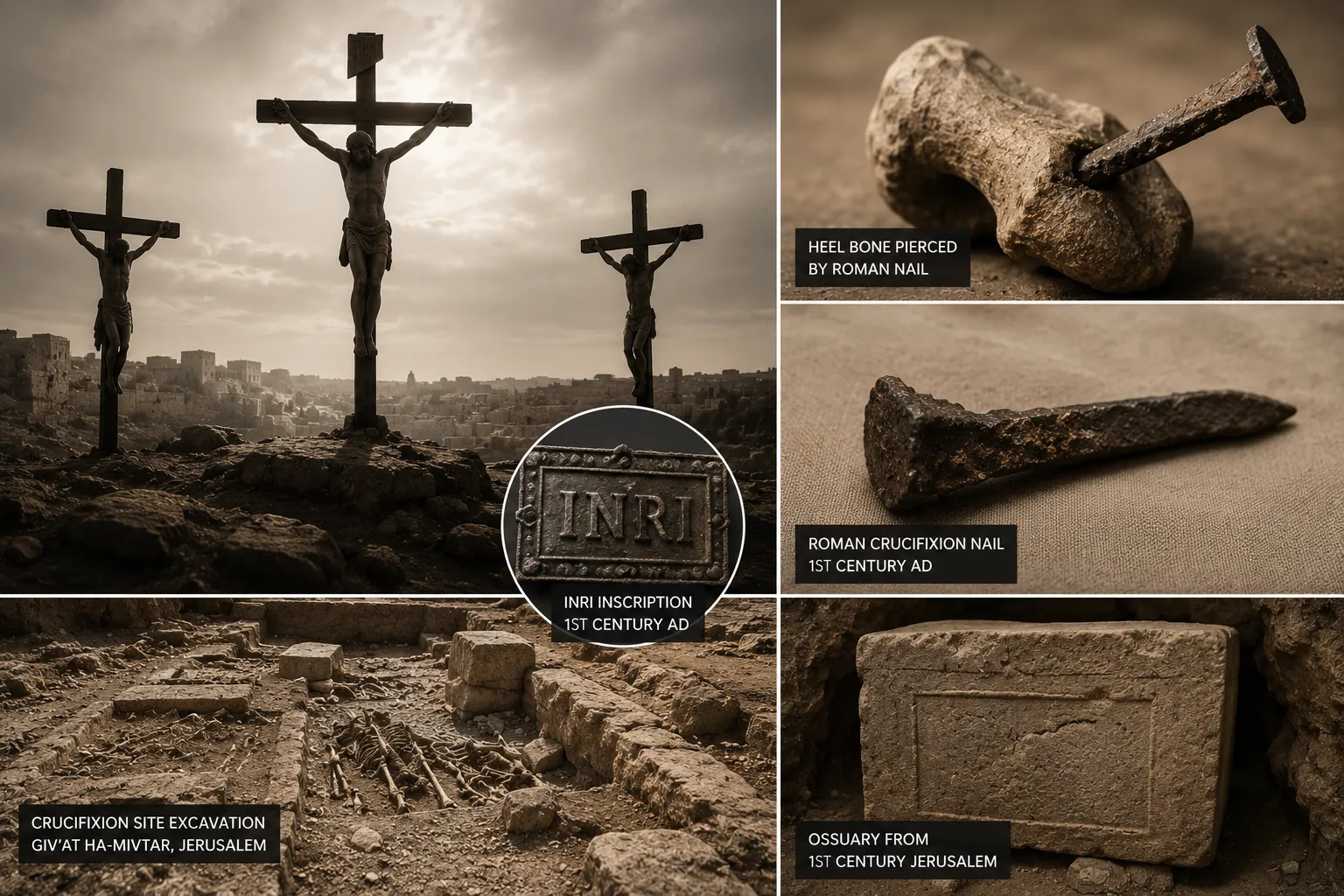
7. Archaeology Confirms Roman Crucifixion Practices
One of the strongest archaeological discoveries concerning the Gospel setting is the remains of a first-century crucified man known as Yehohanan.
His remains were discovered in a Jewish burial context near Jerusalem.
A heel bone still contained an iron nail, providing direct archaeological evidence that crucifixion was practiced in Judea during the first century.
This is important because the Gospels describe Jesus being crucified by Roman authorities.
Archaeology therefore confirms that the method of execution described in the Gospel accounts was historically practiced in the region.
However, Yehohanan was not Jesus.
8. What About Caiaphas?
The New Testament identifies Caiaphas as the high priest involved in the events leading to Jesus' death.
An ornate first-century ossuary discovered in Jerusalem bears the inscription commonly read as:
"Joseph son of Caiaphas."
Many archaeologists and historians associate this individual with the high priest Caiaphas mentioned by Josephus and the New Testament.
However, archaeological identifications should be presented cautiously because the inscription does not say "high priest" or explicitly identify the individual with the Gospel character.
The evidence is considered significant, but it should not be exaggerated.
9. What About the James Ossuary?
One of the most famous archaeological controversies involves the James Ossuary.
Its inscription was translated as:
"James, son of Joseph, brother of Jesus."
If authentic and genuinely connected with James the brother of Jesus, it would provide an extraordinary archaeological link to Jesus' family.
However, the object has a complicated history.
It was not recovered in a controlled archaeological excavation, meaning its original archaeological context is unknown. Scholars have debated the authenticity and interpretation of the inscription for years.
Therefore, it should not be presented as established proof that the box belonged to the brother of Jesus.
This is an excellent example of why archaeological evidence must be evaluated carefully.
10. Archaeology vs. Historical Evidence
It is also important to distinguish archaeology from ancient historical writings.
Some evidence for Jesus comes from ancient authors rather than excavations.
For example, the first-century Jewish historian Josephus refers to:
"James, the brother of Jesus, who was called Christ."
Modern scholarship generally regards this passage in Josephus' Antiquities as authentic.
This is historical textual evidence, not archaeological evidence.
Likewise, Roman historian Tacitus refers to Christ's execution under Pontius Pilate.
Together, archaeological and literary evidence provide different kinds of historical information.
What Can Archaeology Prove?
This is where the subject becomes especially interesting.
Archaeology can strongly support:
Nazareth existed during Jesus' lifetime.
Capernaum was an inhabited Jewish settlement.
Jewish communities lived throughout Galilee and Judea.
Synagogues existed in the region.
Pontius Pilate was a real Roman official.
Roman crucifixion was practiced in Judea.
First-century Jewish burial practices match the general Gospel setting.
Jerusalem contained extensive Jewish burial complexes and Second Temple remains.
Archaeology cannot directly prove:
Jesus' miracles.
Jesus' resurrection.
His divine nature.
Every individual event recorded in the Gospels.
That a particular archaeological object belonged to Jesus.
These questions move beyond what archaeology alone can establish.
Real-World Example
Imagine discovering an ancient battlefield.
You might uncover:
Weapons.
Coins.
Buildings.
Human remains.
Military equipment.
Those objects may prove that a battle occurred in a particular place and period.
But they may not tell you everything about what happened to every individual soldier.
Archaeology works similarly with Jesus.
It helps reconstruct the historical environment in which He lived, taught, was tried, and was crucified.
Easy Explanation
Archaeologists have not found Jesus' personal belongings or a stone saying that Jesus lived there.
Instead, archaeology has uncovered a world that closely matches the setting described in the Gospels.
Nazareth existed.
Capernaum existed.
First-century Jewish villages existed.
Pilate existed.
Roman crucifixion existed.
Jewish burial practices existed.
These discoveries help demonstrate that the Gospel accounts are rooted in a recognizable first-century historical environment.
Did You Know?
Nazareth has archaeological evidence dating to the period when Jesus would have lived there.
The Pilate Stone provides archaeological evidence for Pontius Pilate's role as Roman prefect.
A first-century crucifixion victim named Yehohanan provides direct evidence of Roman crucifixion in Judea.
The James Ossuary remains controversial and should not be treated as proven evidence connected to Jesus.
Archaeology can confirm historical settings without proving supernatural events.
The overwhelming majority of specialists in New Testament history accept that Jesus existed as a historical first-century Jewish figure.
What Do Archaeologists Actually Say About Jesus?
The most responsible conclusion is neither:
"Archaeology proves everything in the Bible."
nor:
"Archaeology has found nothing connected with Jesus."
The evidence lies between those extremes.
Archaeology has reconstructed a remarkably detailed picture of first-century Galilee and Judea that fits many aspects of the historical environment described in the Gospels.
It has also confirmed important figures, places, cultural practices, and political circumstances associated with Jesus' lifetime.
However, archaeology has not produced direct physical evidence of Jesus Himself.
That distinction is essential for responsible biblical research.
Does Archaeology Prove Jesus Existed?
Archaeology alone does not prove Jesus' existence.
The historical case for Jesus comes from multiple categories of evidence, including:
The New Testament writings.
Early Christian testimony.
Jewish historical references.
Roman historical references.
Archaeological evidence for the world in which Jesus lived.
The existence of Jesus is therefore not dependent upon finding a personal artifact belonging to Him.
As with many ancient historical figures, the evidence comes from the combined historical record.
Spiritual Reflection
Archaeology can uncover stones, buildings, inscriptions, tombs, coins, and ancient objects.
But archaeology cannot measure faith.
It cannot excavate a miracle.
It cannot put the resurrection into a laboratory.
What archaeology can do is help us understand the real historical world in which Jesus walked.
The discoveries from Nazareth, Galilee, Jerusalem, and Roman Judea provide a fascinating window into that world.
For Christians, these discoveries do not replace faith—they help illuminate the historical setting of the Gospel story.
Key Takeaway
Archaeologists have not discovered a personal artifact that conclusively proves Jesus Himself, but archaeological discoveries strongly illuminate the world described in the Gospels. Evidence from Nazareth, Capernaum, first-century Jewish settlements, Roman crucifixion practices, Jewish burial customs, and the Pilate Stone fits the historical environment of Jesus' lifetime. Archaeology therefore provides important contextual and corroborating evidence, while claims about Jesus' miracles, divinity, and resurrection belong to the larger historical and theological discussion.
📚 References
Scripture
Holy Bible, King James Version (KJV)
Matthew 2:23
Matthew 4:13–23
Mark 1:9–15
Luke 2:52
Luke 4:15–24
John 19:1–18
Archaeological & Historical Sources
Israel Antiquities Authority — Nazareth excavations
Archaeological research documenting settlement remains from the late Hellenistic and Early Roman periods.Biblical Archaeology Society — Historical Jesus research
Discussion of archaeological and extra-biblical evidence relating to Jesus.Josephus — Antiquities of the Jews, 20.200
Ancient reference to James, identified as the brother of Jesus called Christ. Modern scholarship broadly accepts this passage as authentic.James Ossuary research
Scholarly discussion of the disputed inscription and its uncertain archaeological provenance.Roman crucifixion archaeology
Archaeological discoveries of first-century crucifixion victims provide evidence for the Roman execution practice described in the Gospels.
About This Article
This article examines what archaeology can—and cannot—tell us about Jesus of Nazareth. It uses the King James Version (KJV), archaeological discoveries, ancient historical sources, and modern scholarship to distinguish between direct archaeological evidence, contextual evidence, historical testimony, and Christian theological claims.
Classification
Topic: Biblical Archaeology / Historical Jesus
Biblical References: Matthew 2:23; Matthew 4:13–23; Mark 1:9–15; Luke 2:52; Luke 4:15–24; John 19
Historical Status: Strongly Supported. Jesus is widely accepted by historians of antiquity as a real first-century Jewish figure. Archaeology provides substantial evidence for the geographical, cultural, political, and social environment described in the Gospel accounts.
Archaeological Status: Indirect but Significant. No authenticated archaeological artifact definitively identifies Jesus personally. However, excavations at Nazareth, Capernaum, Jerusalem, and other sites, together with evidence for Roman administration, crucifixion, Jewish burial, and first-century Jewish life, provide important contextual evidence.
Interpretation Status: Archaeology cannot independently establish Jesus' miracles, divine identity, or resurrection. Those claims require historical, textual, and theological evaluation beyond archaeology alone.
Editorial Note: This article is based on the King James Version (KJV), archaeological publications, ancient historical sources, and recognized scholarship. Guiding Verses distinguishes carefully between direct archaeological evidence, contextual evidence, historical testimony, and Christian theological interpretation. The goal is to present the evidence honestly without overstating what archaeology can prove.