Food During Jesus Time
In Jesus' time, what did people eat in first-century Israel?
📖 Bible Verses (KJV)
Then Jesus took the loaves, and giving thanks, he distributed them to his disciples; and the disciples to those who were seated.Then Jesus took the loaves, and after he had given thanks, he distributed them to his disciples, and the disciples to those who were seated.
— John 6:11 (KJV)
Additional Supporting Verses
They were all filled and ate.
— Matthew 14:20 (KJV)
Before them, they set before him a piece of a broiled fish, and of an honeycomb, and he did eat thereof.
— Luke 24:42–43 (KJV)
Give us this day our daily food.
— Matthew 6:11 (KJV)
📅 Approximate Year Written
* Matthew: Around AD 50–70
* Luke: Around AD 60–62
* John: Around AD 85–95
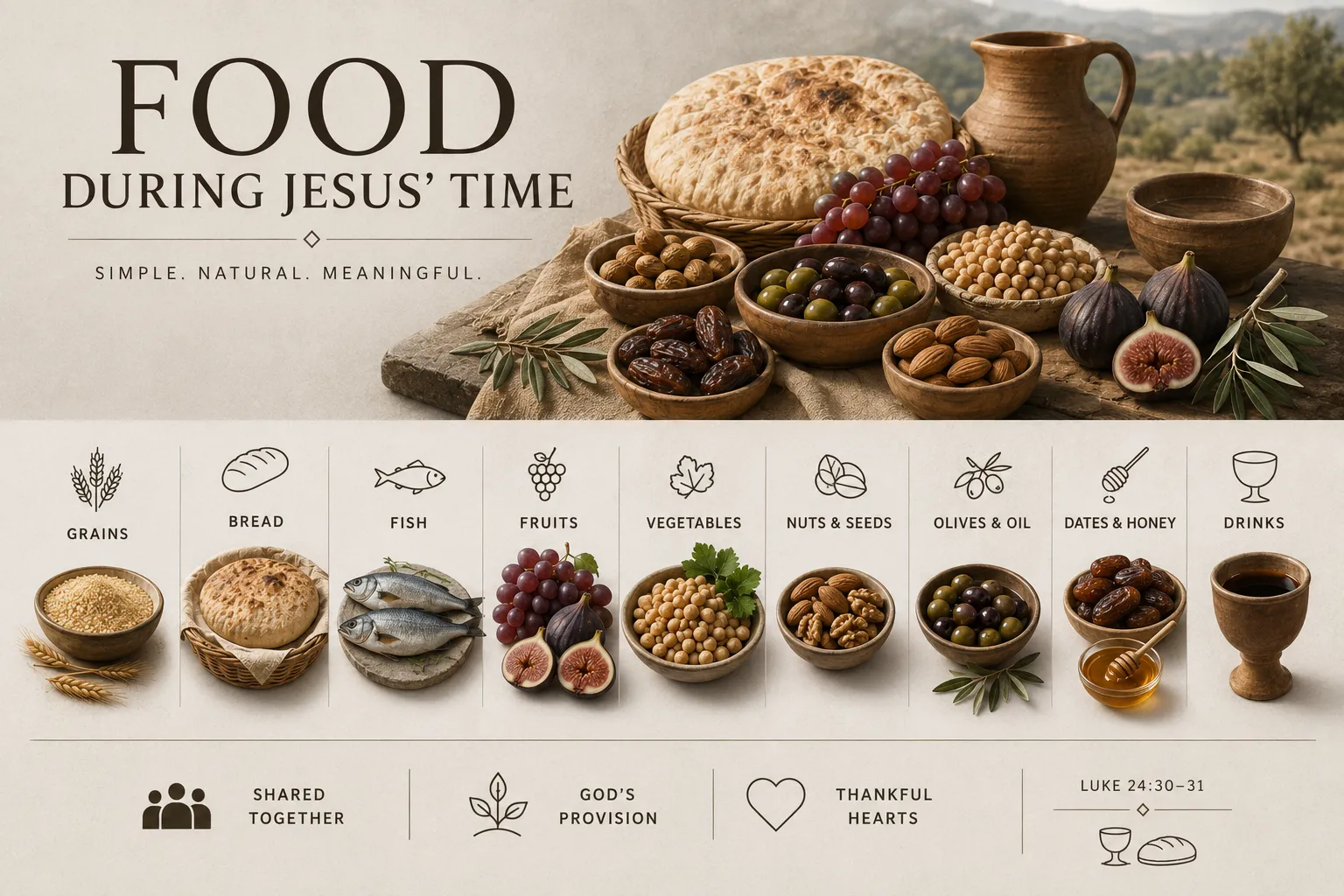
The Gospels offer numerous insights into the daily food habits of first-century Jews, and suggest a rather plain diet influenced by agriculture, fishing, Jewish law, and the seasons.
🏛️ Historical Background
The majority of the people in Judea and Galilee were farmers, fishermen, shepherds, or craftsmen during Jesus' time in this region.
They ate very basic, healthy, and locally available food.
Meat was not consumed regularly, as in modern diets. Rather, the meals served each day were based on:
* Bread
* Fish
* Fruits
* Vegetables
* Olive oil
* Dairy products
* Legumes
More extravagant meals would be served at special feasts, marriages and religious festivals.
What were the typical foods consumed?
🍞 Bread
Everyday foods were most significant in the life of bread.
Was typically composed of:
* Wheat
* Barley
Clay ovens were used for baking flat loaves.
Jesus often used bread as a means of teaching spiritual truths, calling Himself:
"The bread of life."
— John 6:35 (KJV)
🐟 Fish
In the region of the Sea of Galilee fish was a big part of life, providing a source of protein.
Peter, Andrew, James and John were all fishermen.
Fish is mentioned in the Gospels:
The miracle of the loaves and fishes.
The miraculous catch of fish.
Jesus' appearance after His resurrection and eating broiled fish.
Excavation at locations like Magdala has revealed fish processing areas that highlight the significance of fishing in the area.
🫒 Olive Oil
The oil used for was olive oil.
* Cooking.
* Dipping bread.
* Lighting lamps.
* Religious anointing.
Much of Judea and Galilee had olive groves around many villages.
The Mount of Olives was named after its many olive trees.
🍇 Fruits
Common fruits included:
* Grapes
* Figs
* Dates
* Pomegranates
Fresh fruit consumed as desired and dried fruit stored for later consumption.
In Jesus' parables he frequently speaks of a vineyard, fig trees and fruit.
🥬 Vegetables and Legumes
Meals often included:
* Lentils
* Beans
* Chickpeas
* Onions
* Garlic
* Cucumbers
* Herbs
Lentil stew is mentioned in the story of Esau and Jacob in the book of Genesis 25.
🥛 Dairy Products
People commonly consumed:
* Goat's milk
* Sheep's milk
* Cheese
Including yogurt, sauerkraut, and kefir.Such as fermented milk products (e.g., yogurt-like products).
These foods provided essential nutrients all the way throughout the year.
🍯 Honey
One of the main sweeteners of the ancient world was honey.
The famous apostle of Christ, the Baptist, was known for his diet of:
They say "Locusts and wild honey.They say: "Locusts and wild honey.
— Matthew 3:4 (KJV)
Jesus was given broiled fish and honeycomb after His Resurrection before His disciples ( Luke 24:42–43).
🍷 Wine
Wine was regularly drunk at meals, and was often diluted with water.
It was a safer drink than untreated water in many instances, and it was an integral part of Jewish celebrations.
The first miracle recorded in the Bible was when Jesus turned water into wine at the wedding at Cana (John 2).
What Archaeology has found out?
Archaeological finds from throughout Israel suggest that the early first century diet consisted of:
* Stone grain mills.
* Bread ovens.
* Olive presses.
* Wine presses.
* Fishing boats.
Fish hooks and nets.
* Storage jars.
* Animal bones.
Ancient crop seeds & pollen.
The most interesting find is the Sea of Galilee Boat, possibly a fishing boat that dates back to the time of Jesus, the first century.
These are very similar to the foods and occupations mentioned in the Gospels.
Food and Jewish Law
Jesus and His disciples were eating according to the laws concerning food that had been put in place for the people of Israel.
Unclean foods (as defined in Leviticus 11) were not eaten.
As well, meals were observed to celebrate Jewish festivals, such as:
* Passover
* Pentecost
* Feast of Tabernacles
The Last Supper was closely related to the Passover meal, to remember God's deliverance of Israel from Egypt.
Real-World Example
Picture a rural community where most of the food on your plate is grown in the local fields, vines, orchards or local lake.
Daily baking of fresh bread.
Fishing for fish is done every morning.
Domestic olive groves are used for the extraction of olive oil.
This was the normal life in which Jesus lived and ministered.
Easy Explanation
The food that people used to eat at Jesus' time was very simple and locally grown.
Bread was the main component of almost all meals.
Fish, olives, fruits, vegetables, legumes, dairy and honey rounded out a healthy diet in the Mediterranean style.
The foods mentioned in the Gospels are mentioned naturally and are part of the daily lives of these people.
Did You Know?
In a lot of cases bread was synonymous with food.
During Jesus' time, the Sea of Galilee was a prosperous fishing industry.
Olive presses and wine presses have been found in Israel all over the country and date back to the first century A.D.
The first century "Jesus Boat" offers an insight into what kinds of boats Jesus used to fish in around the time of Christ.
Many of the foods Jesus ate are still used today in the Middle East, including olives, figs, dates and lentils.
🔍 Historical and Archaeological Consensus
Using ancient documents, botanical analysis and archaeological excavations, historians and archaeologists have gradually come to know more about the daily life of the first century Israelites.
The foods mentioned in the Gospel are completely in keeping with archaeological findings.
The discovery of bread ovens, fishing gear, olive presses, wine presses, and agricultural artifacts all help confirm the historical context of Jesus' ministry.
🙏 Spiritual Reflection
Jesus was fond of using common food as a medium for his lessons on extraordinary spiritual truths.
They brought him bread, saying to Him, "Your Father's Bread.They gave Him bread, saying, "Your Father's Bread.
Wine symbolized the new covenant.
Fish started to appear as one of the miracles that spoke of His power.
Food became a time of fellowship, thanks and learning about God's Kingdom.
The dishes of Galilee remind us that God often teaches us great spiritual truths through the mundane moments of every day.
📌 Key Takeaway
The diet of Jesus' time was fundamentally Mediterranean, consisting of bread, fish, olive oil, fruits, vegetables, legumes, dairy and honey. The archaeology – from bread ovens, fishing boats, olive presses, to ancient food remains – mirrors the first century Israel described in the Bible. These common foods were also important symbols in Jesus' teaching that led people to the real spiritual things.
📚 References
Scripture
Holy Bible, King James Version (KJV)
Matthew 3:4; 6:11; 14:13–21
Mark 6:30–44
Luke 24:42–43
John 2:1–11
John 6
Leviticus 11
Archaeological Sources
Israel Antiquities Authority
Magdala excavations
Sea of Galilee Boat
Biblical Archaeology Society
Encyclopaedia Britannica – Ancient Israel
Historical Sources
New Bible Dictionary
The Baker Encyclopedia of the Bible.
Who was Jesus and why did He come?Who was Jesus and why did Jesus come?
Zondervan Illustrated Bible Backgrounds Commentary
Paul J. Achtman – Archaeology for the People of Galilee
About This Article
Here is a combination of the Bible story (KJV), finds of the times and historical scholarship to explore what Jesus ate day to day. It is an introduction to the understanding of how common meals of first-century Israel revealed the culture of the time and how Jesus employed familiar foods to deliver deep spiritual truths.
Classification
Wrapping up Biblical History & Culture.
Biblical References: Matthew 3, 6, 14; Mark 6; Luke 24; John 2, 6; Leviticus 11
Historical Status: Good sign of strength. Much can be gleaned from the archaeological evidence and the ancient history of Judea and Galilee concerning the foods, agriculture, fishing industry, and dietary habits of the first century.
The archaeological finds of fishing boats, grain mills, ovens, olive presses, wine presses, storage jars, seeds and food remains all corroborate the biblical portrayal of daily life during Jesus' earthly ministry.
Interpretation Evidence: The foods listed in the Gospels fit the time period of the first century Jewish culture. The interpretation of the use of bread and fish and wine and other foods in Jesus' time serves historical and theological purposes in the scriptural tradition.
This article is written based on the King James Version (KJV), archaeological findings, historical research and known biblical scholarship. While the biblical accounts reveal the spiritual messages transmitted, Guiding Verses is a distinction between what is well documented in history and the spiritual messages.