
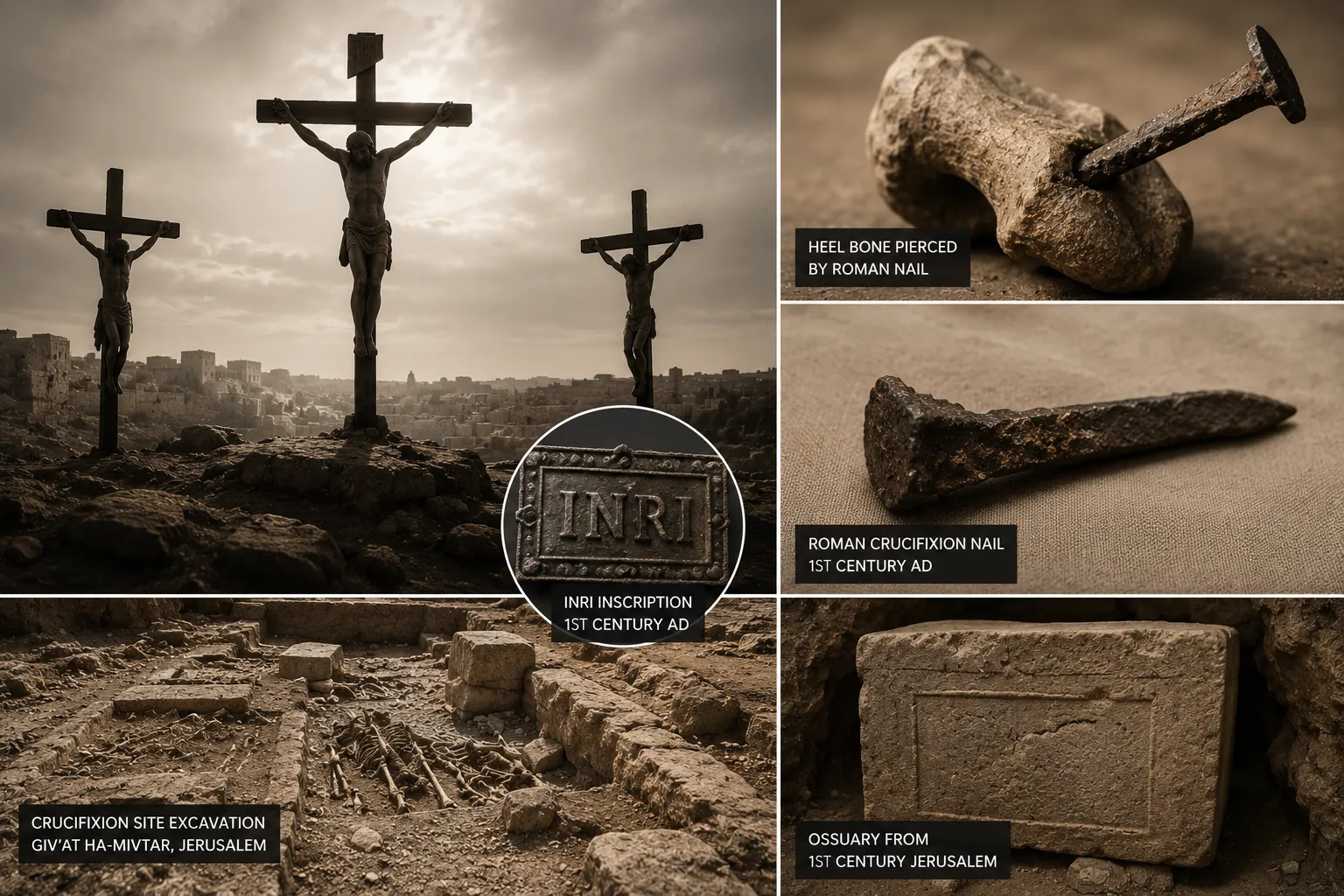
Physical Evidence of Roman Crucifixion: What Archaeology Reveals
However, there are physical clues that help us to understand the crucifixion.
📖 Bible Verses (KJV)
Now they came to the place called Calvary, there they crucified him.
— Luke 23:33 (KJV)
Additional Supporting Verses
Then he handed him over to them to be crucified. And they took Jesus, and brought him away.
— John 19:16 (KJV)
But one of the soldiers had a lance and pierced his side and immediately blood and water flowed out.
— John 19:34 (KJV)
📅 Approximate Year Written
* Luke: Around AD 60–62
* John: Around AD 85–95
The crucifixion of Jesus occurred at the time of the governorship of Pontius Pilate around AD 30-33.
🏛️ Historical Background
One of the most cruel ways of execution for the Roman Empire was crucifixion.
It was used almost exclusively by:
* Rebels
* Slaves
* Criminals
* Enemies of Rome
It was not only to be a killing mission but also a mission of public shaming and dissuasion.
The victims were often scourged, and then nailed or tied to a wooden cross and left to die over hours or days.
The crucifixion of Jesus is described in the New Testament, where he is said to have been a victim of the crucifixion during the tenure of Pontius Pilate as governor of Judea, and it is one of the most important events of history.
However, there was not much direct archaeological evidence of Roman crucifixion as Victim's nails were rarely attached to their bodies at burial and wooden crosses perish over the years.
That changed in 1968.
---
What People Believed Before the Discovery is the name of the game.This game is called What People Believed Before the Discovery.
Prior to the modern archaeological discoveries, historians knew about crucifixion chiefly from:
* Roman historical writings.
* Jewish historians.
* The New Testament.
* Ancient artwork.
There were some suspicious people who were raising questions about the details of the crucifixion as few physical remains had been found.
There is little evidence, which is understandable, because:
* Wood decomposes.
Often, iron nails were removed and reused.
Often corpses were left without their nails or with their nails unfixed.
🔬 The Discovery of Yehohanan
A Jewish tomb site at Giv'at ha-Mivtar was being excavated in 1968, and one of the most significant finds concerning Roman crucifixion was made.
They discovered the bones of a man whose name was Yehohanan, who lived in the 1st century AD.
Most remarkably, there was still an iron nail about 11.5 centimetres (4.5 inches) long sticking through his heel bone.
The nail had hit a knot in the wood and bent, thus requiring the nail to be left in place until the grave was filled.
This fortuitous preservation made the first direct archaeological proof of the crucifixion of Romans.
🦴 What the Skeleton Revealed
The remains were carefully studied by scientists and they found:
Shin splints is a large iron nail going through the heel bone.
Evidence that the feet attached to the sides of the wooden cross.
Bones of the legs broken, as in Roman times to accelerate death, known as crurifragium.
Indications that the man was buried according to Jewish ritual after his death.
The results were very similar to many ancient accounts of Roman crucifixion.
How does this connect to Jesus?
The New Testament has several things to say about Jesus' crucifixion:
After being beaten, he was crucified.
His hands and feet were nailed (from John 20:25-27).
He had already died, and His legs were not broken (John 19:33) by soldiers - prophecy was fulfilled (Psalm 34:20).
They gave him a spear in his side.
The discovery of Yehohanan does NOT prove the crucifixion of Jesus.
It shows, however, that crucifixion by nailing was a real Roman custom in Judea during the very period that is covered by the Gospels.
🚀 Additional Archaeological Evidence
Other finds which confirm the historical context are:
The Pilate Stone
The Pilate Stone, found in 1961, is a document that helps to establish the historical reality of Pontius Pilate's existence as the Roman governor who condemned Jesus.
Roman Nails
Several archaeological sites around the Roman Empire have yielded iron nails that are identical in design to those of the Romans for building and executions.
Ancient Historical Records
Jesus' crucifixion is also mentioned by non-Christian writers.
These include:
* Tacitus
* Flavius Josephus
Lucian of Samosata (indirect mention of crucifixion practice)
Archaeology and historical evidence overwhelmingly support the assumption that crucifixion was a fact and was routinely used as a means of execution in Rome.
💡 Easy Explanation
Suppose you read about an ancient execution method earmarked in many historical books.
Then, the skeletons of a man is discovered with the execution nail still in his body.
The skeleton isn't of Jesus, but it does show that the way Jesus was killed was done in that way.
🤯 Did You Know?
Yehohanan' remains are the only fully accepted skeletal remains of a crucified person from the Roman period that have been discovered with an execution nail in place.
The nail measured about *11.5 cm (4.5 inches)**.
When Christianity was legalized in the fourth century, crucifixion was abolished.
The bodies of crucified individuals were rarely given a proper burial and as a result it was possible to rarely find archaeological proof of what happened to them.
The Israel Antiquities Authority preserve the Yehohanan remains.
🔍 Historical and Archaeological Consensus
There is a general consensus among historians that crucifixion was a method of execution used in Rome.
The discovery of Yehohanan has offered direct physical proof of Roman crucifixion of people in first century Judea.
Archaeology, in conjunction with the writings of the Romans and Jewish historians and the New Testament, strongly confirms the historical setting of the crucifixion of Jesus.
Theology cannot be substantiated by archaeology, but it is a fact established by archaeology that crucifixion was a real historical practice in the time of Jesus.
🙏 Spiritual Reflection
The archaeological data reminds us of the fact that the crucifixion was not just a symbolic tale but took place in the real world of Roman history.
The cross is the symbol of the Christian faith, symbolizing God's love, sacrifice, and redemption.
The physical remains of another crucified man cannot confirm Jesus' resurrection, but they do remind us that the Gospel accounts describe events which occurred in a real historical context.
The cross is more than a means of Roman execution; it is also the focal point of Christian hope.
📌 Key Takeaway
The strong physical evidence of Roman crucifixion comes from the discovery of the crucified man Yehohanan. It, together with the other ancient historical documents and finds, like the Pilate Stone, establishes that crucifixion by the Romans was a historical fact in first-century Judea. Theology and the meaning of Jesus' death can not be determined by archaeology, but the historical background of the Gospel is firmly supported.
📚 References
Scripture
Holy Bible, King James Version (KJV)
Psalm 34:20
Luke 23
John 19
John 20:25–27
Archaeological Sources
Israel Antiquities Authority
Excavations at Giv'at ha-Mivtar, with reports:
Encyclopaedia Britannica – Crucifixion
Biblical Archaeology Society
Oxford Encyclopedia of Archaeology in the Near East
Historical Sources
Tacitus – Annals 15.44
Flavius Josephus – Antiquities of the Jews
Martin Hengel – Crucifixion
This title is available in the following format:This book is available in the following format:
About This Article
This article integrates the biblical evidence (KJV), the archaeological evidence, the Roman historical evidence and the modern scholarship to present the evidence of Roman crucifixion. It separates history from theology related to the death of Jesus Christ.
Classification
Topic: Archaeology & the Bible
Biblical References: Luke 23; John 19–20; Psalm 34:20
Historical Status: Strongly Confirmed. Much is known about Roman crucifixion from the archaeological evidence, the writings of the Romans, the Jewish historians, and the New Testament.
Archaeological Status: The first-century discovery of Yehohanan, someone who was crucified by the Romans in Judea with iron nails, offers direct physical evidence for Roman crucifixion of people in Judea. The Pilate Stone also helps to prove the historical setting of Jesus' trial.
Interpretation Status: Archaeology establishes the historical use of crucifixion but cannot establish the theological aspects of the death of Jesus, His atoning sacrifice, nor His resurrection. These are issues of the Christian faith, based upon the biblical testimony.
This article is compiled from the King James Version (KJV), archaeological evidence, Roman historical sources and reputable scholarly research. The author of Guiding Verses discerns between what has been found in history, and what has been written in Scripture as the word of God.