Nebuchadnezzar and Babylon
Nebuchadnezzar and Babylon: The King Who Conquered Jerusalem
📖 Bible Verses (KJV)
Nebuchadnezzar king of Babylon came to Jerusalem and besieged it.
— 2 Kings 24:11 (KJV)
Additional Supporting Verses
O King, you are this gold of my head.
— Daniel 2:38 (KJV)
The king Nebuchadnezzar made an image of gold.
— Daniel 3:1 (KJV)
📅 Approximate Year Written
* 2 Kings: Around 560–540 BC
* Daniel: Around 530 BC
A powerful king of the ancient world, Nebuchadnezzar II ruled the Neo-Babylonian Empire from 605 BC to 562 BC.
🏛️ Historical Background
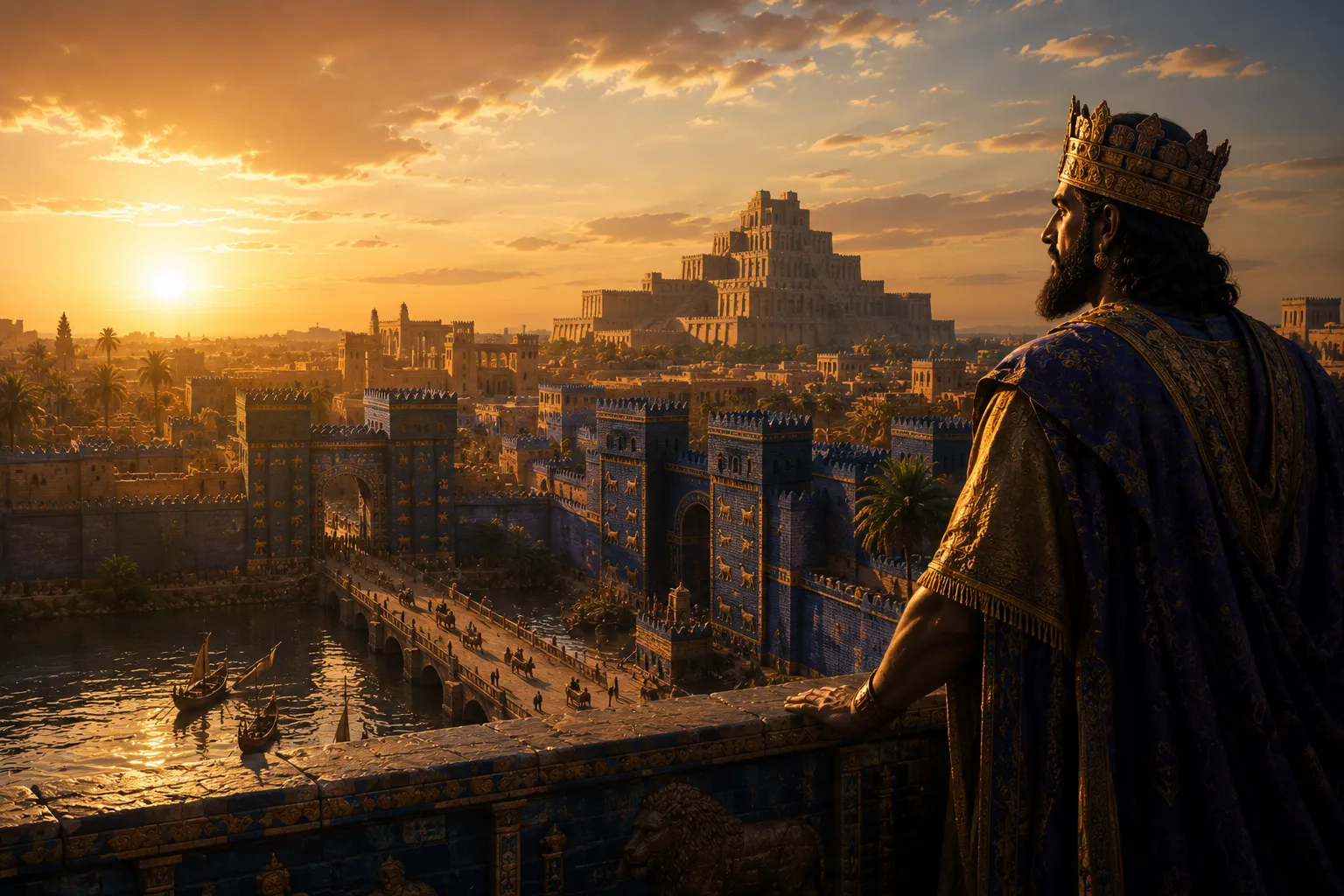
Nebuchadnezzar II was the most important of his times in Babylonian kingship. During his reign, Babylon grew to be one of the wealthiest and most splendid cities of the ancient world.
The Bible records that Nebuchadnezzar attacked the Kingdom of Judah a number of times. In the course of these campaigns, he conquered Jerusalem, took away many of its inhabitants such as Daniel and the many young captives, and eventually destroyed Solomon's Temple in 586 BC.
Nebuchadnezzar had dreams, he was proud, he was thrown into the fiery furnace, and he came to know that God rules.
In the outside scriptures, there is evidence of the existence of Nebuchadnezzar, his military campaigns, and his large building programme, in both the scriptures and in the archaeological record.
🌍 Babylon: The Greatest City of Its Time
The city of Babylon was located on the banks of Euphrates River in Iraq.
The city was renowned:
* Massive defensive walls.
* Magnificent palaces.
* The Processional Way.
* The Ishtar Gate.
* Advanced irrigation systems.
Remarkable temples to the gods of Babylon.Remarkable temples to the Babylonian gods.
The ancients associated Babylon with one of the wonders of the Ancient World.
It was the most powerful empire of the sixth century BC, spreading its influence throughout much of the Near East.
🔬 What Archaeology Has Discovered
A great amount of proof has been discovered through archaeological excavations of the existence and rule of Babylon.
The Ishtar Gate
The Ishtar Gate is one of the most well known monuments of Babylon, constructed under Nebuchadnezzar's reign.
It was decorated with beautiful blue glazed bricks and relief carvings of lions, dragons and bulls and was one of the grand entrances of the city.
Most of the re-constructed gate is now on display in the Pergamon Museum.
---
Babylonian Inscriptions
Thousands of clay tablets with Nebuchadnezzar's name have been uncovered.
These inscriptions describe:
* Construction projects.
* Religious dedications.
* Military campaigns.
* Royal achievements.
Inscriptions were used to mark many bricks used in Babylon's buildings as the work of Nebuchadnezzar.
The Babylonian Chronicles
Nebuchadnezzar was a military hero, and his successes are recorded in the Babylonian Chronicles, an ancient record of Babylonian history.
The capture of Jerusalem was recorded in a chronicle as having happened in 597 BC and this is in accord with the biblical account in 2 Kings 24.
Babylon's Ruins
Excavations have revealed:
* Palace foundations.
* Massive city walls.
* Temples.
* Streets.
* Canals.
* Administrative buildings.
The finds prove that Babylon was indeed one of the biggest cities of antiquity.
🚀 Real-World Example
Modern archaeologists still continue to work in Babylon today with the aid of the following:
* Satellite imagery.
* 3D digital reconstruction.
* Excavation records.
* Ancient inscriptions.
Climate and environmental studies.
In 2019, UNESCO marked Babylon as a World Heritage Site because of its great history and culture.
The city continues to reveal new information about its history and the ancient Near East.
💡 Easy Explanation
Suppose you read the story of a well-known emperor in an old book.
Now picture archeologists dig up his palace and the official inscriptions, his name on his bricks, military records, and the gates of his city, his capital.
This is what happened with Nebuchadnezzar.
There is a significant amount of archaeological evidence that proves Nebuchadnezzar was a real person and ruler, unlike many other ancient rulers known only from written sources.
🤯 Did You Know?
Nebuchadnezzar reigned for about 43 years.
His name is graced with hundreds of Babylonian inscriptions.
The original height of the Ishtar Gate is 12 meters (39 feet).
At its peak, the Babylon covered almost 2200 acres (900 hectares).
In 2019, Babylon was inscribed on the UNESCO World Heritage List.
---
🔍 Historical and Archaeological Consensus
The overwhelming consensus of historians is that Nebuchadnezzar II was a historical king and that the city of Babylon was the capital of the Neo-Babylonian Empire.
Inscriptional evidence, clay tablets, and monumental architecture, along with Babylonian chronicles, all support his reign and a great deal of the information found in the Bible.
Both Biblical and extra-Biblical historical evidence supports the destruction of Jerusalem in 586BC by the Babylonians.
Archaeology is not concerned with the miraculous occurrences in Daniel, but it does give us a definite historical background in which they are brought to pass.
🙏 Spiritual Reflection
Nebuchadnezzar is a powerful figure in the Book of Daniel.
But it also proclaims that the kingdom of earth is passing away and the kingdom of God will not pass away.
This is the story of Nebuchadnezzar's pride, judgment, humility and restoration. His eventual confession in Daniel 4 teaches readers that God is the only one who has authority.
Today the ruins of Babylon remind us that all empires rise and fall, yet God's purposes are timeless.
📌 Key Takeaway
Nebuchadnezzar II and the city of Babylon are among the most well attested ancient historical figures and places. The monumental architecture, royal inscriptions and histories of Babylon have been confirmed through archaeology and established as a strong historical context for the biblical narratives in Kings, Chronicles, Jeremiah, Ezekiel and Daniel.
📚 References
Scripture
* The Holy Bible in King James English (KJV)
* 2 Kings 24–25
* 2 Chronicles 36
* Jeremiah 25
* Jeremiah 52
* Daniel 1–4
* Ezekiel 1
Archaeological Sources
1. Babylon archaeological excavations
2. Ishtar Gate
3. UNESCO – Babylon World Heritage Site
4. Dictionaries and encyclopedias – Nebuchadnezzar II
This is the title for an encyclopedia of archaeology in the Near East published by Oxford University Press.
Historical Sources
1. Babylonian Chronicles
2. New Bible Dictionary
3. Zondervan Illustrated Bible Backgrounds Commentary
4.The Archaeological Study Bible.
5. British Museum – Babylonian Collections
Classification
Topic: Archaeology & the Bible
The Bible is used twice.There are two uses of the Bible: 2 Kings 24-25, Dan 1-4, Jer 25, Ezek 1.
Historical Status: Strongly Confirmed. Extensive archaeological discoveries and ancient historical records corroborate the existence of Nebuchadnezzar II, Babylon, and the Babylonian conquest of Judah.
There is no lack of evidence in the form of the Royal inscriptions, monumental buildings, the Babylonian Chronicles and excavated remains to show the power and importance of Nebuchadnezzar's reign and of Babylon.
Interpretation Status: Historical context of the biblical story is confirmed by archaeology. The 'miracles' recorded in the book of Daniel like the fiery furnace and Nebuchadnezzar's divine assignment to madness are all theological statements that cannot be confirmed or refuted by archaeology.
The Editor has used the King James Version (KJV), the records of the Babylonians, the evidence of the diggings and the recognized historical scholarship. Guiding Verses distinguishes between history as a fact, archaeology, and the theological message of the biblical text.