Pharaohs Mentioned in Scripture
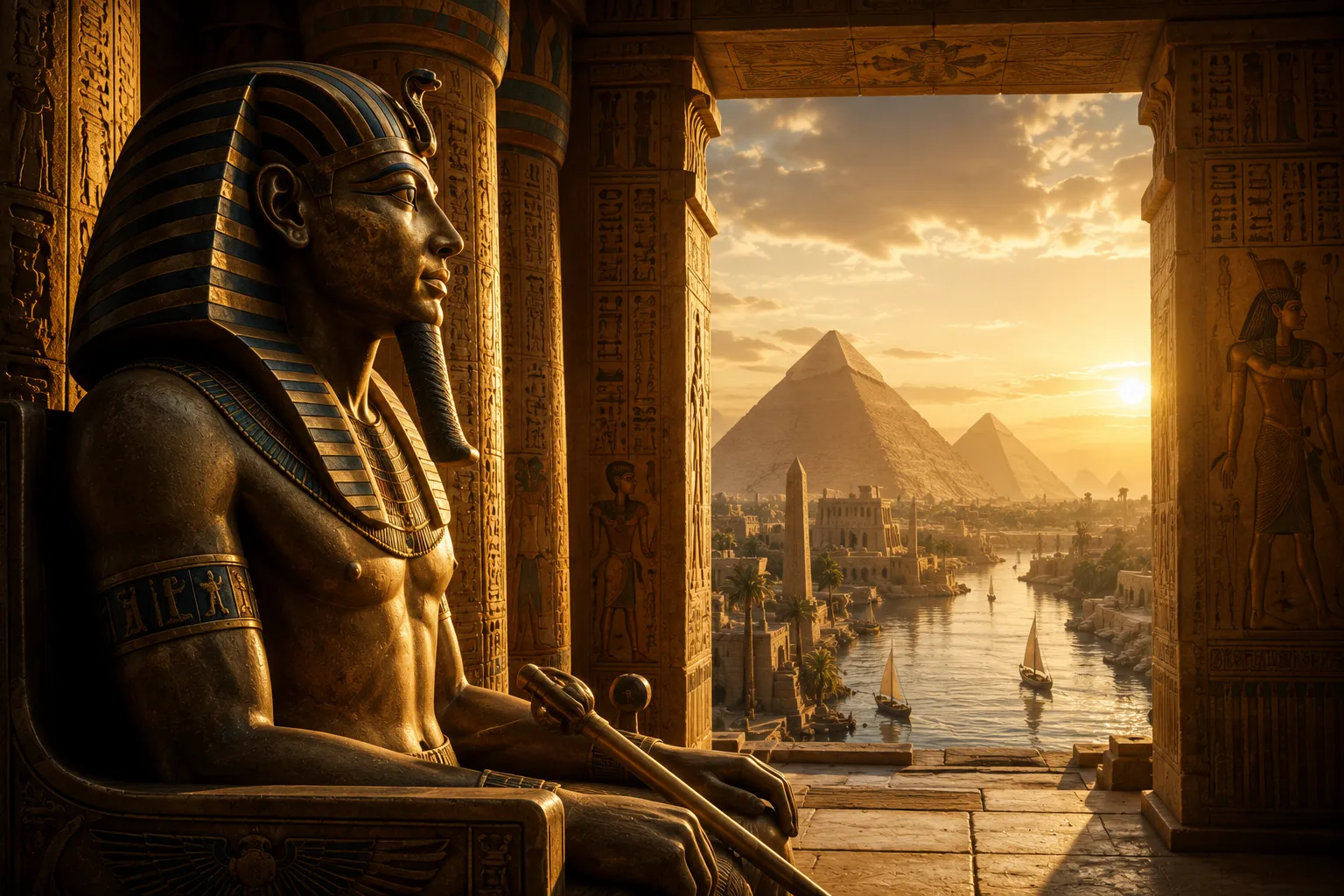
These are the Egyptian Kings of the Bible also known as the Pharaohs mentioned in Scripture.
📖 Bible Verses (KJV)
When Joseph died, and all his brethren, and all that generation; there arose up a new king over Egypt, which knew not Joseph.
— Exodus 1:6, 8 (KJV)
Additional Supporting Verses
Then Pharaoh's daughter said to her, "Take this child away, and nurse him for me...
— Exodus 2:9 (KJV)
The words of the LORD God of Israel: "Let my people go...
— Exodus 5:1 (KJV)
📅 Approximate Year Written
* Genesis & Exodus: Around 1445–1400 BC
* Kings & Chronicles: Around 560–430 BC
* Prophets: Between 750–570 BC
Egyptian pharaohs are mentioned in the Bible over a period of more than 1000 years, starting from Abraham to the days of Jeremiah.
🏛️ Historical Background
The ancient Egyptian civilization was a great civilization, lasting more than 3000 years.
It was ruled by a succession of Pharaohs meaning "Great House" (the royal palace) and later the king.
Egypt has been a large part of the Bible:
During a time of famine, Abraham went there.
Egypt's second ruler was Joseph.
During the Exodus, Moses faced Pharaoh.
Solomon was married to an Egyptian princess.
Judah had several kings who were in battle against Egyptian armies.
After the Fall of Jerusalem, the prophet Jeremiah lived in Egypt.
The Biblical history took place at times when Egypt was one of the major superpowers of the world.
🌍 Why Doesn't the Bible Usually Name Pharaohs?
The name of pharaohs is not often mentioned in the Bible.Usually, the name of pharaohs does not show in the Bible.
A question frequently asked is why many of the Pharaohs are called "Pharaoh" and not their name?
This was the common practice in the ancient Near East.
Just as modern people say:
* "The President"
* "The Pope"
* "The King"
The term "Pharaoh" is frequently used as the royal title in the Bible.
In many Egyptian documents this style was employed as well.
🔬 Pharaohs Associated with the Bible
Abraham comes to Pharaoh.Abraham visits Pharaoh.
Genesis 12
The Bible tells us that Abraham went to Egypt during a time of famine.
The name of the Pharaoh is not mentioned.
Historians are not certain that they can identify this ruler.
The Pharaoh in Joseph's Ascension
Genesis 41
Joseph explained Pharaoh's dreams and was appointed as governor over Egypt.
As before, Scripture does not mention the name of the king.
There are a number of proposed Egyptian rulers, but none has been agreed upon.
A king, or ruler, in ancient Egypt.One of the rulers of ancient Egypt.
Pharaoh of the Exodus
Exodus 5–14
The most popular Pharaoh in the book of Scripture is the one who denied Moses' request to let Israel go.
There is no mention of his name in the Bible.
There are several candidates for the question, including:
* Ramesses II
* Merneptah
* Amenhotep II
* Thutmose III
One of the most controversial issues in biblical archaeology is the correct identification.
Pharaoh Shishak
This Pharaoh was named, unlike previous rulers.
According to the Bible, Shishak attacked Jerusalem in the time of King Rehoboam.
Most historians believe that the Shishak is the same person as the Shoshenq I.
This identification is substantiated by Egyptian inscriptions that refer to campaigns into Canaan.
Pharaoh Necho II
2 Kings 23
According to the Bible, Pharaoh Necho fought the battle of Megiddo against King Josiah.
The ruler is named after a historical personage, Necho II.
Pharaoh Hophra
Jeremiah 44
Pharaoh Hophra (also called Apries) is mentioned in the prophet Jeremiah.
His reign is confirmed by the work of Greek historians and Egyptian records.
🚀 What Archaeology Has Discovered
Egypt is one of the well documented oldest civilizations.
Archaeologists have uncovered:
* Royal palaces.
* Temples.
* Tombs.
* Statues.
* Thousands of inscriptions.
* Administrative papyri.
* Military records.
* Monumental architecture.
These are all proof of the existence of many pharaohs who are referred to or connected with the biblical history.
For example:
On the Karnak Relief, Shoshenq I is shown making his military excursion to Judah.
The inscriptions of Necho II and Apries (Hophra) are verified in Egyptian inscriptions.
The earliest extra-biblical mention of Israel is on the Merneptah Stele (c. 1208 BC), which describes the existence of a people known as Israel in Canaan by the end of the 13th century BC.
💡 Easy Explanation
Suppose you read a book about the history of the United States of America and found that they call the President "the President".
Historians can, in part, identify which president is being discussed if they come across official government records later.
Many Egyptian rulers do much the same as the Bible.
There are a number of pharaohs that are not named, but several are known from inscriptions, monuments, and history by archaeology.
🤯 Did You Know?
The rule of Ancient Egypt stretched for more than than 30 dynasties.
In history, Egypt witnessed the reign of more than 170 pharaohs.
The Merneptah Stele is the oldest known non-biblical mention of Israel.
There is evidence of Pharaoh Shishak's invasion of Judah in both the Egyptian inscriptions and the Bible.
The region of Egypt is among the world's most rich in archaeological sites.
🔍 Historical and Archaeological Consensus
Historians have found that Egypt's rulers matched well-known time periods and that many of the events recorded in the Bible that involved Egypt matched well known time periods.
There are a number of pharaohs that are securely identified by archaeology and history: Shishak, Necho II, and Hophra.
The names of the Pharaohs whose history is told in the Bible, both during Joseph's lifetime and at the time of the Exodus, are not certain due to the lack of personal names in the scriptures.
Consequently, scholars are still considering biblical chronology along with Egyptian history.
🙏 Spiritual Reflection
Egypt is a place of refuge and a place of oppression throughout Scripture.
God used Joseph to save lives in Egypt and then used Moses to save Israel from slavery.
The continual mention of the rulers of Egypt reminds the reader that even the mightiest earthly kingdoms are under God.
The Bible states clearly that there exists a divine plan behind the course of history, even though Pharaohs have built great empires.
📌 Key Takeaway
There are many Pharaohs referred to in the Bible, through a span of over 1,000 years. The names of several rulers, such as Shishak, Necho II and Hophra have been identified by archaeology, and others are still debatable, particularly the Pharaoh of the Exodus. Biblical texts and archaeological finds yield a rich historical setting for many of the significant events in Scripture.
📚 References
Scripture
Holy Bible, King James Version (KJV)
Genesis 12
Genesis 41
Exodus 1–14
1 Kings 3
1 Kings 11
2 Chronicles 12
2 Kings 23
Jeremiah 44
Ezekiel 29–32
Archaeological Sources
British Museum – Egyptian Collections
The inscriptions of the Karnak Temple Complex
Merneptah Stele
The Encyclopedia Britannica – Ancient Egypt
Oxford Encyclopedia of Ancient Egypt
Historical Sources
New Bible Dictionary
The Archaeological Study Bible
On the Reliability of the Old Testament is a book by Kenneth A. Kitchen.On the Reliability of the Old Testament is the book written by Kenneth A. Kitchen.
Zondervan Illustrated Bible Backgrounds Commentary
About This Article
This article integrates biblical history (KJV), Egyptian archaeology and history with the Pharaohs in Scripture. It separates rulers that can be substantiated with historical proof from those whose identities are not certain.
Classification
Topic: Archaeology & the Bible
For further information, check out the following books of the Bible:
Historical Status: Strongly Confirmed. The history of ancient Egypt is well documented by inscriptions, monuments and historical accounts, and many of the Pharaohs are named in Scripture.
Archaeological status: The names of Shishak (Shoshenq I), Necho II and Hophra (Apries) of the pharaohs have been confirmed via archaeology. It is not known what the two Pharaohs of the Exodus and Joseph's Pharaoh were called, and there are several different scholarly suggestions about their names.
Interpretation Status: Egypt was identified by archaeology and many of the biblical rulers have been identified, but some Pharaohs have not been linked to a specific name because they were never mentioned by name in the Bible.
This article has been prepared using the King James Version (KJV), archaeological finds in Egypt, ancient inscriptions and scholarly works. Guiding Verses distinguishes between historical facts established in the past, scholarly historical reconstructions and questions that are open to further research.