The Pool of Bethesda Discovery
Archaeology and the Gospel of John: Did Archaeology Confirm the Gospel of John?
📖 Bible Verses (KJV)
Now there was at Jerusalem by the sheep market, a pool, which is called in the Hebrew tongue, Bethesda, having five porches.
— John 5:2 (KJV)
Additional Supporting Verses
Jesus says to him, "Get up, pick up your bed, and walk.
— John 5:8 (KJV)
The man was instantly healed, and picked up his bed, and walked.
— John 5:9 (KJV)
📅 Approximate Year Written
Around AD 85–95
The fourth gospel, John, was one of the latest of the first century AD, and includes specific references to locations in Jerusalem where Jesus performed miracles.
🏛️ Historical Background
One of Jesus' most famous miracles took place in the Pool of Bethesda.
Jesus came to Jerusalem, during a Jewish festival, and met a man who had been unable to walk for 38 years (John 5). The man was by the Pool of Bethesda, where people used to come and get healed.
Jesus only said to him:
Get up and move about, pick up your bed and go.
The man was miraculously cured.
Many critics doubted the existence of the Pool of Bethesda described by John, for centuries. Some people thought that John made up his location as there was no pool like this found.
This all changed in the 19th century when archeologists explored the area.
The pool was once rumored to be a pig farm.
The Pool of Bethesda has five porches, says John.
Historians were baffled by this unique feature of architecture.
Most ancient pools were rectangular in shape with four paving walks—the first walkway, or paving frame, along each side.
Some scholars suggested that John's description of five porches was symbolic, rather than historical, as there was no known pool that had five porches.
Because of the lack of archaeological evidence, many 19th century critics doubted the accuracy of John's Gospel.
🔬 What Archaeology Has Discovered
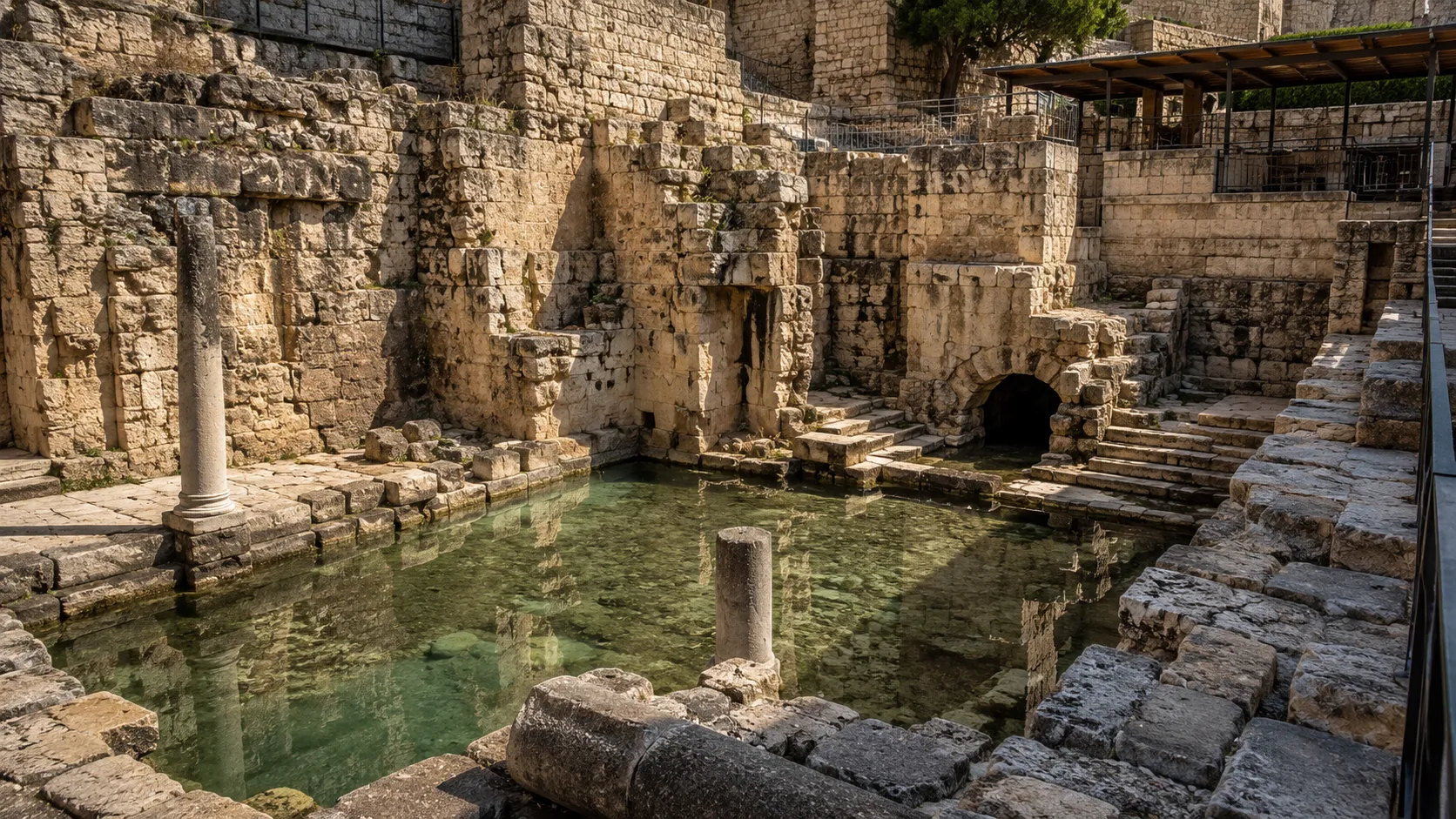
An ancient pool complex was discovered in the late 1800s during excavations around the monastery of Saint Anne.
The discoveries included:
Two large, adjacent pools.
A dividing wall (or dike) separating them in the middle.
Pools surrounded by colonnade.
A 5th colonnade constructed on the central dividing wall.
This is a rare design that fits John's description of the pool being "five porches.
The site was in use during the Second Temple period and into Jesus' time.
The remains of the Pool of Bethesda in Jerusalem can be visited today.
🏺 Additional Discoveries
The site was also found to have links to healing.
The area contained:
* Roman-period structures.
After the Romans took over Jerusalem, a shrine was dedicated to the healing god Asclepius.
Water reservoirs that were used over many centuries.
These revelations may account for the reason that so many sick people were found there as recorded in the Gospel of John.
The older pool complex was constructed in the first century AD, although the additions are later Roman.
🚀 Real-World Example
The Pool of Bethesda was one of several places mentioned in the New Testament that had been doubted but ultimately proven from archaeological finds.
Other examples include:
The *Pool of Siloam**, rediscovered in 2004.
The Pilate Stone, found in 1961, establishing the historical existence of Pontius Pilate.
The Corinthian inscription of Erastus, who is mentioned in Romans 16:23.
These finds continue to bring to light the historical context of the New Testament.
💡 Easy Explanation
Suppose you read a diary of an old building that has a strange design.
No one has been able to locate it for hundreds of years.
Then, archaeologists discover just that structure – and it matches the description of the building in surprising detail.
That's what happened to the Pool of Bethesda.
This discovery was not proof of the miracle itself, but it certainly confirmed that John was correct in his description of a real place in ancient Jerusalem.
🤯 Did You Know?
The Pool of Bethesda was located close to The Sheep Gate, near Jerusalem.
The healed man was suffering from a disability for a period of 38 years.
For centuries, the scholars were bewildered by the peculiar structure of the pool called "five-porch.
Today the remains of the excavation are open to visitors.
This is considered one of the most significant archaeological substantiation of John's comprehensive knowledge of Jerusalem.
The consensus of the historians and archaeologists is to this day.
The majority of historians and archaeologists are convinced that the excavated site near the Church of Saint Anne is the Pool of Bethesda, mentioned in the Gospel of John 5.
The discovery substantiated some of the information given in the Gospel:
It is located close to the Sheep Gate.
Its presence in the 1st century.
Its oddball design consisting of five porches.
Archaeology can not prove the miracle, but it is very convincing that the geographical setting John described was accurate.
The Pool of Bethesda is now regarded as one of the clearest New Testament cases of archaeology establishing a particular location.
🙏 Spiritual Reflection
Readers are reminded by the discovery of the Pool of Bethesda that the Gospels are based on real places and real history.
More importantly, the miracle related there is a testimony of Jesus' heart and power.
Many were waiting at the pool hoping to be healed but Jesus showed that the healing was available only in Him.
The archaeological find enables an appreciation of the historical context and the biblical message remains to draw readers to Christ.
📌 Key Takeaway
In fact some critics rejected the Pool of Bethesda because they could not locate a matching site. Later archaeological digs did find a pool complex at the site, dating back to the first century, with the precise five-porch plan of John's Gospel. Archaeology can't prove the miracle that took place there, but it does strongly confirm that the Gospel of John recorded correctly the location where Jesus healed a man who had been disabled for 38 years.
📚 References
Scripture
This is a copy of the Holy Bible, King James Version (KJV)
* John 5:1–18
Archaeological Sources
Excavation reports from the pool of Bethesda.
2. Church of Saint Anne
3. Israel Antiquities Authority
4. Encyclopaedia Britannica – Bethesda
5. Biblical Archaeology Society
Historical Sources
New Bible Dictionary
Zondervan Illustrated Bible Backgrounds Commentary
The Archaeological Study Bible
Oxford Encyclopedia of Archaeology in the Near East
About This Article
This article uses the Bible (KJV), archaeological finds and historical scholarship to look at the Pool of Bethesda. It separates the evidence of the historical location from the miraculous event that is written in Scripture.
Classification
Topic: Archaeology & the Bible
Biblical References: John 5:1–18
Historical Status: Strongly Confirmed. Archaeological excavations in Jerusalem have identified the Pool of Bethesda mentioned in the John's Gospel.
The archaeological status is: the excavations have established the presence, location and unique design with 5 porches of the pool as described by John. The results of these studies are generally accepted by the scholars.
Interpretation Status: Evidence of the historical setting of the miracle is confirmed by archaeological evidence, but not the healing itself. The miracle is still a mystery of faith, as stated in the Gospel of John.
The text for this article has been taken from the King James Version (KJV), archaeological excavation reports and recognized historical scholarship. Guiding Verses is clear between what is found in archaeology and what is found in the written Word.