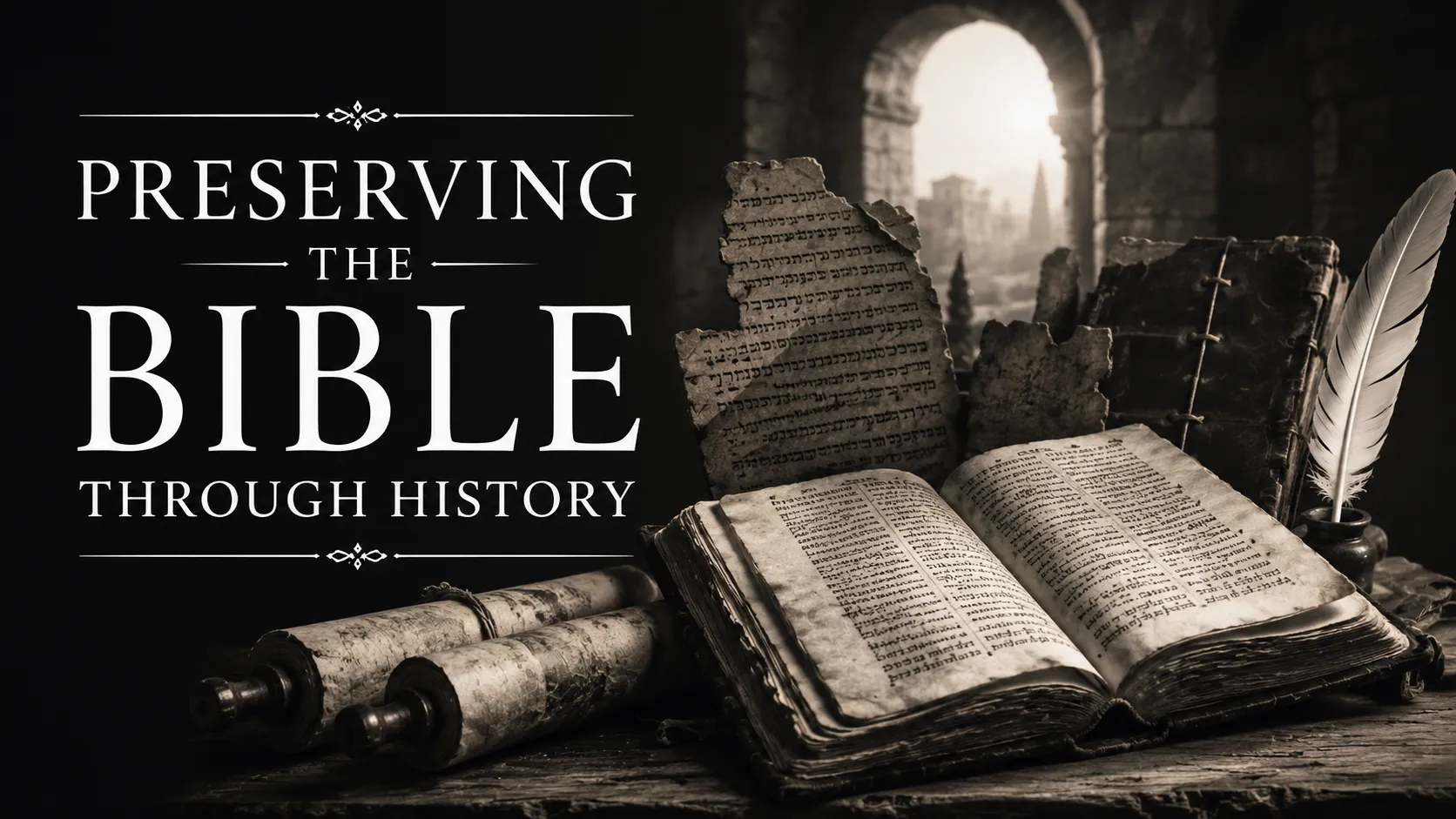
Preserving the Bible Through History
Preserving The Bible Through History: How God's Word has been faithfully transmitted through the centuries
📖 Bible Verses (KJV)
The grass withers, the flower fadeth: but our word endureth for ever.
— Isaiah 40:8 (KJV)
Additional Supporting Verses
Heaven and earth shall pass away, but my words shall not pass away."
— Matthew 24:35 (KJV)
All Scripture is inspired by God. . . .
— 2 Timothy 3:16 (KJV)
"For the word of God is quick, and powerful..."
— Hebrews 4:12 (KJV)
📅 Approximate Year Written
Isaiah: Around 740–700 BC
Matthew: Around AD 50–70
2 Timothy: Around AD 64–67
Hebrews: Around AD 60–70
Written over some 1500 years by over 40 writers, the Bible has been preserved remarkably well through careful copying, translation and transmission. It is still the most widely distributed, and translated, book in history today.
🏛️ Historical Background
Prior to the invention of printing, each and every Bible copy would have to be handwritten.
In ancient times the scribes would work long hours, copying scriptures meticulously.
The Old Testament was copied by Jewish scribes, and the New Testament by early Christian scribes who spread the writings around the Roman Empire.
Despite centuries of wars, persecution, natural disasters, and attempts to destroy the Scriptures, the Bible has continued to be preserved.
The Old Testament has been preserved in how? 🌍
Jewish Scribes
The Jews considered the writings of the Bible to be the word of God.
Each book was carefully copied by scribes, who were professional.
They established very careful procedures to minimise copying errors such as:
Counting letters and words.
Checking each completed manuscript.
Making comparisons between new copies and known examples.
Disposal of manuscripts with serious copying errors.
These practices resulted in the preservation of the Hebrew Scriptures with an amazing degree of accuracy.
The Dead Sea Scrolls
The discovery in 1947 was one of the greatest of all discoveries concerning the Bible and its associated history.
Heralds of the Holy Family found hundreds of ancient scrolls near Qumran Caves.
These were called the Dead Sea Scrolls.
Portions of almost all the books of the Old Testament are included.
The famous Great Isaiah Scroll, written around 125 BC, is very similar to the traditional Hebrew which was copied more than a thousand years later.
This finding proved how stable and stable the text of the Old Testament was over the course of many centuries.
✝️ How Was the New Testament Preserved?
The NT books were originally written in the Koine Greek.
Rapidly, the early Christians made copies, as churches throughout the Roman Empire sought to read the apostles' writings.
Those are some of the types of studies that are now available to scholars:
Over 5,800 copies of the Greek New Testament.
Over 10,000 Latin manuscripts.
Thousands more manuscripts in Syriac, Coptic, Armenian, Ethiopic and other ancient languages.
This is the best attested of all the New Testament texts, by far, of the ancient literature.
📜 Early Bible Manuscripts
Some of the most important surviving biblical manuscripts include:
Codex Sinaiticus
It was made in the 4th century AD and it has almost the full text of the Bible in Greek.
Codex Vaticanus
This is one of the most valuable and oldest Greek Bible manuscripts.
Codex Alexandrinus
Another important early witness to the biblical text.
These manuscripts enable scholars to make thousands of copies and pinpoint small differences in copying and to establish the original wording with a very high level of confidence.
🔬 Did Copying Errors Occur?
Yes.
There were slight differences in the text naturally; manuscripts were written by hand.
Most involve:
Spelling differences.
Word order.
Words repeated or words that have been omitted.
Minor grammatical changes.
Importantly:
Most of these differences don't impact on any central Christian belief.
Modern translations of the Bible are not derived from a single manuscript, but from thousands of manuscripts.
The study of such manuscripts is known as the textual criticism, and is a scholarly endeavor aimed at finding the wordings of the biblical text as they are earliest possible.
🌍 The Printing Press Changed Everything
Johannes Gutenberg invented the movable type printing press in the 15th century.
In 1455, the Gutenberg Bible was one of the first European books to be printed.
When it came to Bible printing, it opened the door to the Bible for the masses and made the chance of a copy error becoming part of the text unlikely.
🌐 Bible Translation Through History
The Bible was translated into a wide variety of languages as Christianity spread.
The following are some of the significant points:
The Septuagint (LXX) – Greek translation of the Old Testament (3rd – 2nd century BC).
The Vulgate – the Latin translation by Jerome (late 4th century AD).
The King James Version (KJV) – The first version of the KJV was published in 1611, and it was one of the most influential versions of the Bible in English.
Today, the Bible is available in full or in part in thousands of different languages, so that people all over the world can read the Bible in their native language.
🚀 Real-World Example
Think of a priceless historical document which has been copied thousands of times in many countries.
If there was a little bit of error in one copy, it could be compared with hundreds or thousands of copies to find out the original wording.
The study of biblical manuscripts is precisely what it is today.
This is possible in part because there are still many manuscripts available, allowing scholars to assess the variations in the text with great accuracy.
💡 Easy Explanation
Long before printing was invented, faithful scribes preserved the Bible.
Because there were thousands of manuscripts, from various times and areas, scholars have been able to make comparisons of copies and discover small differences.
The Dead Sea Scrolls are among the archaeological finds that validate the transmission of the biblical text over many centuries.
🤯 Did You Know?
It took almost 1,500 years for the Bible to be written.
The manuscripts in the Dead Sea Scrolls are over 2000 years old.
Today, we have over 5,800 Greek New Testament manuscripts.
The King James Version, edited in 1611, is one of the most significant English versions.
The Bible has been translated into the most languages in the world.
🔍 Historical and Scholarly Consensus
Historians and textual scholars broadly agree that the Bible is one of the best-preserved collections of ancient writings.
Although minor copying variations exist, the wealth of surviving manuscripts allows scholars to reconstruct the biblical text with a very high degree of confidence.
Archaeological discoveries—including the Dead Sea Scrolls—have significantly strengthened confidence in the faithful transmission of the Old Testament.
Christians understand this preservation as consistent with God's providential care for His Word.
🙏 Spiritual Reflection
Throughout history, kingdoms have risen and fallen, libraries have burned, and governments have attempted to suppress Scripture.
Yet the Bible has endured.
For believers, this preservation reflects not only the dedication of countless scribes and translators but also God's faithfulness to His promise that His Word would endure.
As Jesus declared:
"Heaven and earth shall pass away, but my words shall not pass away."
**— Matthew 24:35 (KJV)
God's Word continues to guide, encourage, and transform lives across every nation and generation.
📌 Key Takeaway
The Bible has been faithfully preserved through centuries of careful copying, translation, and scholarship. From Jewish scribes and the Dead Sea Scrolls to early Christian manuscripts and the invention of the printing press, history demonstrates the remarkable transmission of Scripture. While minor copying variations exist, the abundance of ancient manuscripts provides strong historical confidence that the Bible we read today faithfully reflects the original writings.
📚 References
Scripture
Holy Bible, King James Version (KJV)
Isaiah 40:8
Matthew 24:35
2 Timothy 3:16–17
Hebrews 4:12
Psalm 119:89
Historical Sources
The New Bible Dictionary
Baker Encyclopedia of the Bible
The Text of the New Testament
Revisiting the Corruption of the New Testament
The Canon of Scripture
Archaeological Sources
Dead Sea Scrolls
Qumran Caves
Codex Sinaiticus
Codex Vaticanus
About This Article
This article explores how the Bible has been preserved throughout history using the King James Version (KJV), archaeological discoveries, manuscript evidence, and recognized textual scholarship. It distinguishes between historical evidence for the transmission of the biblical text and the theological belief that God has preserved His Word.
Classification
Topic: Bible History / Biblical Manuscripts
Biblical References: Isaiah 40:8; Matthew 24:35; 2 Timothy 3:16–17; Hebrews 4:12; Psalm 119:89
Historical Status: Strongly Supported. The transmission of the biblical text is extensively documented through thousands of ancient manuscripts, early translations, and centuries of scribal practice.
Archaeological Status: Discoveries such as the Dead Sea Scrolls and early codices provide strong evidence for the careful preservation of the Scriptures and are among the most significant archaeological finds related to the Bible.
Interpretation Status: Historians and textual scholars broadly agree that the biblical text has been transmitted with remarkable fidelity despite minor manuscript variations. Christians further understand this historical preservation as consistent with God's providential care for His Word.
Editorial Note: This article is based on the King James Version (KJV), archaeological discoveries, manuscript evidence, and recognized biblical scholarship. Guiding Verses distinguishes between historical facts, textual research, and theological interpretation while presenting the remarkable story of how the Bible has been preserved through history.