The History of Bible Translation
The History of Bible translation: How God's Word Reached the World
📖 Bible Verses (KJV)
The words of the LORD are pure words: as silver tried in a furnace of earth, purified seven times.
— Psalm 12:6 (KJV)
Additional Supporting Verses
In answer, he said: "Heaven and earth shall pass away, but my words shall not pass away.
— Matthew 24:35 (KJV)
“Go and make disciples of all nations…”
— Matthew 28:19 (KJV)
📅 Approximate Year Written
* Psalm 12: Around 1000 BC
* Matthew: Around AD 50–70
About 40 different authors, inspired by God, wrote the books of the Bible over about 1500 years of time, from about 1400 BC to AD 95.
---
🏛️ Historical Background
The Bible did not originally come in English.
Rather its books were written in three ancient languages:
Hebrew (Matthew, Mark, Luke and John)
Aramaic (Daniel and Ezra)
Greek: The whole New Testament (the entire New Testament)
These writings have been copied by hand onto scrolls of papyrus and parchment for centuries. In ancient times, when there was no printing press, each copy had to be painstakingly handwritten by trained scribes.
After Christianity spread beyond Israel, believers began to require a translation of the Scriptures into a language that they could understand. With the passage of time, the Bible became the most translated book in the history of mankind and most distributed.
We begin by looking at the timeline of Bible translation.First, let's examine the timeline of Bible translation.
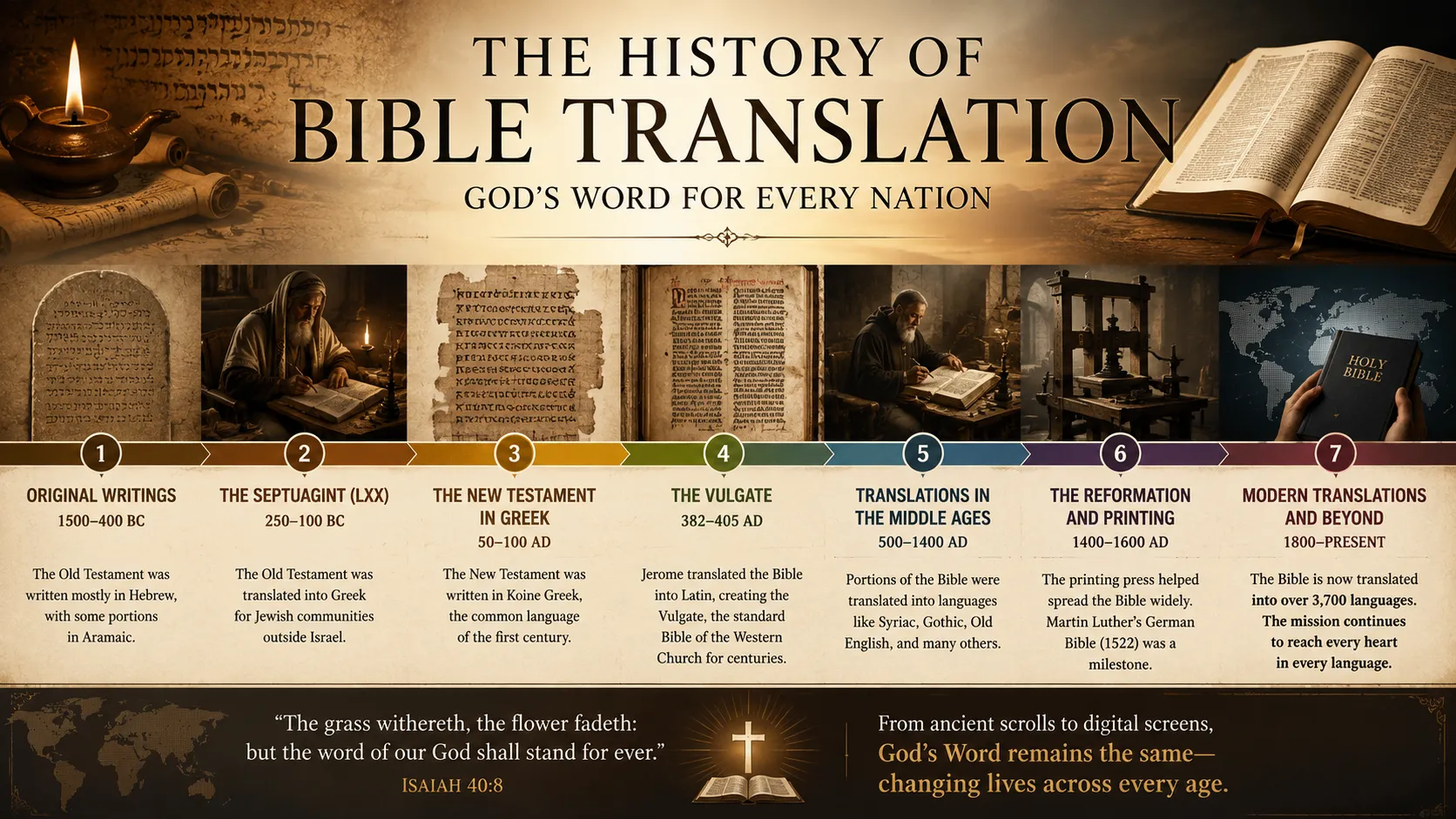
📜 Around 250–100 BC – The Septuagint (LXX)
As many Jews began speaking Greek instead of Hebrew, scholars in Alexandria, Egypt, translated the Old Testament into Greek.
During Jesus' and the apostles' day, this translation was commonly used and became known as the Septuagint (LXX). The New Testament contains numerous quotations from the Old Testament which are very similar to the Septuagint.
📜 Around AD 382–405 – The Latin Vulgate
Jerome translated the Bible into Latin at the request of Pope Damasus I.
It was known as the Latin Vulgate, and was the standard Bible used for over a thousand years by western Christianity.
📜 Around AD 1382 – The Wycliffe Bible
John Wycliffe, with his followers, translated the first complete Bible into English.
It was translated from Latin Vulgate, a translation of the Bible from the Hebrew and Greek, and therefore differed from many modern translations.
The most significant aspect of its value was providing Scripture to the common people of English.
---
In 1526, William Tyndale translated the New Testament into English.William Tyndale translated the NT into English in AD1526.
William Tyndale was a translator of the New Testament from Greek to English.
He felt it was the duty of everyone to be able to read the Bible in their own tongue.
His translation had a tremendous impact on subsequent English Bibles.
Tyndale produced a translation which was the basis for many later English versions, and for whom Tyndale was arrested and executed in 1536.
📜 AD 1560 – The Geneva Bible
The Geneva Bible became one of the most popular English Bibles of the Reformation.
It introduced:
* Verse numbers.
* Study notes.
* Readable English.
It was widely used among the English Protestants, including many of the Pilgrims who eventually came to America.
📜 AD 1611 – The King James Version (KJV)
The King James Version follows the Hebrew and Greek sources which were best available at the time and was translated by around 50 scholars commissioned by King James VI and I.
It has become one of the best known books in history due to its literary beauty, accuracy and influence.
More than four centuries later, it continues to be widely read throughout the world.
📜 Modern Bible Translations
Many older manuscripts of biblical texts have been discovered since 1947, when the Dead Sea Scrolls were found.
Thanks to thousands of ancient manuscripts and advances in archaeological, linguistic and textual criticism, translations are produced today.
Examples include:
New King James Version (NKJV)
New International Version (NIV)
English Standard Version (ESV)
New American Standard Bible (NASB)
Christian Standard Bible® (CSB).
There are different philosophies behind each translation from more literal ("word-for-word") to more dynamic ("thought-for-thought").
---
How do translators ensure that they are accurate?
Modern Bible translation involves comparing thousands of manuscripts of an ancient nature.
Scholars examine:
* Hebrew manuscripts.
* Greek manuscripts.
* Ancient translations.
The church writers were the first to use the phrase "kinds of men," which were later adopted by modern writers.
Variations between the manuscripts are examined and analysed using the academic discipline of textual criticism, which attempts to detect the earliest recoverable wording of the biblical text.
The differences in the text are mostly due to spelling, word order, or variations by copyists, and have little impact on the main message of Christianity.
🚀 Real-World Example
However, today's organizations are still translating the Bible into new languages all over the world.
Organizations like Wycliffe Bible Translators, United Bible Societies, and SIL International collaborate with local communities to bring Scripture to languages which do not have a full Bible.
Today, the Bible has been fully translated into thousands of languages and has been partially translated into dozens of other languages.The Bible is the most translated book in the world; as of today it has been fully translated into thousands of languages and it has been partially translated into dozens of other languages.
💡 Easy Explanation
Suppose a letter was written thousands of years ago that was of great importance.
It is guarded and carefully copied by hand, over the years.
Later that letter is true to itself and translated into hundreds of languages so people all over the world can understand it.
The Bible has been preserved and translated over the years in that very same way.
The purpose has always been to express the first message as clearly as possible.
🤯 Did You Know?
The Bible is the book that has been translated into the most languages in the world.
More than 3,700 languages have been used for parts of the Bible.
There are hundreds of languages of Complete Bibles, with new ones being added each year.
The printing press was invented by Johannes Gutenberg around 1455, making the spread of the Bible throughout Europe much easier.
For over 400 years the King James Version has had a profound impact upon English literature, law, music and culture.
🔍 Historical Consensus
There is a consensus among historians that the Bible has been painstakingly copied and translated over many centuries.
There are no surviving original manuscripts (autographs), but thousands of ancient biblical manuscripts enable scholars to make comparisons and to be reasonably confident of reconstruction.
The discovery of the Dead Sea Scrolls greatly reinforced the reliability of the Old Testament based on the remarkable agreement between the earliest and later Hebrew manuscripts.
The message of the Bible is consistent between the major Christian translations; however, there are differences in the modern translations due to the various translation philosophies and/or manuscript traditions.
🙏 Spiritual Reflection
A great thing about the Bible is that it is able to span cultures, language and even centuries.
Over the centuries, God's Word has been written by hand, printed, and recorded on digital devices in order to preserve it and share it.
Jesus told His disciples to go and make disciples of all nations. Bible translation has been instrumental in accomplishing that mission by providing people the opportunity to read the Scriptures in their native language.
Today the Bible is read and studied in Hebrew (Greek, English, Telugu, Tamil, and thousands of other languages) and it continues to inspire, teach, and encourage millions of people around the world.
📌 Key Takeaway
The story of Bible translation is a story of careful preservation and global outreach. The Scriptures were written in Hebrew, Aramaic, and Greek and have been copied and translated into thousands of languages over the years. Although there are various approaches to translation, scholars strive to faithful representation of the message of Scripture to enable people everywhere to read the Bible in the language of their own lands.
📚 References
Scripture
Holy Bible, King James Version (KJV)
Psalm 12:6
Matthew 24:35
Matthew 28:19–20
2 Timothy 3:16–17
Historical Sources
Jerome – Latin Vulgate
John Wycliffe – Early English Bible
William Tyndale (English New Testament)
James VI and I – King James Version
How many of you read the Bible in Hebrew and how many of you read the Dead Sea Scrolls?How many of you read in Hebrew, and how many of you read the Dead Sea Scrolls?
Scholarly Resources
Bruce M. Metzger – The Bible in Translation
The Books and the Parchments by F. F. Bruce
New Bible Dictionary
The Text of the New Testament (Metzger & Ehrman)
About This Article
This article uses the King James Version (KJV), along with historical scholarship and manuscript studies, to trace the history of Bible translation. It is a distinction between the known facts of history, the known facts of translation tradition, and the new textual scholarship.
Classification
Topic: Bible History
Biblical References: Psalm 12:6; Matthew 24:35; Matthew 28:19–20
Historical Status: The history of Bible translation is richly documented, whether in manuscript form or through historical records or through the efforts of centuries of scholars.
Interpretation Status: Christians can choose to use various Bible translations according to their understanding of translation or their tradition. This article does not endorse any one single version of the Bible, but rather the history of Bible translation, and it only quotes Scripture in the King James Version (KJV).
This article is compiled on the basis of the King James Version (KJV), the manuscript evidence and the accepted historical research. Its goal is to communicate what has happened to the Bible over the years and to communicate generally agreed historic facts.