The Euphrates River and the Four Angels Bound There
The Euphrates River and the Four Angels Bound there: Understanding Revelation 9.
📖 Bible Verse (KJV)
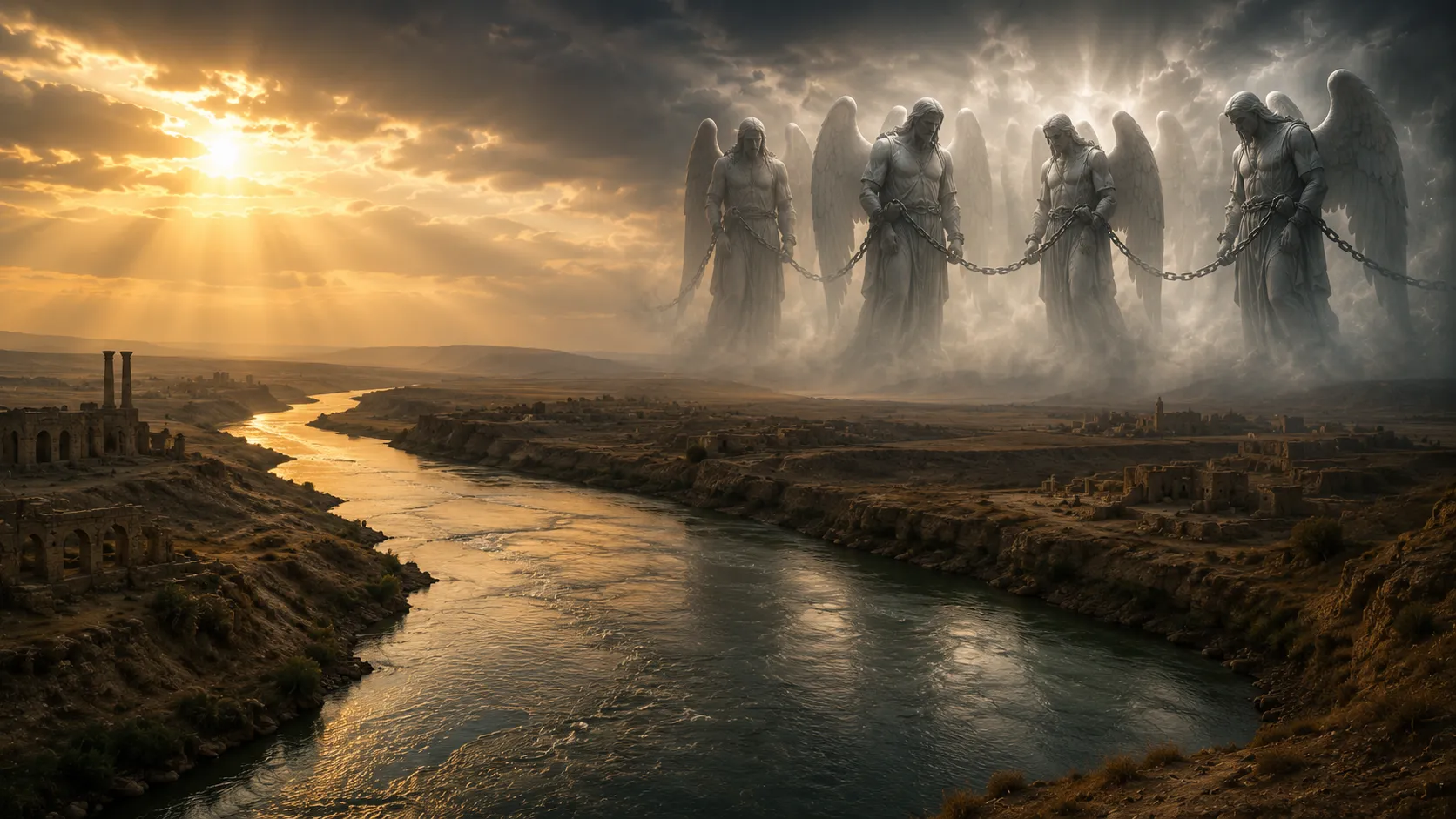
When the sixth angel comes with the trumpet, he says, "Loose the four angels that are bound at the great river Euphrates.
— Revelation 9:14 (KJV)
### Continuing Passage
And the four angels were let go, they that were prepared for the hour, and a day, and a month, and a year, for to slay the third part of men.
— Revelation 9:15 (KJV)
📅 Approximate Year Written
Around AD 95–96
The Apostle John was exiled to the island of Patmos by the Roman emperor Domitian, and it was there that he composed the Book of Revelation.
🏛️ Historical Background
The Book of Revelation is the last book in the Bible and is a form of writing called Apocalyptic literature. A literary genre that employs colourful imagery, visions, and symbols to convey spiritual truths and God's eventual triumph over evil.
The sixth trumpet is described in Revelation 9. Four angels, bound at the great Euphrates River, are released at God's bidding to execute a certain judgment.
This passage is one of the most debated parts of Revelation, and includes both symbolic imagery and references to real geographical locations.
🌍 Why Is the Euphrates River Important?
The Euphrates is one of the world's oldest and most popular rivers. It passes through present-day Turkey, Syria, and Iraq and then merges with the Tigris River.
The Euphrates has been mentioned many times in the Bible:
* It was part of the land given to Adam & Eve as their inheritance (Genesis 2:14).
It was the north line of the land that God gave to Abraham (Genesis 15:18).
It was the borderland between Israel and strong empires like Assyria and Babylon.
It is mentioned once more in Revelation in the end-time revelations.
The Euphrates was also a symbol of impending troubles and judgment, since many invading armies would come down this way to attack Israel.
Who are the four angels?
Revelation refers to them only as the "four angels which are bound in the great river Euphrates.
The Bible doesn't tell you about:
* Their names.
At the time of their binding.
Why they were tied up?
As to whether they are holy angels commissioned to judgement, or fallen angels who are being held back until God's time.
There is not much more Scripture provides and thus Christians have come to differing conclusions.
Some think they are fallen angels who are held back till Judgment Day.
Others think that they are angels who are fulfilling God's judgment in His divine will.
They are not specifically described as such in the text.
What does Revelation 9 teach us?
According to Revelation:
Then the sixth trumpet is sounded.
God gives a command through His altar.
All four angels are let out.
They were prepared for a certain time – hour, day, month and year.
There is a terrible verdict coming.
These events are actually only at God's appointed time.
Whether one looks on Revelation as a series of events unfolding through time, or as a series of fulfilled prophecies, God is still completely in control of the course of history.
A modern debate on the Euphrates.The modern discussion on the Euphrates.
Over the last few years, many people have observed that portions of the Euphrates River are at their lowest water levels on record due to:
* Prolonged drought.
* Climate change.
* Large dams.
* Irrigation projects.
* Increased water demand.
There have been many pictures showing that parts of the river are becoming smaller.
Some have linked these reports to the biblical prophecy.
It is necessary, however, to distinguish between what is going on today, and what Revelation actually says.
The angels are not released due to the drying up of the river, as is often thought, but because of the destruction of the sea (v. 13).
The drying up of the Euphrates in the pouring out of the sixth bowl judgment is referred to in a separate passage (Revelation 16:12) in order to set the stage for the coming of "the kings of the east. This is another vision than the 6th trumpet in Revelation 9.
Today's droughts are not the fulfillment of either passage as they are not mentioned in the Bible.
🚀 Real-World Example
Today the Euphrates is an important river for the millions of people who live in Turkey, Syria and Iraq.
In recent decades, low rainfall and widespread damming have resulted in lower water levels in some reaches of the river.
Satellite imagery, river gauging, and climate information are all used to study these changes and to determine their environmental and economic consequences.
Although these developments are important, the scholars warn against claiming any modern event to be fulfillment of biblical prophecy based on no biblical evidence.
💡 Easy Explanation
Suppose you read a warning about a well-known bridge in a history book.
If a bridge were to show up in current news for flooding or repairs then it does not automatically mean that the ancient warning is being met.
The Euphrates River is a very real place, and the challenges it faces today are very real.
The same real river is used in Revelation in a prophetic vision, but it is not easy to make a simple link between the current news and the biblical prophecy.
🤯 Did You Know?
The Euphrates River is about 2800 km (1740 mi) long.
It is one of the four rivers of the Garden of Eden (Genesis 2:14).
It is mentioned in the first book of the Bible (Genesis) and the last book of the Bible (Revelation).
The Euphrates is referred to two times in the Book of Revelation (in chapter 9 and in chapter 16), yet within two different prophetic contexts.
For over 5,000 years the Euphrates has been a vital role in human civilization.
🔍 Scholarly Consensus
The Euphrates is a geographical place with a rich history and meaning, and Biblical scholars explain its existence with certitude.
But the meaning of the four bound angels is different in Christian traditions.
Others see Revelation largely as a book about future events.
Others interpret much of its imagery symbolically, or as emblematic of past and/or future realities.
It is not yet generally accepted by scholars that the current low flow rates in the Euphrates River satisfy Revelation 9 or Revelation 16.
Responsible interpretation separates fictional interpretation from historical interpretation from speculative interpretation thus.
🙏 Spiritual Reflection
The theme of Revelation isn't fear, it's hope.
But in the book's judgments too, God remains ruler over history.
The four angels are unleashed only by God's permission, to remind the believers that nothing can transpire without God's knowledge and power.
Revelation does not invite us to speculate, but rather to be faithful, vigilant, and trusting of God's ultimate victory.
📌 Key Takeaway
One of the most significant rivers in the Bible is the Euphrates, and it features prominently in Revelation 9. The four angels bound at the Euphrates are the angels released at the 6th Trumpet judgment scene. Contemporary modifications of the river have led to a lot of attention being paid to the subject, but there is no explicit reference in Scripture to current events as being the fulfillment of this prophecy. A careful study encourages readers to differentiate between the text of the Bible, the time in which it was written and the different interpretations it has been given over the years.
📚 References
Scripture
Holy Bible, King James Version (KJV)
Genesis 2:14
Genesis 15:18
Jeremiah 46
Revelation 9:13–21
Revelation 16:12
Historical Sources
The Euphrates River is a large body of water in Asia.The Euphrates River is a body of water in Asia.
New Bible Dictionary
Zondervan Illustrated Bible Backgrounds Commentary
The IVP Bible Background Commentary: New Testament
Scholarly Resources
New International Dictionary of Biblical Theology is an honorable mention.New International Dictionary of Biblical Theology is a worthy mention.
Baker Encyclopedia of the Bible
Table of contents for The Lexham Bible Dictionary.
About This Article
The article is a blend of KJV, geographic information from the past, and biblical insights to interpret Revelation 9. It separates the biblical text from the historical facts and from interpretations that are still a subject of debate among Christians.
Classification
Topic: Bible Prophecy
The first is from Revelation 9:13-21, the second is Revelation 16:12.
Historical and Geographical Landmark: The Euphrates River is a historical and geographical landmark in Scripture.
There are varying interpretations on the meaning of the four angels and when they will be released, among the different Christian denominations. No current events are to be introduced as fulfilled prophecy without clear biblical support.