
Archaeological Evidence for Pontius Pilate
Archaeological Evidence for Pontius Pilate: The Roman Governor Who Sentenced Jesus is a compelling, engaging, and informative book.
📖 Bible Verses (KJV)
So, then, Pilate took Jesus and beat him.
— John 19:1 (KJV)
Additional Supporting Verses
Then Pilate decreed what they had demanded.
— Luke 23:24 (KJV)
Suffered under Pontius Pilate, was crucified, dead and buried.
This wording subsequently became part of the Apostles' Creed, it becoming so significant in Christian tradition that it was commonly accepted that Pilate was a saint.
📅 Approximate Year Written
* Gospel of Luke: Around AD 60–62
* Gospel of John: Around AD 85–95
Pontius Pilate was the Roman governor (prefect) of Judea from around AD 26 to 36 under the reign of the Roman emperor Tiberius.
🏛️ Historical Background
Pontius Pilate was one of the more notable Roman officials of the times because of the trial and crucifixion of Jesus Christ.
The Jewish religious leaders brought Jesus to the Roman governor, Pilate, because only the Roman governor could approve a crucifixion.
Pilate asked Jesus, "Is it true that you are the King of the Jews?...I see no reason to find fault worthy of death in this man. . . .", but was influenced by the religious leaders and mob to order His crucifixion.
For many years there was controversy over whether or not Pilate was a real person and no proof of him could be found apart from the Bible.
In 1961, however, all that changed.
What people believed before the discovery:
Until the 20th century, historians primarily knew of Pontius Pilate through written sources.
These included:
* The New Testament.
The book of Flavius Josephus, the Jewish historian.
One of the Roman historians, Tacitus.
The Hellenistic Jewish philosopher Philo of Alexandria.
This is because these historical texts always mentioned Pilate, but some critics suggested that there was no physical evidence of his existence.
🔬 What Archaeology Has Discovered
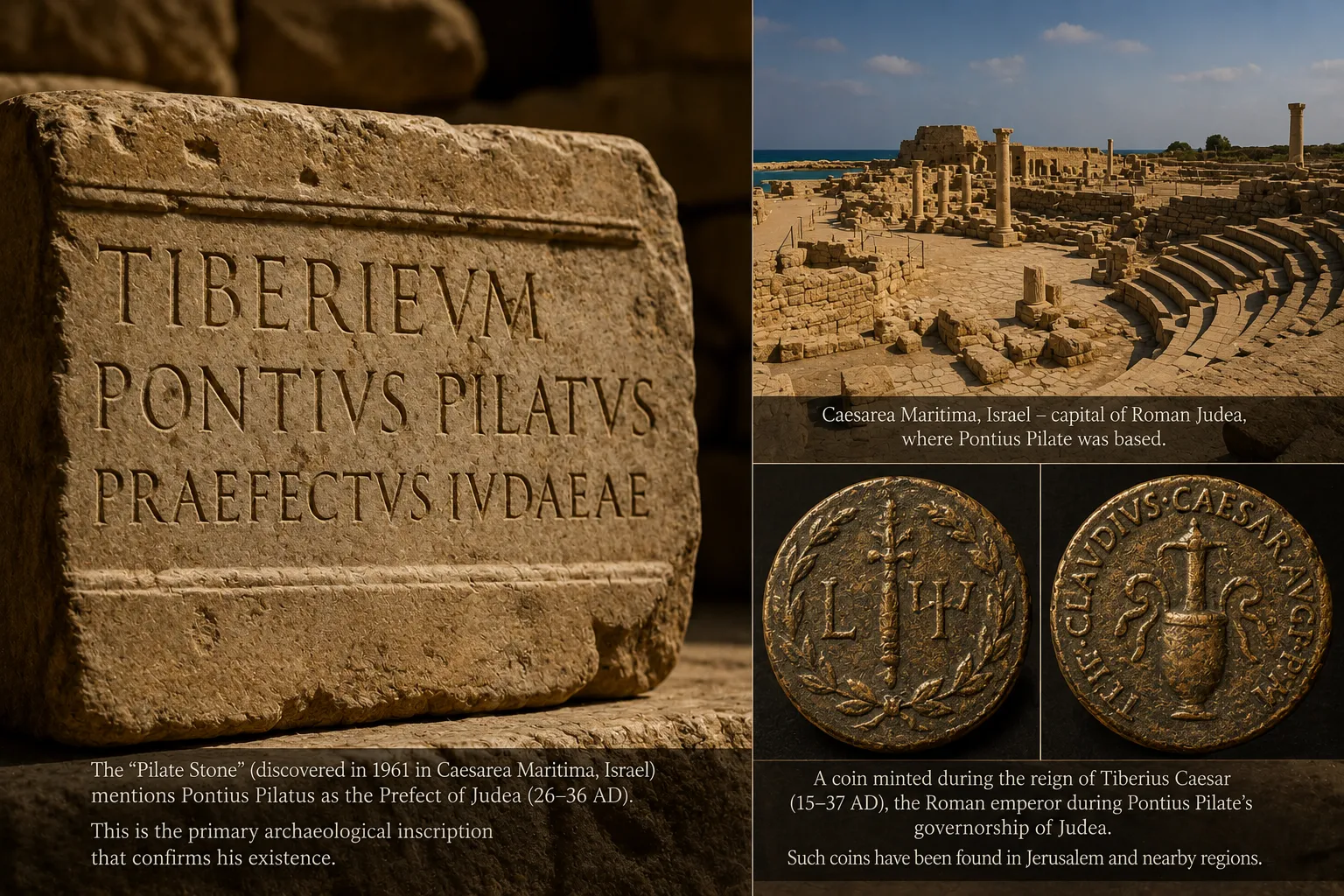
A great discovery was made in 1961 during the excavation of the ancient Roman theater of Caesarea Maritima by the Italian archaeologists.
They found worded in Latin: "They discovered a broken inscription in limestone, which read:
"...Pontius Pilatus... Prefect of Judea..."
This is now called the Pilate Stone.
The damage to the inscription does not obscure the name of Pontius Pilate, who is definitely known to be the Roman prefect of Judea.
It was once part of a public building, dedicated to Emperor Tiberius.
It is the only inscription found in the lifetime of Pilate that is directly his and his official title.
🪙 Additional Archaeological Evidence
The Pilate Stone is the best of the archaeological evidence, but there is more as well to help illuminate the historical context of Pilate.
These include:
Coins struck by the Romans under Pilate, AD 29–AD 31.
Work in the governor's palace at Caesarea Maritima.
The street and buildings of Jerusalem during the Roman era.
Remnants of Roman practices in crucifixion, such as the remains of a crucified man found near Jerusalem.
These discoveries give us some background to the New Testament accounts.
🚀 Real-World Example
A copy of the Pilate Stone is on display in the Israel Museum today, and the original is kept for study.
The discovery is frequently referred to in university courses on Roman history, biblical archaeology and early Christianity.
It is still one of the largest and most important archaeological finds with a definite personal connection to a man mentioned in the New Testament.
💡 Easy Explanation
Envision reading about a governor in an ancient book.
Many years later, archaeologists find a government building whose official name is the governor's name.
This does not substantiate all that took place during the time of the governor.
It does, however, have very good historical evidence that the person existed and occupied the post as described in the historical records.
For all these reasons, the Pilate Stone is of significance.
🤯 Did You Know?
In 1961, the Pilate Stone was discovered.
It was discovered used as a staircase in the Roman theater at Caesarea.
The inscription is in the Latin language.
Pilate ruled over Judea for about 10 years.
One of the most significant archaeological finds of the NT is the Pilate Stone.
🔍 Historical Consensus
The overwhelming majority of historians believe that PONTIUS PILATE was a real person.
He has been verified by:
* The New Testament.
The writings of Josephus.
Tacitus' work.
The writings of Philo.
The Stone of Pilate found in Caesarea.
Although archaeology cannot confirm the details of Jesus' trial, the Pilate Stone does offer direct archaeological evidence that Pontius Pilate was prefect of Judea during the time of Jesus' trial as recorded in the Gospels.
The historical existence of Pilate is now well accepted today.
🙏 Spiritual Reflection
Pontius Pilate's historical place is a special one.
He is not only mentioned in the Bible but also in the historical records of the Romans and Jews.
To Christians, the decision of Pilate was one of the most important in history, as he passed sentence of the crucifixion of Jesus Christ.
The archaeological evidence reminds us that the Gospel accounts are based on real locations, real governments, and real historical figures.
Yet discoveries such as the Pilate Stone contribute to giving greater light to the world of the New Testament.
📌 Key Takeaway
The Pilate Stone was found in 1961, offering direct archaeological proof of the historical existence of the Roman governor of Judea, who presided over the trial of Jesus, Pontius Pilate. It is also along with the historical writings of the Romans and Jews that this inscription places Pilate beyond any doubt as a real historical person and reinforces our knowledge of the historical context of the Gospels.
📚 References
Scripture
The full text of the Holy Bible, King James Version (KJV)
* Matthew 27
* Mark 15
* Luke 23
* John 18–19
* Acts 3:13
Archaeological Sources
1. Israel Antiquities Authority
2. Caesarea Maritima Excavation Reports
3. Encyclopaedia Britannica – Pontius Pilate
4. Biblical Archaeology Society
5. Oxford Encyclopedia of Archaeology in the Near East
Historical Sources
The Antiquities of the Jews (Book 1) by Flavius Josephus
2. Tacitus, Annals 15.44
Embassy to Gaius 3. Philo of Alexandria
The Archaeological Study Bible
5. New Bible Dictionary
About This Article
This article blends together the biblical record (KJV), archaeological finds, Roman historical records and scholarship. It distinguishes between archaeologic facts and the theological importance of the role of Pilate in the crucifixion of Jesus.
Classification
Topic: Archaeology & the Bible
Bible verses: Matthew 27, Mark 15, Luke 23, John 18-19
Historical Status: Established. The Pilate Stone found at Caesarea Maritima and several independent historical sources confirm Pontius Pilate.
Archaeological status: it is generally believed that the Pilate Stone provides direct archaeological evidence for the historical existence of Pontius Pilate and that he really was prefect of Judea.
Interpretation Status: Archaeology provides proof of Pilate's existence and his role, but on its own does not prove the theological significance of the events surrounding Jesus' trial.
Editorial Note: This article has been written to reflect the King James Version (KJV), archaeological research, Roman historical sources, and modern scholarly research. It makes a clear separation between historical facts and theological interpretation, offering a balanced and accurate picture.