Sodom and Gomorrah: What Do We Know?
In Sodom and Gomorrah, what do we know? A look at the Biblical Account and Archaeological Evidence
📖 Bible Verses (KJV)
Then the LORD rained on Sodom and on Gomorrah brimstone and fire from the LORD out of heaven.
**— Genesis 19:24 (KJV)
Additional Supporting Verses
Then he turned his gaze toward Sodom and Gomorrah, and he saw the smoke of the land rising "as the smoke of a furnace.
— Genesis 19:28 (KJV)
As Sodom and Gomorrah, "are set forth for an example, suffering the vengeance of eternal fire.
— Jude 1:7 (KJV)
📅 Approximate Year Written
* Genesis: Around 1445–1400 BC
* Jude: Around AD 60–80
The Bible says that Sodom and Gomorrah were destroyed during the lifetime of Abraham, which was around 2000 BC.
🏛️ Historical Background
One of the most famous places that appear in the bible is the cities of Sodom and Gomorrah.
Genesis 18-19 states these cities were in the fertile land close to the Jordan River. The Bible says that they were prosperous, but very wicked. G-d, after hearing Abraham's prayer for the cities, decided to judge them by sending "brimstone and fire" from heaven.G-d heard Abraham's prayer for the cities and decided to judge them by "brimstone and fire" from heaven.
Lot and his daughters were saved, but his wife's name was "a pillar of salt" (Genesis 19:26).
The destruction of these cities was an everlasting reminder of God's judgment in the Old and New Testaments.
🌍 What People Believed Then
Many people thought the ruins of Sodom and Gomorrah were about the Dead Sea, which is one of the lowest places on earth.
Flavius Josephus, an ancient Jewish historian, recorded in his time traces of the destroyed cities were still visible.
The South Dead Sea area was also linked to the biblical story by early Christian pilgrims and later by explorers.
But no one was aware of the actual location of the cities.
🔬 What Archaeology Has Discovered
There are several sites suggested for the location of Sodom and Gomorrah, but no site has been unanimously accepted.
The two proposals get the most attention.
Theory 1: Tall el-Hammam (Jordan)
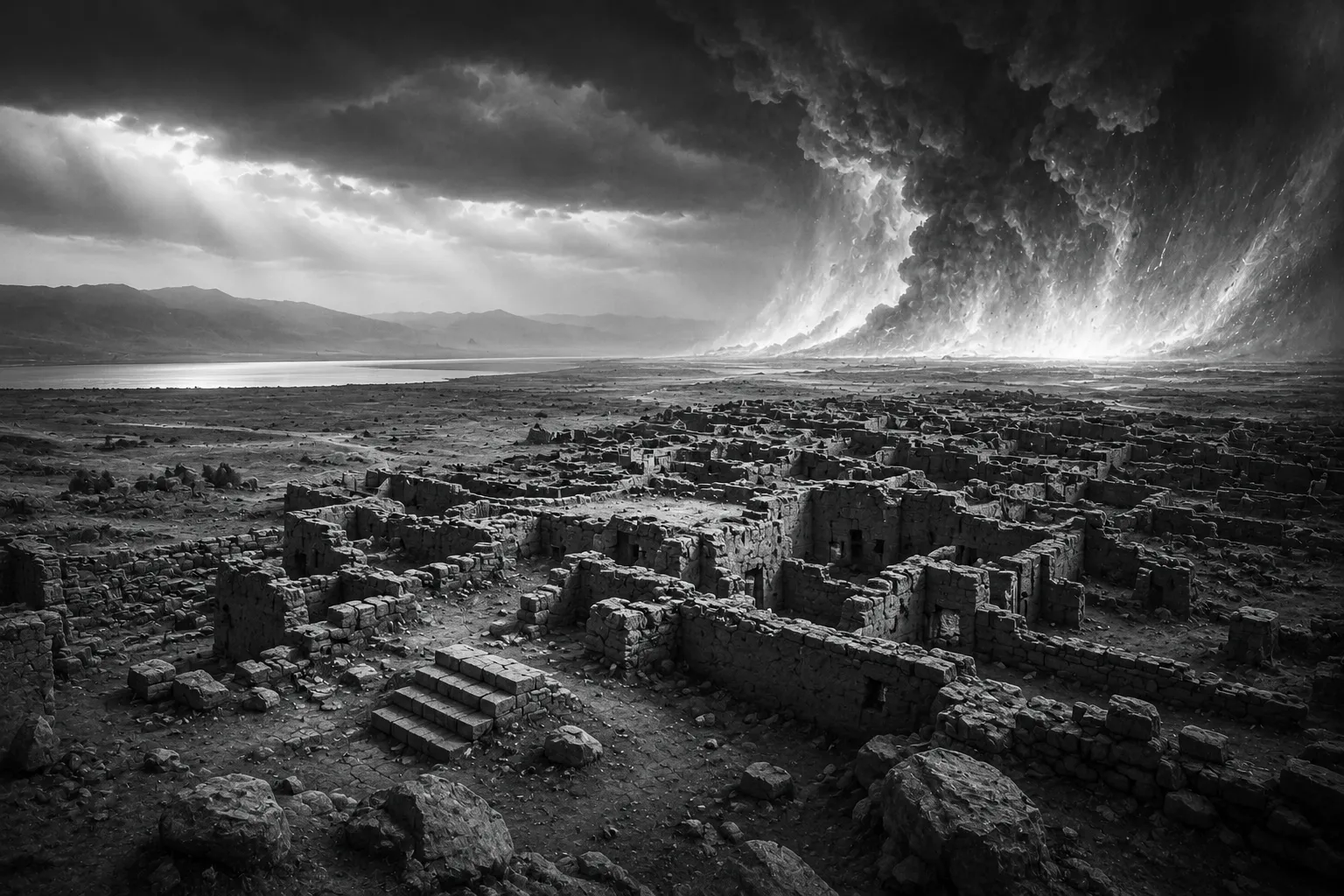
A candidate is Tall el-Hammam, northeast of the Dead Sea.
Excavations have revealed:
A big bronze age city.
Sudden destruction, as indicated by evidence.
Burned mudbricks and pottery.
* Melted building materials.
Abnormally high salinity levels.
Indications of very high temperatures.
A strong cosmic airburst, like the one that killed the city in 1908 in Siberia, could have toppled the city in 2021, researchers say.
Some scholars point to this event as being similar to the Biblical account of fire from heaven.
The identification is however much up for debate and many archaeologists are not convinced that Tall el-Hammam is Sodom.
---
Theory 2: Southern Dead Sea Sites
Other archaeologists prefer the sites of:
* Bab edh-Dhra
* Numeira
They were destroyed in the Early Bronze Age and have always been linked to the biblical cities.
Their placement is more in line with the traditional interpretation of the story of the creation of the world in the book of Genesis, according to supporters.
But, doubts exist as to their dating and their relationship to the biblical time.
🚀 Real-World Example
Geology, archaeology, chemistry and the study of satellite images are still being used to study ancient disasters.
Near the Dead Sea, scientists study:
* Burn layers.
* Sulfur deposits.
* Shocked minerals.
* Melted pottery.
* Earthquake evidence.
* Salt formations.
These investigations can help to recreate what may have happened thousands of years ago when definitive conclusions are not possible yet.
💡 Easy Explanation
Now think of finding the ruins of an old city that's been blown up by a big bang!
The clues left behind by the destruction can be detected by archaeologists, and from them they are able to date the event and investigate the causes.
But if that's the same city as the one in an ancient text, it's a question that needs to be answered by comparing the archaeology, geology, written records and timelines of history.
That's why the location of Sodom and Gomorrah is not yet decided.
🤯 Did You Know?
One of the lowest elevations on Earth, this is the Dead Sea, which rests some 430 meters (1,410 feet) below sea level.
It has also natural deposits of bitumen, salt and sulfur, which are mentioned by the ancient writers.
Genesis 14:10 references many slime pits (bitumen pits) in the area called the Vale of Siddim.
One of the biggest Bronze Age archaeological sites in the Jordan Valley is the Tall el-Hammam.
Every year new studies are being published about the possible sites of Sodom.
The process of establishing a consensus on history and archaeology.The process of forming an agreement over history and archaeology.
The most general consensus among historians is that the account in Genesis is based on the geography of the Dead Sea region.
But none of the archaeological sites has been accepted as Sodom and Gomorrah.
The Tall el-Hammam hypothesis has gained international fame and is still a subject of debate in the archaeological world.
Likewise, the southern Dead Sea locations are still supported by scholars but are not agreed upon by all.
Currently, the archaeology has established that a number of ancient cities that lie near the Dead Sea were destroyed suddenly during the Bronze Age, but can not determine which, if any, of these is Sodom.
🙏 Spiritual Reflection
The lesson from Scripture is that the story of Sodom and Gomorrah is not remembered for the cities but for the lessons to be learned.
The Bible makes the story a warning against the wickedness and injustice of man and the consequences of man's rejection of God; it also emphasizes the mercy of God towards Lot and His willingness to listen to the intercession of Abraham.
The story, either through archaeology or Scripture, ends with a call to readers to consider righteousness, justice and God's mercy.
📌 Key Takeaway
Sodom and Gomorrah are still one of the greatest historical mysteries in the Bible! There are several good sites that have been identified, and a few sites near the Dead Sea where there has been catastrophic destruction. But none of the places has been agreed on as the biblical cities. The archaeological research is ongoing and the biblical story is one of the most timeless of stories of judgment and mercy in scripture.
📚 References
Scripture
Holy Bible, King James Version (KJV)
Genesis 13
Genesis 14
Genesis 18–19
Deuteronomy 29:23
Isaiah 1:9–10
Ezekiel 16:49–50
Matthew 10:15
Jude 1:7
Archaeological Sources
Israel Antiquities Authority
Biblical Archaeology Society
Encyclopaedia Britannica – Sodom and Gomorrah
Oxford Encyclopedia of Archaeology in the Near East
The published archaeological research of Tall el-Hammam and the Bronze Age period.
Historical Sources
Josephus, F., Antiquities of the Jews.
New Bible Dictionary
Zondervan Illustrated Bible Backgrounds Commentary
This Archaeological Study Bible includes the Lexicon.
About This Article
The biblical account (KJV), archaeological findings, geological studies and historical research are put together. It separates the fact from the prevailing archaeological theories and those that are still under debate.
Classification
Topic: Archaeology & the Bible
Areas of Agreement: prior consent; a sister's place; women's dignity; the sanctity of marriage.Themes: Genesis 13-19; Jude 1:7.
Historical Status: Ancient cities have been found in the vicinity of the Dead Sea and there is archaeological evidence of catastrophic destruction at a number of Bronze Age sites in the area.
Identification of Sodom and Gomorrah: The correct identification of Sodom and Gomorrah is not confirmed. The proposed sites of Tall el-Hammam, Bab edh-Dhra and Numeira are still on active discussion by scholars.
Interpretation Status: The destruction was a judgment of God. Archaeology seeks to uncover the historical context and possible locations, but not a theological meaning of the event.
This article uses the King James Version (KJV), archaeological studies and geological research and historical scholarship. When evidence is controversial, Guiding Verses painstakingly distinguishes between established findings, leading hypotheses, and matters of biblical interpretation.