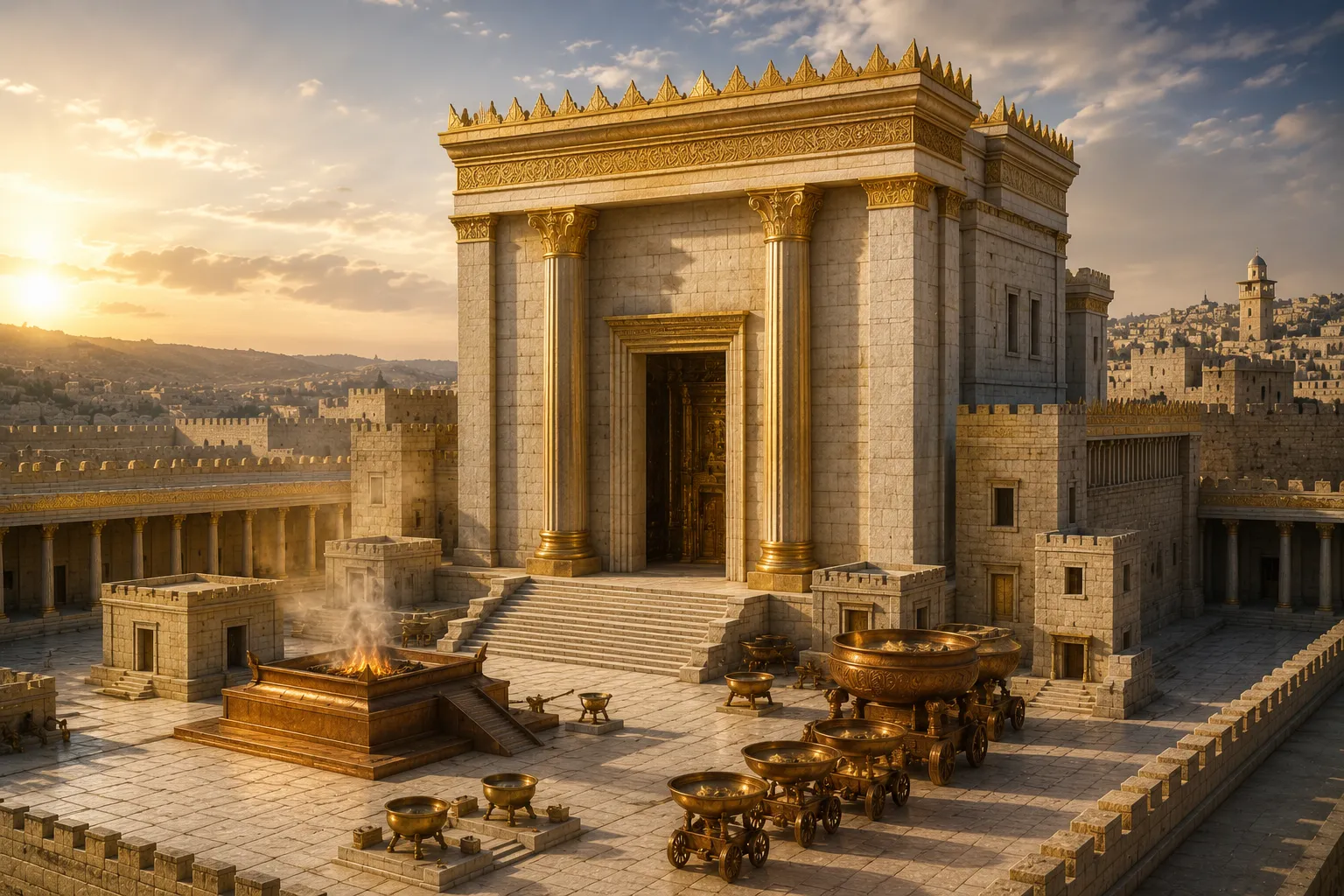
The Magnificent first Temple of Jerusalem, Solomon's Temple.
📖 Bible Verses (KJV)
Now in the fourth year of his reign, "Solomon started to build the house of the LORD at Jerusalem in mount Moriah...
— 2 Chronicles 3:1–2 (KJV)
Additional Supporting Verses
"The house which king Solomon built unto the LORD was threescore cubits long, by the breadth thereof twenty cubits, and by the height thereof thirty cubits.
— 1 Kings 6:2 (KJV)
But will God really dwell on the earth? "Look, the heaven and the heaven of heaven is not enough; how much less this house that I have built!
— 1 Kings 8:27 (KJV)
📅 Approximate Year Written
1 Kings: Around 560–540 BC
2 Chronicles: Around 450–430 BC
The Bible praises Solomon for completing the building of his Temple around 957 BC.
🏛️ Historical Background
King David desired to have a permanent house for the Ark of the Covenant after he had made Jerusalem the capital of Israel. But Scripture tells us that God selected the son of David, Solomon, to do the job.
The building was started in the fourth year of Solomon's reign on Mount Moriah, the traditional site of the place where Abraham was to sacrifice Isaac. The Temple was the center of religious activity in the Old Testament, where the people of Israel would gather to worship and the priests would make sacrifices.
It was in existence for almost 400 years until it was destroyed by the Babylonian king Nebuchadnezzar II in 586 BC. This event was one of the most important events in Israel's history and was the catalyst for the Exile to Babylon.
🌍 What People Believed Then
For the Nation of Israel, the Temple was the symbol of God's covenant with His people.
Israel didn't believe that God was only in the Temple, as its neighbors did. Your Heaven and the heaven of heavens can not contain God, even Solomon admitted when the Temple was dedicated. On the contrary however, the Temple was considered to be the place where God's presence was particularly revered and where Israel met for worship and sacrifice.
The surrounding kingdoms were shown as a wealthy country through the majesty of its temples and worship of religion. Solomon's Temple was one of the most famous sacred structures in the ancient Near East.
🔬 What Archaeology Has Discovered
Given the importance of the Temple Mount as a site of religion, modern archaeologists are not able to do extensive excavations directly under the ground. Consequently, the entire excavation of Solomon's Temple has never been done.
But archaeology has revealed significant evidence that aids in the understanding of the time of the Temple's existence.
Discoveries include:
Monuments of Jerusalem's First Temple era.
Administrative buildings and fortifications of the Kingdom of Judah.
Inscriptions in ancient Hebrew of the same time.
Bullae, clay seal impressions, of officials referred to in the Bible.
Ancient water and wall systems in Jerusalem, excavated.
Objects that relate to the worship at the first Temple.
Furthermore there are records of the conquest of Jerusalem by Nebuchadnezzar II outside the Bible, such as the Babylonian chronicles, that will document the year of the destruction as 586 BC, the same date as the Bible.
While the Temple itself is not yet extensively studied, the artifacts found around it do give some insight into the history of the city under Solomon.
🚀 Real-World Example
Today, the visitor to Jerusalem is able to visit numerous archaeological sites related to the First Temple Era.
Some buildings, walls and artifacts of the Kingdom of Judah can be seen in the City of David, the Ophel excavations, and the Jerusalem Archaeological Park.
Scientific methods like 3D mapping, laser scanning and digital reconstruction are still being employed by researchers to examine the ancient topography of Jerusalem while maintaining the sanctity of the Temple Mount.
💡 Easy Explanation
Suppose you read about the existence of a famous palace, but it no longer stands.
The city, official records, coins, roads and buildings around the palace can provide clues to historians about life in the palace, even if the palace itself cannot be excavated.
This is like the case with Solomon's Temple.
Archaeologists are not able to fully excavate the Temple Mount, but the discoveries in Jerusalem do provide a picture of the historical context in which the Temple was located.
🤯 Did You Know?
The Bible gives the number of thousands of men used by Solomon to construct the Temple.
The building was completed in about seven years (1 Kings 6:38).
The Temple was covered with huge gold sheets, as it had been described in the Bible.
The First Temple remained standing for almost 370 years until its destruction.
The Temple Mount continues to be one of the most sacred and important sites in the world to Judaism, Christianity and Islam.
🔍 Historical Consensus
The majority of scholars believe that the First Temple period was the time of Jerusalem's reign as capital of the Kingdom of Judah.
There is general agreement among scholars that there was a temple in Jerusalem before the destruction that occurred in 586 BC. Some texts in the Bible, as well as some historical records and the surrounding archaeological evidence, support this, and the Bible uses the word ‘temple' to refer to the holy of holies, which was in existence before the temple described in Ezra and Nehemiah began to be built.
But with the extent of excavation that is not feasible under the Temple Mount, archaeologists can't confirm all of the architectural details found in the Bible.
Like most historic monuments, historians use archaeological findings, historical records and historical analysis to gain insight into Solomon's Temple.
🙏 Spiritual Reflection
Solomon's Temple, to Israel, was a place of worship, a place of covenant and a place where God could be found among his people.
Jesus in the New Testament called Himself greater than the temple and said that worship should not be just a building but it is more important to worship God. The Temple is a symbol to Christians that transcends the physical to the spiritual, for the Lord wants to be among His people.
Solomon's Temple is one of the most important buildings in biblical history, whether viewed from a historical or spiritual perspective.
📌 Key Takeaway
Solomon's Temple was the center of religious life in ancient Israel and one of the most renowned religious structures in history. While the Temple is not completely excavated today, the archaeological findings in Jerusalem, combined with the ancient historical sources, support the historical reality of the ancient world in which the Temple stood. Today the Temple is a place of great historical, archaeological, and religious importance.
📚 References
Scripture
Holy Bible, King James Version (KJV)
1 Kings 5–8
2 Chronicles 2–7
2 Kings 25
Jeremiah 52
Archaeological Sources
Israel Antiquities Authority
City of David Foundation
Solomon's Temple, Encyclopaedia Britannica.Encyclopaedia Britannica – Solomon's Temple.
Oxford Encyclopedia of Archaeology in the Near East
Biblical Archaeology Society
Historical Sources
The Archaeological Study Bible
New Bible Dictionary
This is a commentary on the Bible using illustrative backgrounds.
The Babylonians records (Nebuchadnezzar's campaigns)
About This Article
In this article the Bible account (KJV), discoveries from archaeological remains and history research are used to explain Solomon's Temple. It separates historical facts, archaeological discoveries from biblical descriptions and acknowledges the possibility of limitations to archaeological research.
Classification
Topic: Archaeology & the Bible
The Biblical references are 1 Kings 5-8 and 2 Chronicles 2-7.
Historical Evidence: The history of Jerusalem's First Temple period and the destruction in 586 BC are supported by historical and archaeological evidence.
Interpretation Status: The Bible gives the basic detailed description of Solomon's Temple. The historical context of First Temple Jerusalem is supported by strong archaeological evidence, but at the present time, there is no room to broaden the scope of the excavation of the Temple itself due to the protected and religiously sensitive status of the Temple Mount.