The Ark of the Covenant: History and Mystery
The Ark of the Covenant—History and Mystery
📖 Bible Verses (KJV)
They shall make an ark of shittim wood: two cubits and a half shall be the length thereof and a cubit and a half the breadth thereof, and a cubit and a half the height thereof.
— Exodus 25:10 (KJV)
Additional Supporting Verses
“And there I will appear to him, and will talk with him from above the mercy seat.”…
— Exodus 25:22 (KJV)
Then the priests carried the ark of the LORD's presence into his room, the house of the sanctuary.
— 1 Kings 8:6 (KJV)
📅 Approximate Year Written
Exodus: Around 1445–1400 BC
1 Kings: Around 560–540 BC
The Bible states that the Ark of the Covenant was built when Israel was in the desert following their Exodus from Egypt.
🏛️ Historical Background
One of the most well-known and enigmatic items mentioned in the Bible is the Ark of the Covenant.
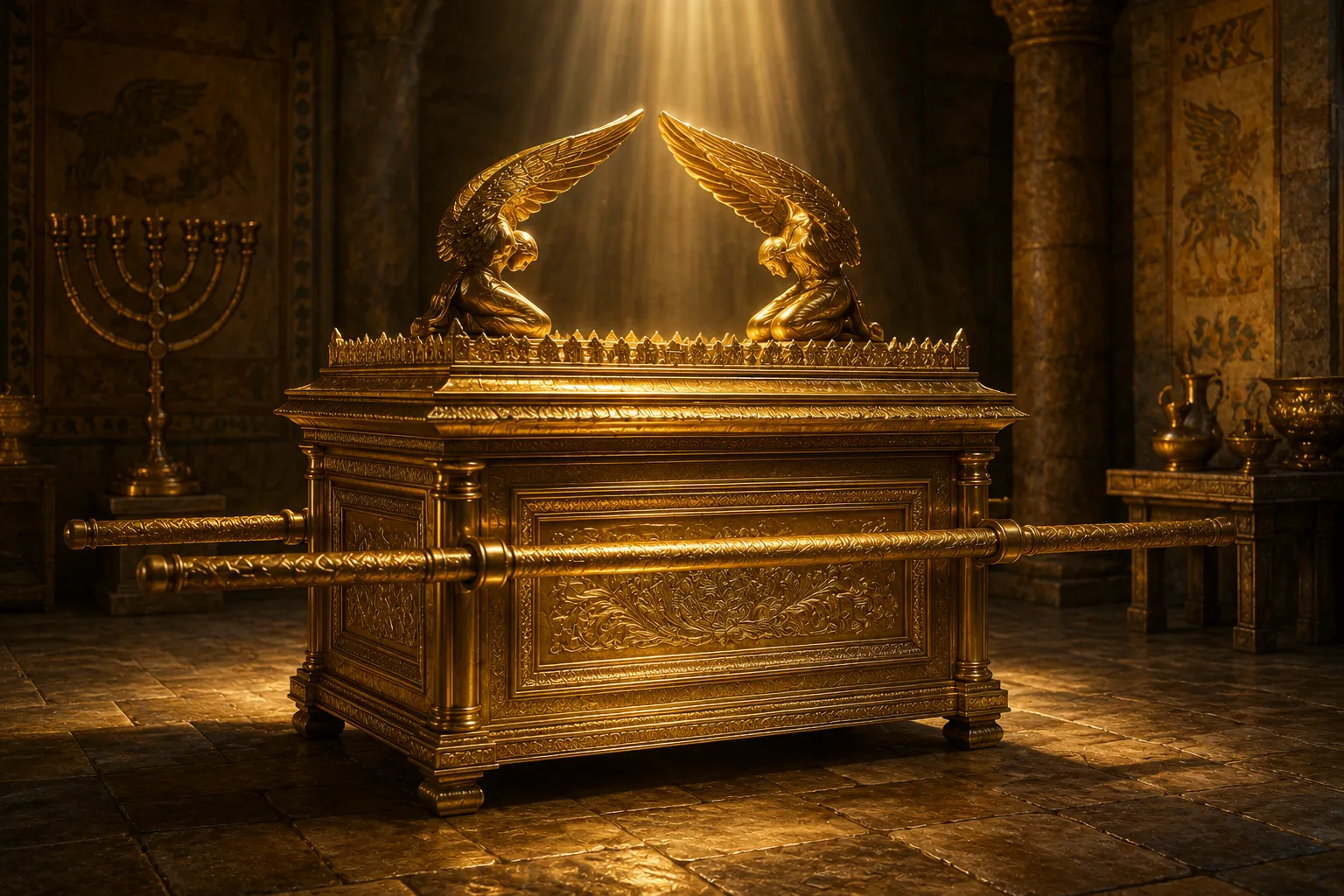
God told Moses to make the Ark as a sacred box that was to represent His covenant with Israel. It was made from acacia (shittim) wood and covered inside and outside with pure gold. On the mercy seat were two golden cherubim which were the place where God would meet with Moses.
As Scripture tells us, the Ark held:
The stone tablets of the Ten Commandments.
The rod that Aaron touched which budded.
A pot of manna and a golden pot.
The ark was carried to Israel in the wilderness, through the Jordan River, around Jericho, and finally into Solomon's Temple in Jerusalem.
It symbolized God's presence and covenant with His people – it was not a place where God was physically present within the Ark, rather, it was the designated reminder of God's relationship with Israel.
🌍 What People Believed Then
In ancient times, several countries in the Near East had sanctuaries filled with sacred objects that symbolized their deities.
There is no likeness or resemblance to any other ark in the world.
In contrast to the other cultures around them, the Ark of God did not have any image of God or idol. Instead, it contained the covenant tablets Moses gave them. The blank space above the mercy seat was a reference to the invisible God who could not be depicted with any form of sculpture.
The Ark was treated very reverently. It was carried by special priests, on poles fixed through gold rings. The Ark of God was extremely sacred as a result of being handled without authority, as we can see in Scripture.
Archaeology, what has it uncovered?
The Ark of the Covenant has not yet been definitely located after centuries of searching.
No discovery of any kind has ever been made by archaeology that can be positively attributed to the biblical Ark.
Archaeology has, however, established many historical facts about the world in which the Ark operated and this comprises:
The Iron Age period of ancient Israel.
Jerusalem, the capital of the Kingdom of Judah.
The First Temple period.
Ancient priestly practices.
Architecture of the ancient Near East at the Temple level.
The destruction of Jerusalem by the Babylonians in 586 B.C. is well attested by both Old Testament and Babylonian accounts. Following this event the location of the Ark is no longer clearly described in the Bible.
It has never been solved, and remains one of the biggest mysteries in history.
🚀 Theories About the Ark's Location
Many ideas have been put forward over the centuries over what became of the ark.
Some of the most popular are:
Before Babylon's invasion, hidden by the enemy
Others propose that the priests of the Lord, who were faithful, concealed the Ark of the Covenant in or near Jerusalem prior to the Babylonians' sack of the temple.
There's no proof of this theory.
Under the Temple Mount
The other theory suggests that the Ark is still buried under the Temple Mount.
This idea can currently not be tested as large-scale archaeological excavations under the site are not allowed.
Ethiopia
The Ethiopian Orthodox Tewahedo Church believes that the Ark is stored in the Church of Our Lady Mary of Zion in Aksum.
This tradition has not been subject to independent archaeological research as the claimed Ark has never been made available for this purpose.
Lost Forever
Others believe that the ark was destroyed, captured or lost in the Babylonian conquest.
So far, there is no archaeological proof of this either.
💡 Easy Explanation
Picture a historic crown that was lost in battle.
The history of the crown is known, because there are many reliable records describing the crown.
If however, it is not known where it is today, the crown is still a historical mystery.
The Ark of the Covenant is like that.
While the Bible gives many descriptions of its construction and use, the final location is unknown.
🤯 Did You Know?
The size of the Ark was about 1.3 m (4.3 ft).
It was transported by two long wooden poles, and was never to be handled directly.
The Ark was with Israel for hundreds of years.
The last clear reference to the Ark in the Bible is found in 1 Kings 8.
The only claims to an archaeological find of the Ark have been unverifiable.
🔍 Historical Consensus
The Old Testament narrative of the Ark of the Covenant holds a pivotal role in the history of Israel, and most historians place it in the central position.
But there is no clear proof of the current location of the ark.
There have been a number of claims over the ages, but none has been substantiated by scientific research or accepted by most archaeologists.
So the Ark is still one of the greatest unsolved mysteries of archaeology.
🙏 Spiritual Reflection
The Ark of the Covenant was the symbol of God's covenant with His people.
The Bible speaks more about God's faithfulness than God's ark, although what is known is that it is now lost.
The meaning of the Ark, for Christians, finally leads to God's desire to live with His people. In Scripture, God's presence cannot be contained in a sacred object, it is found in the relationship with those who trust in Him.
The question of what happened to the Ark of the Covenant, then or later, still causes wonder, but the most important message of the Ark was the covenant it symbolized.
📌 Key Takeaway
The Bible contains one of the most important of its sacred items, and one of history's greatest mysteries, the Ark of the Covenant. It was all set in the past in an historical context that has been confirmed by archaeology, but no one or thing has yet been found that verifies the existence of the Ark itself. Its narrative is continuing to link together faith and history and archaeology and is a reminder to the reader of God's covenant with His people.
📚 References
Scripture
Holy Bible, King James Version (KJV)
Exodus 25:10–22
Numbers 10:33–36
Joshua 3–6
1 Samuel 4–6
2 Samuel 6
1 Kings 8
Hebrews 9:4
Archaeological Sources
Israel Antiquities Authority
Encyclopaedia Britannica – Ark of the Covenant
Oxford Encyclopedia of Archaeology in the Near East
Biblical Archaeology Society
The Archaeological Study Bible
Historical Sources
New Bible Dictionary
Zondervan Illustrated Bible Backgrounds Commentary
Encyclopaedia Britannica – Temple of Jerusalem
Babylonian Chronicles
About This Article
The biblical account (KJV), archaeological research and historical scholarship all come together in this article to explain the Ark of the Covenant. It differentiates between proven fact, tradition and theories which are not yet proven.
Classification
Topic: Archaeology & the Bible
Biblical References: Exodus 25; Joshua 3–6; 1 Samuel 4–6; 2 Samuel 6; 1 Kings 8
Historical Status: The Ark of the Covenant is described in great detail in the Bible and is an integral part of the religious life of the Israelites. It is historically plausible because it may have existed in the context of ancient Israel, but has not yet been archaeologically found.
Interpretation Status: In Scripture, there is a description of the original purpose and role of the Ark. It is not known where it now is and suggested sites (including under the Temple Mount and in Ethiopia) have not been confirmed and are not accepted as historical facts.
Editorial Note: The information in this article comes from the King James Version (KJV) and archaeological research and historical scholarship. When evidence is missing or controversial, the article is clear and separates out factual information from historical traditions and informed theories.