
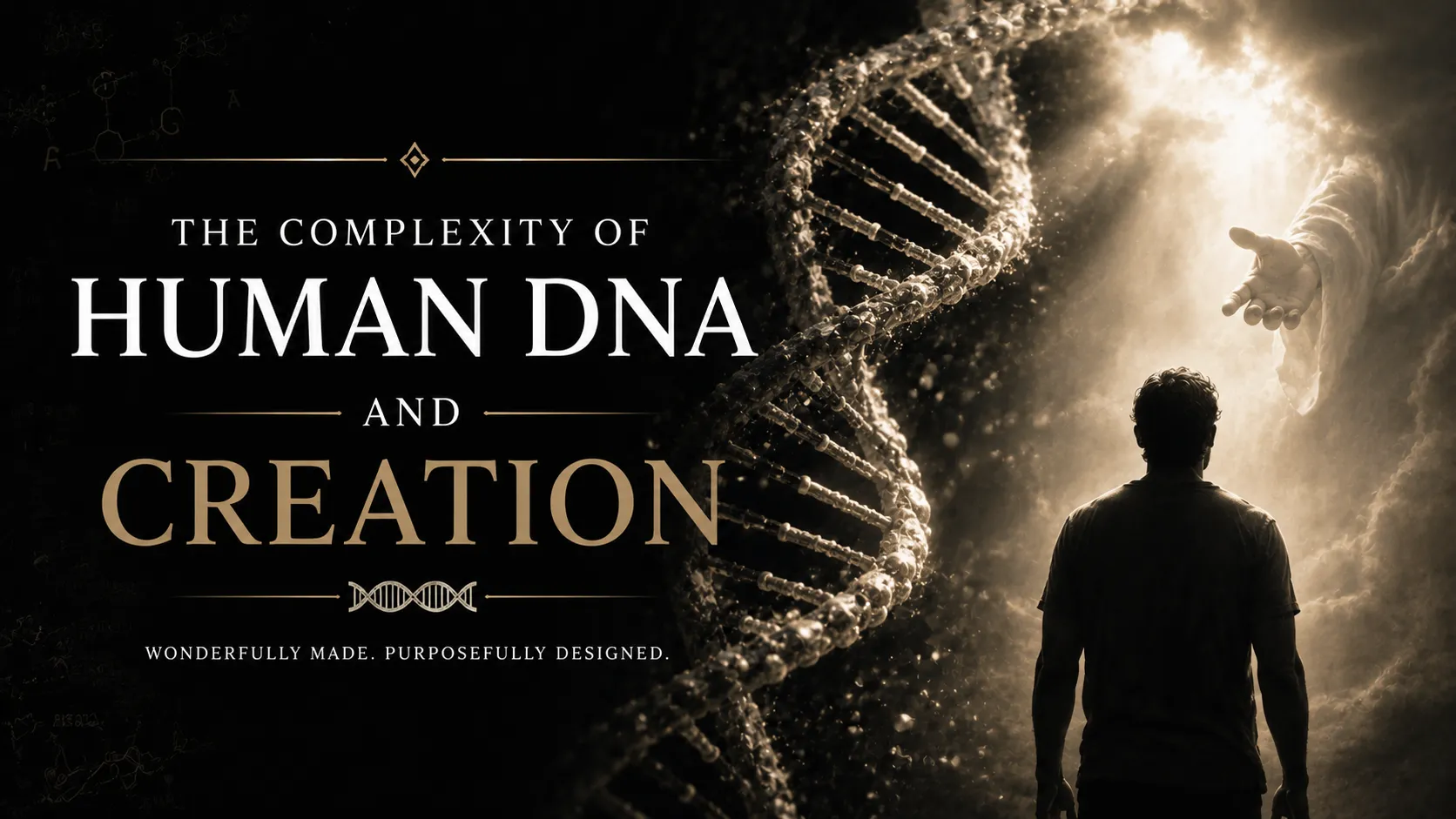
The Complexity of Human DNA and Creation
📖 Bible Verses (KJV)
I will thank thee and will praise thy name for I am wonderfully made; marvellous are thy works; and that my soul knoweth well.
— Psalm 139:14 (KJV)
Additional Supporting Verses
So God created man in His likeness, God created man in His likeness.
— Genesis 1:27 (KJV)
He that built all things is God; but every house is builded by man.
— Hebrews 3:4 (KJV)
📅 Approximate Year Written
* Genesis: Around 1445–1400 BC
* Psalms: Around 1000 BC
* Hebrews: Around AD 60–70
The Bible had already spoken about the intentional creation of man and his "fearfully and wonderfully" making long before the discovery of DNA.
🏛️ Historical Background
People have always been aware that they resemble their parents, but they did not understand how traits were passed on.
It was in the nineteenth century that Gregor Mendel conducted experiments that changed all that, the foundation for genetics. James Watson, Francis Crick, Rosalind Franklin and Maurice Wilkins all helped to discover the structure of DNA in 1953.
Now DNA is known as the molecule that contains instructions for growth, development and function of living organisms.
The Bible doesn't talk about “DNA” specifically, but many Christians believe that DNA research helps them to appreciate more the complexity of God's creation.
What is Human DNA?
Hereditary material present in almost all cells of the humans is called DNA (**Deoxyribonucleic Acid**).
It contains instructions for building and sustaining life.
Key facts include:
All cells of the body (except for mature red blood cells) have DNA.
There are approximately 3.2 billion base pairs in the human genome.
Humans possess about 20,000 protein coding genes, and many regulatory DNA sequences that help to determine when and where genes are turned on or off.
When the DNA from one human cell is stretched out, it becomes approximately 2 meters (6 feet and 5 inches) long.
DNA's ability to organize information in a library-like manner makes it similar to a library or instruction manual.
What is DNA's role?What does DNA do?
DNA is very complex, yet its function is quite simple: It carries the information necessary for cells to make proteins and control their processes.
The following is a simplified representation of this process.
In the process of transcription, a portion of DNA is transcribed into messenger RNA (mRNA). The mRNA will then carry the instructions to the protein factory. Proteins have many functions in the body such as building tissues, transporting molecules, supporting the immune system.
Learn more about what science has to say with this book.
Modern genetics has discovered very interesting properties of the DNA:
An Information-Rich System
DNA contains a tremendous amount of information for life, and the bases are four chemical compounds:
* Adenine (A)
* Thymine (T)
* Cytosine (C)
* Guanine (G)
These bases occur in a specific sequence that has an effect on the development and function of cells.
Precision and Repair
The cells have elaborate mechanisms which:
* Detect DNA damage.
Correct numerous copying mistakes.
* Regulate gene activity.
Organize the development and division of cells.
These systems are involved in stabilizing the genome during life.
Every person is genetically unique.There are no two people who are identical.
Except for identical twins, each individual has a distinct sequence of DNA.
This uniqueness is a factor to differences in appearance, health and inherited traits.
Does DNA mean that there is a God?
This question transcends biology and enters into the realm of philosophy and theology.
Science can describe:
The structure of DNA is a topic that will be explored.
* How genes function.
How genetic information is passed on.
How mutations and natural selection result in changes in organisms over time.
Science doesn't decide if DNA is the result of exclusively natural processes or divine creation or another philosophical account.
The complexity, richness of information in DNA is seen by many Christians as compatible with the belief in an intelligent Creator.
It is the opinion of many Christian scientists, including some geneticists.
Some scientists view the same evidence in an evolutionary context, however, and do not consider DNA to be evidence for a Creator.
The data are commonly accepted, but the interpretation is to some extent subjective and based on the philosophical and theological outlook of the interpreter.
Real-World Example
Suppose you found an encyclopedia filled with billions of letters carefully sorted into paragraphs of instructions to build and operate a complicated machine.
It is very well organized information all people will agree.
However, people can vary in their opinion of the origins of such information.
Similarly, there is agreement among scientists that there is a tremendous amount of biological information in DNA; and there is disagreement about what this means for origins.
Easy Explanation
Imagine that DNA is the body's instruction manual.
These instructions are used by each cell to develop, repair damage and carry out specific functions.
This amazing organism is viewed by Christians as a demonstration of the creative wisdom of God, and by science as the mechanisms by which DNA works.
The main content of the Bible is not about molecular biology but it's about the fact that people are created in God's image.
Did You Know?
If a human DNA molecule was spread out, it would be approximately 2 meters (6.5 feet) long.
There are billions of cells in the human body, and the vast majority of them have the same DNA.
The majority of DNA is the same in all people, and only a minor portion is responsible for variations between individuals.
Medical uses of DNA include insulin for diabetes and vaccines for the flu. Genealogy employs DNA to help identify the genetic father or mother of a child. Forensics uses DNA to aid in identification cases.
New functions for DNA regions that were previously believed to play little role are being discovered with modern genetics.
The consensus of scientific and theological circles
The structure, function and importance of DNA is agreed upon by scientists.
They also agree that all known forms of life have DNA that contains hereditary information and that DNA is the centre of all known forms of life.
The differences lie in the interpretation of the origin of this information.
Many Christians and intelligent designists see that DNA is evidence that is consistent with purposeful creation.
Many evolutionary biologists consider DNA to be the result of evolutionary processes that have operated for lengthy periods.
The Bible doesn't give a scientific description of DNA, but it does tell us that humans are purposefully created by God, and have His image in them.
🙏 Spiritual Reflection
DNA has made man more appreciative of the complexity of life.
The complexity can stimulate worship, not supplant it, for believers.
David wrote:
I will give praise to you; for that you made me, O Lord.
The human body is a marvelous created organism, both under the microscope and in the context of Scripture.
According to the Bible, our best value is not just our amazing biology but that we belong to God and He loves us.
📌 Key Takeaway
The human DNA is one of the most complex systems that have been found in nature. Modern science has been amazed at the complexity of this, its role in heredity, and its complex mechanisms of storing and using genetic information. Christians view these discoveries as in accordance with the biblical principle that 'man is made in the likeness of God' and that science does not determine philosophical or theological conclusions about the ultimate origin of life.
📚 References
Scripture
Holy Bible, King James Version (KJV)
Genesis 1:26–27
Psalm 139:13–16
Hebrews 3:4
Colossians 1:16–17
Scientific Sources
National Human Genome Research Institute
National Institutes of Health
Nature – DNA and genomics research.
Genome Research
Historical Sources
Francis S. Collins – The Language of God
New Bible Dictionary
The Baker Encyclopedia of the Bible.
Zondervan Illustrated Bible Backgrounds Commentary
About This Article
This article is an amalgamation of the Biblical story (KJV), modern genetics, and historical scholarship in order to provide a closer look at the connection between human DNA and the belief in creation. It separates out scientific conclusions from life's origin and philosophical or theological ones.
Classification
Topic: Science & the Bible
Biblical References: Genesis 1:26–27; Psalm 139:13–16; Hebrews 3:4; Colossians 1:16–17
Scientific Status: highly confirmed. Decades of genetic research have firmly established the structure, function and inheritance of DNA.
Historical Status: The Bible came long before DNA was discovered and reads that man was created on purpose, in God's image.
Interpretation of the complexity of DNA: Different worldviews interpret the complexity of DNA differently. Many Christians see it as a proof of purposeful creation, many scientists interpret it in the context of evolutionary biology. Science explains how DNA works but it doesn't explain either the existence of God or the ultimate origins of DNA.
Editorial Note: This article is in the KJV based upon modern genetic research and biblical scholarship. Guiding Verses separates scientific evidence from historical facts from theological interpretations and invites readers to carefully consider both the Word and science.