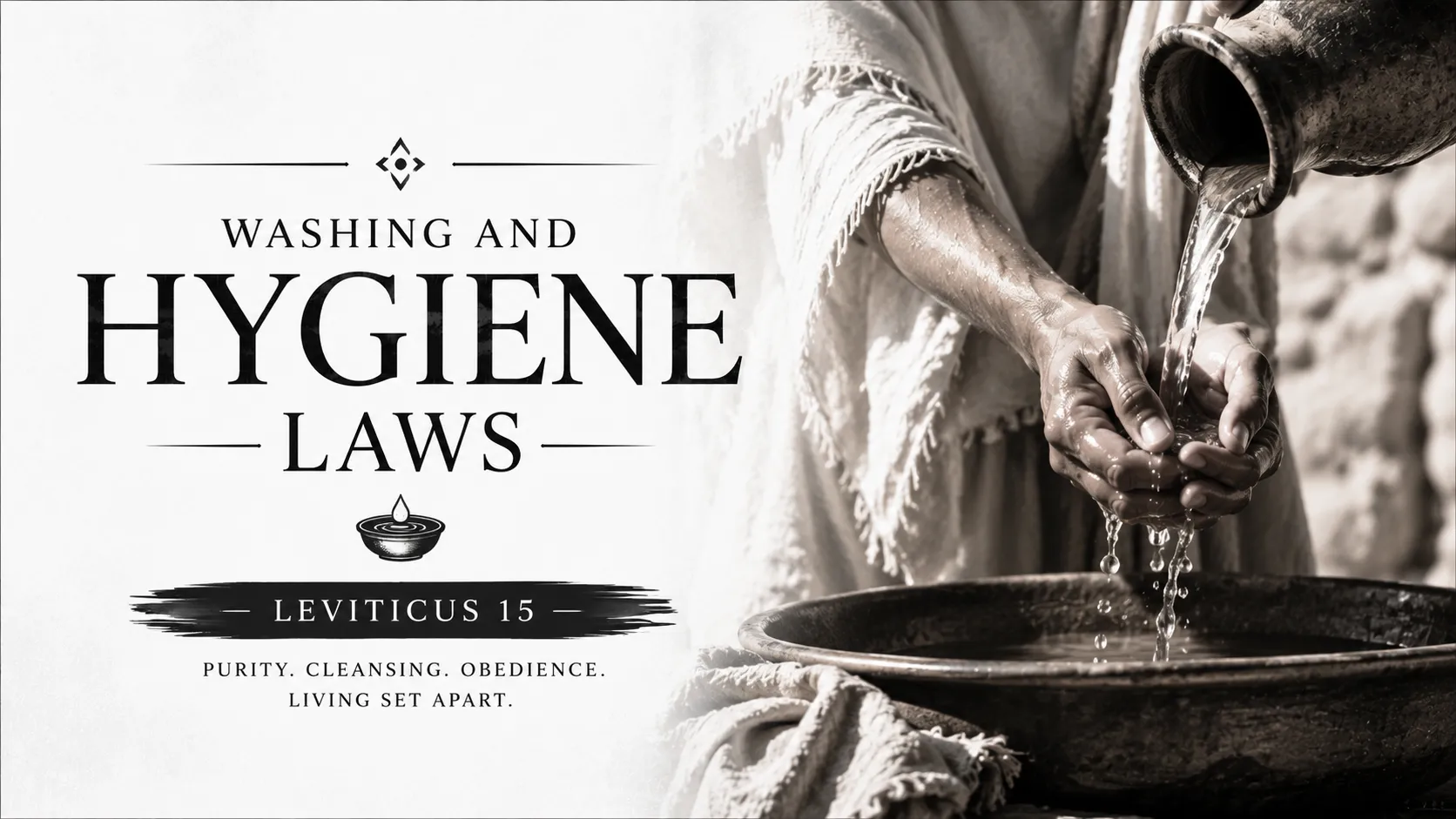
Washing and Hygiene Laws — Leviticus 15
In Leviticus 15, the issue of washing and hygiene laws is raised, is this a progressive or retrogressive law?
📖 Bible Verses (KJV)
"And when he that hath an issue is cleansed of his issue; then he shall number to himself seven days for his cleansing... and wash his clothes, and bathe his flesh in running water, and shall be clean."
— Leviticus 15:13 (KJV)
Additional Supporting Verses
All garments, and all skins upon them, on which is the seed of copulation, shall be washed with water, and shall be unclean until the even.
— Leviticus 15:17 (KJV)
Those who touch the bed where she lies shall wash their garments, and bathe themselves in water, says the Word.The Word says, "And whosoever toucheth the bed whereon she layeth... shall wash his clothes, and bathe himself in water.
— Leviticus 15:21 (KJV)
📅 Approximate Year Written
Around 1445–1400 BC
The Book of Leviticus is a book of laws which were given to Israel shortly after the Exodus. These directions referred to worship, ceremonial purity, communal life and everyday life.
🏛️ Historical Background
Leviticus 15 deals with disruptions in the body, both in the male and the female.
In modern eyes the chapter might appear strange, but it had a number of useful functions in the ancient world.
The chapter needed that those who suffered from some bodily discharge to:
* Wash themselves.
* Wash clothing.
Clean up items that became contaminated.
Keep away from unnecessary contact until purification.
These laws were enacted for the sake of ceremonial cleanliness to enable Israel to worship a holy God. Yet, several scholars have pointed out that some of these practices may also have helped to contain disease in a society without medicine.
What practices did other ancient cultures have?
There were many cultures that laid down the laws regarding ritual purity, but not all of them stressed to wash with water in as systematic a fashion as in the Mosaic Law.
In surrounding cultures:
Often disease was blamed almost entirely on the spirits or on the displeasure of God.
Medical knowledge was found to be restricted.
There were significant differences in hygienic practices.
The Laws of Leviticus often mention washing bodies, clothes and objects after touching bodily fluids.
🔬 What Does Modern Science Say?
Today, doctors are aware that many infectious illnesses can be transmitted through:
* Bodily fluids.
* Contaminated clothing.
* Shared bedding.
* Poor sanitation.
* Close physical contact.
Leviticus wasn't a book of medicine, but it contains a few practices that are similar to those that help keep infectious diseases from being spread.
These include:
Washing the Body
Frequent washing will eliminate many microorganisms and aid in decreasing the spread of infection.
Washing Clothing
Clothes can harbor germs after being touched by bodily fluids.
Washing clothes reduces the risk of spreading.
Cleaning Contaminated Objects
Leviticus taught the method of washing and/or appropriate handling of items contaminated by ceremonial uncleanness.
Current infection control also focuses on cleaning up contaminated surfaces and materials.
Temporary Separation
Some of the situations in Leviticus were situations in which contact was to be avoided until the purification process was finished.
Limited contact and/or temporary isolation is now a known method of minimizing the spread of communicable diseases (CDs) in appropriate situations.
Did God give Israel medical science?
It is not biblical law, but rather God's creation, and the Bible does not claim these laws were intended as scientific and medical discoveries.
Their main function was to serve as ceremonial holiness, to instruct Israel that God is holy and that His people were to live differently from the other nations in the vicinity.
Meanwhile, numerous medical and historical sources have noted how some of these techniques have hygienic advantages as well.
It is not necessary to say that Leviticus was written as a modern health manual in order to recognize these benefits.
🚀 Real-World Example
Suppose a hospital asked its health care staff to:
* Wash their hands.
* Change contaminated clothing.
* Clean equipment.
Avoid close contact with infected patients.
These procedures are intended to minimise the spread of disease.
In the same way, there are numerous instructions in Leviticus that require washing and careful dealing with contamination, but they are provided in a religious/ceremonial context and not a modern medical context.
Easy Explanation
Leviticus presents some physical states which necessitated washing and temporary separation in the status quo.
It is now recognised that cleanliness can also help to prevent the spread of infection.
The central theme of the Bible is holiness before God, and modern science can also provide an explanation as to why many of these practices can be beneficial to public health.
Did You Know?
Washing is often associated with ritual cleansing in the book of Leviticus.
For some of the purification practices, running (living) water was preferred.
Hand washing is one of the most effective public health measures that has been recognized by modern medicine.
A lot of diseases are transmitted via dirty bodily fluids and surfaces.
There are many instructions in the Mosaic Law regarding cleanliness, clothing, food and sanitation.
Scientific consensus and historical context
The purity laws of Leviticus were basically religious rules for the ancient Israelites, and historians are in consensus on this fact.
Medical historians also point out some of these are similar to the principles of hygiene which are known today for minimizing the spread of disease.
But the critics warn against interpreting the text literally with the modern concept of germ theory.
The Bible gives one explanation of these laws: the laws of ceremonial purity and obedience to God; and modern science gives another explanation: the biological mechanisms by which cleanliness will help protect health.
🙏 Spiritual Reflection
Leviticus is a reminder that God is concerned with all aspects of life, even the way His people lived within their community.
Christians accept ideas of fulfillment in Christ for many of the Old Testament ceremonial laws (see Hebrews 10:1-14); but the rules of holiness, respect for others, and healthful care are good ones.
While physical cleanliness can be of benefit to the body, Scripture also encourages believers to strive for purity in their hearts.
As David prayed:
O God, make a clean heart in me.Make in me a clean heart, O God; Renew a right spirit in me.
— Psalm 51:10 (KJV)
📌 Key Takeaway
Leviticus 15 contains the rules about washing, bodily discharges and ceremonial cleanliness. Many of the practices outlined in these instructions are in keeping with hygienic principles which modern medicine confirms to be useful in the prevention of disease, but were used for religious reasons. The chapter highlights God's laws that covered Israel's worship and their community life, and also reminds us of the spiritual dimension and the need for holiness of life.
📚 References
Scripture
Holy Bible, King James Version (KJV)
Leviticus 15
Leviticus 11–15
Numbers 19
Psalm 51:10
Hebrews 10:1–14
Scientific Sources
Priority should be given to preventing the spread of infections and to hygiene measures.Emphasis should be placed on the prevention of infection and on hygiene aspects.
Centers for Disease Control and Prevention – Infection control guidelines.Infection control guidelines from the Centers for Disease Control and Prevention.
The National Institutes of Health are a source of public health research.The National Institutes of Health are an origin for public health research.
Historical Sources
New Bible Dictionary
This is a continuation of the Baker Encyclopedia of the Bible.
Zondervan Illustrated Bible Backgrounds Commentary
This week's reading is excerpts from Leviticus, by Jacob Milgrom (Anchor Yale Bible).
The Book of Leviticus, by Gordon J. Wenham
About This Article
In this article, I will explore the biblical theology, historical context and modern public health approaches to Leviticus 15. It separates the purpose of the chapter from a ceremonial rather than from a hygienic benefit that some of the instructions in the chapter may offer.
Classification
Topic: Science & the Bible / Old Testament
Scriptural Context: Leviticus 15; Numbers 19; Psalm 51:10; Hebrews 10
Scientific Status: Partially supported. Today, we know that most infectious diseases can be spread less by washing, cleaning contaminated objects and limiting exposure. Leviticus, however, is mostly giving ceremonial laws, not scientific health rules.
Historical status: The laws of washing and purity were part and parcel of the life of the covenant of Israel and are well evidenced in the Mosaic law.
The interpretation is that most biblical scholars interpret Leviticus 15 as dealing mainly with laws of ritual purity. It is also accepted by many that even though the text does not describe them in medical terms, these practices may have been incidental public health benefits.
The King James Version (KJV) of the Bible was used, as well as historical scholarship and current public health research. Guiding Verses is a way to differentiate the theological objective of the Bible, the scientific facts that are known, and interpretations regarding the application of biblical laws.